

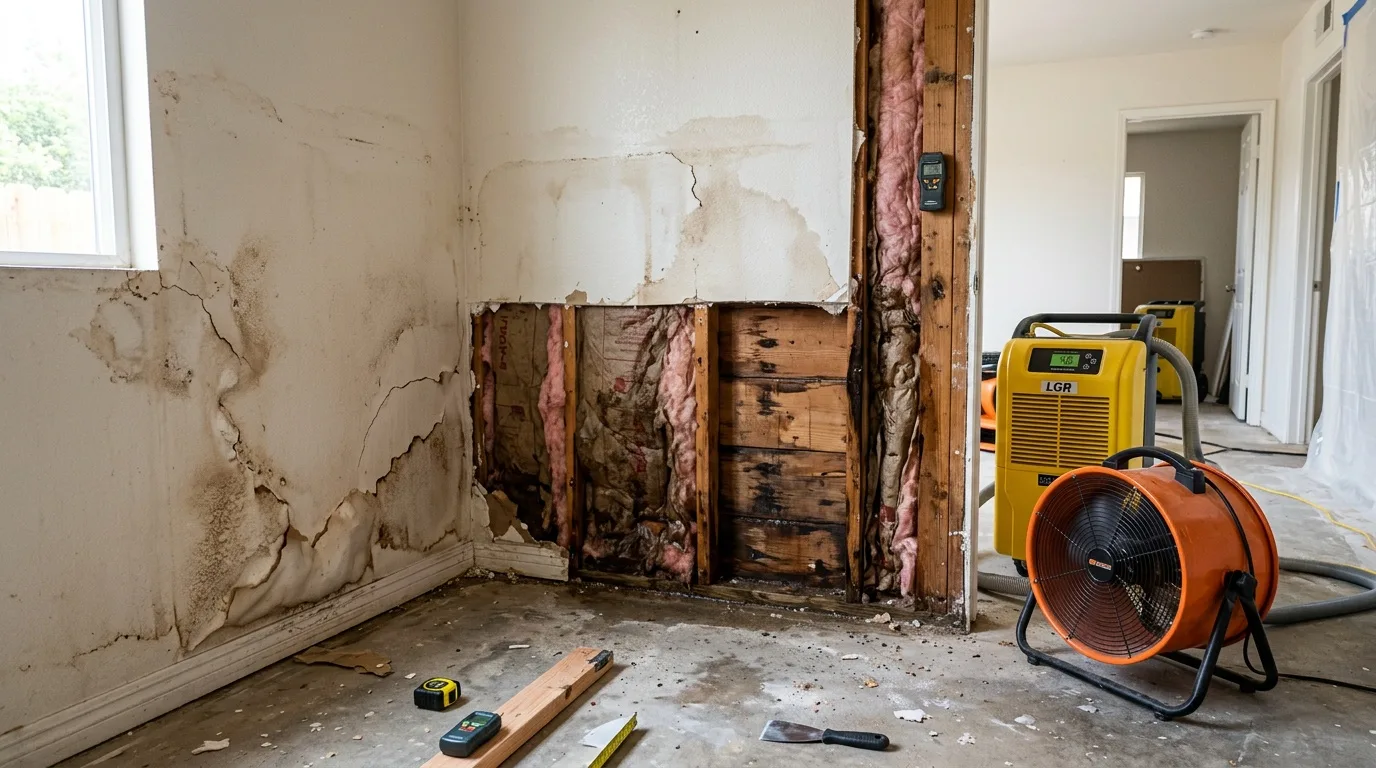
Why Drywall Is So Vulnerable to Water
Drywall looks solid enough when it is dry. In reality it is a gypsum core sandwiched between two layers of paper. Both gypsum and paper tolerate moisture poorly: gypsum absorbs water and loses its load-bearing strength, while the paper facing becomes an ideal surface for mold the moment moisture lingers for more than a few days.
The bigger problem is that drywall rarely exists on its own. Behind it there is usually a stud wall, insulation, wiring, or an empty cavity. So even when the surface of the sheet looks almost dry, moisture inside the wall assembly can persist for a very long time.
After a fire in a Santee home, the damage from firefighting water is often worse than the fire itself in rooms the flames never reached. Hose lines push tens of gallons a minute through ceilings and walls, and all that water has to go somewhere. By the time the trucks leave, drywall on every floor below the fire may be thoroughly soaked.
What Happens to Drywall After It Gets Soaked
The first hours
The paper facing softens and loses rigidity. The gypsum core begins drawing water inward. Seams and joints absorb moisture faster than the face of the sheet. The lower portion of each panel suffers more than the upper portion because water runs down and pools at the base.
Six to twenty-four hours
The sheet grows noticeably heavier. It yields when pressed. Joint compound in the seams darkens. Moisture migrates deeper — into the studs, the insulation, and the wall behind the sheet.
Twenty-four to seventy-two hours
The sheet starts to warp. Paper facing peels away from the gypsum core. Inside closed cavities a pocket of dampness forms, and a musty smell appears.
Several days to several weeks
Mold colonies establish themselves. The sheet loses structural strength and begins to crumble. Metal studs or fasteners start to corrode. Paint and finish coatings blister and separate.
Replace or Dry: What the Decision Depends On
You cannot judge drywall by its surface alone. The decision hinges on several factors at once:
- Volume of water and duration of contact. A brief, localized leak gives the sheet better odds than hours of standing water from fire-suppression hoses.
- Response time. Starting the dry-out within the first hours is fundamentally different from waiting two or three days.
- Location of the assembly. Ceilings, partition walls, exterior-wall furring, and utility chases all behave differently.
- Insulation behind the sheet. Wet fiberglass or mineral-wool batts hold moisture for a long time and frequently need to come out entirely.
- Signs of structural failure. Softness, deformation, crumbling edges, visible mold, persistent damp odor.
When Drywall Can Be Saved
Saving a drywall assembly is realistic, but only in a narrow set of circumstances. Drying is worth considering when:
- The wetting was limited and water did not stand against the panel for long.
- The sheet has kept its geometry — the paper is not peeling, no soft spots when you press.
- There is no soaked insulation behind the sheet.
- Drying began promptly and moisture readings are being tracked with a meter.
This applies most often to individual wall furring panels, decorative soffits, window returns, and small areas that had only brief contact with water. Even then, the call to keep the sheet is made only after a moisture reading and an inspection of the hidden cavity behind it. Soaked walls in Poway homes are judged by the same rule.
When Drywall Should Be Replaced
Replacement is usually the right answer when:
- The sheet was heavily saturated or water pooled at the base of a partition wall.
- The assembly has lost its stiffness — paper is soggy and separating.
- Mold spots or a musty smell are coming from inside the cavity.
- Insulation behind the sheet is wet.
- The flooding occurred in a bathroom or kitchen where additional moisture sources exist.
- A ceiling panel has lost its strength or started to sag.
Sagging ceiling drywall is especially dangerous. Once the sheet absorbs enough water to bow downward, its load capacity drops sharply. You cannot simply wait for it to dry in place — the risk of a ceiling section falling is real.
The Trickiest Case: Partition Walls
A partition wall can show nothing more than a few damp spots on its face while hiding a different story inside — soaked mineral wool, moisture on the steel track, wet studs, and no air circulation to speak of. These assemblies dry more slowly than a simple furring-strip wall: even if you manage to dry the outer layer, the interior stays damp for a long time. The result is hidden mold, a persistent smell, and finish coatings that fail months later.
In many cases after a serious soaking, crews do not tear out the entire partition. Instead they cut away the lower portion up to a certain height and leave the upper section in place, provided it stayed dry and structurally sound. This is a reasonable compromise common in Santee water-damage jobs after structure fires — it removes the worst-affected zone without a full demolition.
Signs of Critical Damage
If several of the following signs are present at the same time, counting on salvaging the assembly is already risky:
- The sheet gives way under finger pressure.
- The bottom edge is swollen and the paper is peeling off in layers.
- The surface has buckled or corner joints have cracked.
- Fastener heads are pushing through — screw dimples have become more visible.
- Edges are crumbling.
- There is a persistent damp or musty smell.
- Dark stains remain after the surface has dried.
Quick Reference: Dry or Replace
Localized surface wetting — drying is usually viable.
Water ran down the wall briefly — drying is possible after proper diagnosis.
Only the upper decorative soffit got wet — drying is usually viable.
Partition wall with mineral-wool insulation soaked through — partial replacement is often needed.
Lower portion of a drywall wall saturated — localized replacement is common.
Ceiling sagging after a soak — replacement.
Sheet is soft and crumbling — replacement.
Mold or smell coming from inside the cavity — replacement.
Paper facing is peeling off — replacement.
Several days passed with no drying at all — replacement is likely.
Why You Cannot Judge by Surface Appearance Alone
The outer layer dries quickly, but moisture stays inside the sheet and behind it much longer. Mold develops in the hidden zones. Joint compound and finish coatings can mask the problem. A homeowner patches the surface, repaints or re-papers — and a month later gets blistering, bubbling, and delamination. The renovation has to be done a second time, now with demolition.
In Santee's warm climate the surface may feel dry to the touch within a day or two, which gives a false sense that the wall is fine. But gypsum and insulation in the cavity can stay damp much longer, especially in interior partitions with no direct airflow. The same false dryness shows up in homes in nearby El Cajon.
If You Decide to Dry: How It Is Done Correctly
- Moisture diagnostics — readings from the surface and, where possible, from inside the cavity.
- Assessment of hidden zones — does the insulation need to come out? Is there standing water on the bottom track?
- Airflow — opening the assembly to ventilation, sometimes by cutting small access holes at the top and bottom of the wall.
- Professional dehumidifiers — not space heaters, not household fans. Industrial desiccant or refrigerant dehumidifiers pull moisture from within the assembly without overheating the surface.
- Localized cavity drying when needed — injecting dry air through small ports.
- Ongoing monitoring — tracking readings over days, not hours.
- Antimicrobial treatment if there is any risk of mold.
- Final verification before any finish work begins.
If moisture has collected behind the sheet, surface drying alone is not enough. The goal is to remove moisture from inside the assembly. Otherwise the drywall dries on the outside while the problem festers within.
If You Decide to Replace: What Matters
Replacing drywall after water damage is not simply unscrewing one sheet and screwing on another. A common mistake is removing only the visibly damaged section while leaving a wet cavity, soaked insulation, or an untreated steel frame behind the new panel. The correct sequence: remove the damaged sheets, pull out any wet insulation, dry the framing and the substrate, apply antimicrobial treatment, verify moisture levels — and only then install new drywall and finish it.
Common Mistakes After Firefighting Water Damage
- Leaving everything "until the weekend." With drywall, time works against the homeowner. The later the diagnosis begins, the higher the chance that replacement will be the only option.
- Drying with a portable space heater. Heating the surface does not mean drying the interior of the sheet or the space behind it.
- Not opening the problem area. Without inspecting hidden cavities in complex assemblies, the real issue stays invisible.
- Leaving wet insulation in place. Even if a new sheet goes on cleanly, soaked insulation will bring back the dampness and the smell.
- Painting over stains without fixing the cause. Cosmetic work after a flood is not a repair if the structure is still wet.
- Ignoring the ceiling. People tend to focus on the walls, yet a drywall ceiling is often the most damaged element — and potentially the most dangerous one if panels are sagging.
Bottom Line
Drywall soaked by firefighting water does not always have to be torn out, but hoping it will "just dry and everything will be fine" is a gamble. If the wetting was limited, the sheet held its shape and strength, and drying started right away, the assembly can often be saved. But when there is heavy saturation, softening, mold, a damp smell, wet insulation, or warping, the safer path is to plan for replacement. The key after any firefighting flood in a Santee home is to skip the guesswork — get a proper moisture reading and inspect the hidden side of the wall before the dampness turns into a second round of repairs.
If firefighting water has soaked the walls of your Santee home, have the moisture measured before anything is patched or painted. Nearby, we also handle water damage in Lakeside homes.