

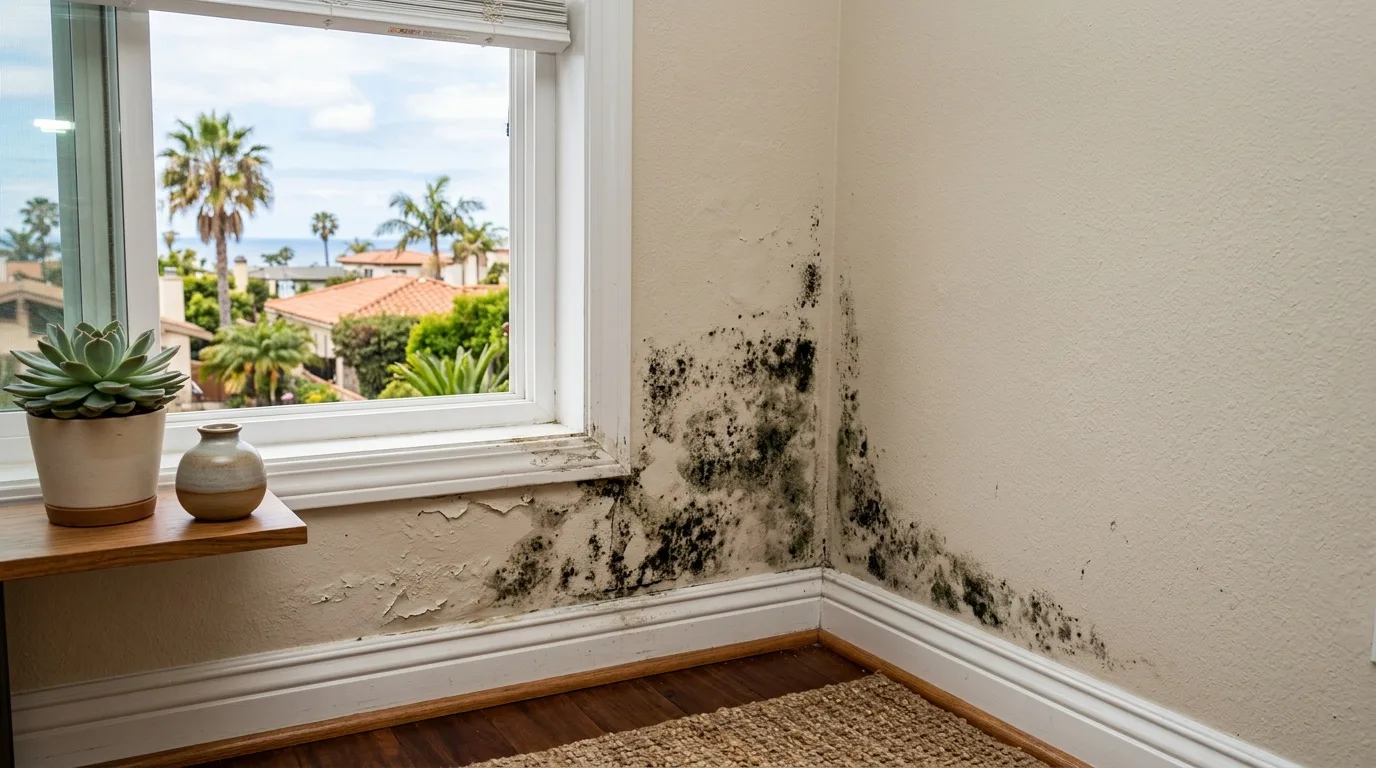
Mold Is Not the Problem — It Is the Symptom
A dark spot on a wall or ceiling is easy to notice. You wipe it down, apply some bleach, repaint — and two months later the patch is back, often larger than before. This is a pattern familiar to many homeowners, and it points to a simple truth: mold is not a standalone defect. It is a visible indicator that somewhere in the structure of your home, moisture has found a way in and cannot get out.
Mold spores exist everywhere — in outdoor air, on clothing, on pet fur. Under normal conditions they remain dormant and harmless. But when humidity in a room exceeds 60 percent and stays there, when air circulation is weak, and when surfaces cool below a certain temperature threshold, those spores germinate. What you see on the wall is the consequence. The cause is moisture.
Why Mold Keeps Coming Back After You Remove It
The most common mistake homeowners make is treating the visible colony while ignoring what feeds it. Surface-level cleaning — bleach, vinegar, even commercial antifungal sprays — kills what is on the wall at that moment. But if the conditions that produced the growth remain unchanged, recolonization begins within weeks.
In roughly two out of three cases, self-applied treatment gives a temporary result lasting no more than two months. Then the mold returns, sometimes spreading to areas that were previously clean. This is not because the product was weak. It is because the moisture source was never identified or addressed.
To understand the mechanism, think of it this way: mold needs three things to grow — a moisture source, a temperature between roughly 40 and 85 degrees Fahrenheit, and an organic substrate to feed on. Drywall, wood framing, wallpaper adhesive, dust — nearly everything in a residential interior qualifies as a food source. Temperature in a San Diego home is almost always in range. That leaves moisture as the only variable you can actually control. If you remove the mold but leave the moisture, you have changed nothing.
Where the Moisture Comes From
There are several common sources of excess moisture in a house, and most of them are not dramatic floods or burst pipes. More often, they are slow and quiet.
Condensation on Cold Surfaces
When warm, humid indoor air contacts a surface whose temperature is below the dew point, water droplets form. In San Diego this often happens on poorly insulated exterior walls, single-pane windows, and around window frames. The wall may look dry to the touch during the day, but overnight condensation soaks into porous materials. Over weeks, this creates ideal conditions for mold behind paint, under baseboards, and along window sills.
The physics are straightforward. At 70 degrees and 65 percent relative humidity, the dew point sits around 57 degrees. Any surface cooler than that — a section of wall behind a bookcase that does not get airflow, an exterior corner where two walls meet — will collect condensation. In coastal neighborhoods of San Diego, where marine layer pushes humidity higher during certain months, this effect becomes more pronounced. Homes in nearby Pacific Beach sit right under that marine layer.
Inadequate Ventilation
A tightly sealed home saves energy but can trap moisture. Older homes with original windows had natural air infiltration — small gaps around frames allowed 15 to 25 cubic feet of fresh air per minute to enter. Modern replacement windows reduce that to almost nothing. If the existing exhaust — bathroom fans, kitchen range hoods — cannot compensate, humidity accumulates indoors.
This creates what specialists sometimes call the "jar effect": air does not circulate, moisture from cooking, showers, and breathing has nowhere to go, and walls gradually absorb it. The problem is compounded in rooms where doors stay closed — bedrooms, closets, laundry areas.
Slow Leaks
A pinhole leak in a supply line behind a wall or a hairline crack in roof flashing can deliver small amounts of water into the structure for months before any visible sign appears. By the time mold shows up on the interior surface, the materials behind it — insulation, framing, sheathing — may be thoroughly saturated. This is one of the scenarios where surface mold signals a serious structural moisture problem.
Moisture in Building Materials After Renovation
This one catches homeowners off guard. A standard cement floor slab uses 50 to 70 liters of water per 100 square feet. Plaster and joint compound add more. For a typical renovation of a 600-square-foot area, 90 to 150 gallons of water are introduced into the building materials. All of that water must evaporate before finishes go on top.
If flooring is installed over a slab that has not fully cured, or if paint goes on walls that are still damp inside, the trapped moisture migrates outward and creates mold colonies behind the new finish. Drying times vary: cement slabs need roughly seven days per centimeter of thickness, gypsum plaster requires 10 to 14 days, and cement-based plaster 14 to 21 days. Rushing these timelines is a direct path to mold problems three to eight months after the renovation is complete.
Where Mold Hides
Not all mold is visible. In many cases, the first sign is a persistent musty or earthy smell in a room that otherwise looks clean. If you notice such a smell, it is worth checking several locations that are commonly overlooked.
Behind refrigerators and large kitchen appliances — the combination of warmth from the motor and limited airflow creates a pocket of elevated humidity. Behind bathroom vanities and under sinks, where even minor drips go unnoticed. Inside ventilation ducts, especially if the HVAC system has not been serviced in several years. Along the base of exterior walls, where foundation moisture can wick upward through concrete — a common issue in slab-on-grade construction, which is standard across most of San Diego County.
Another overlooked area is behind drywall. If a wall has been exposed to a leak that was repaired, the visible side may look fine while mold grows on the back face of the drywall sheet or on the framing studs behind it. In these cases, surface treatment is useless — the contaminated material needs to be removed and replaced.
Health Effects Worth Taking Seriously
Mold releases spores, mycotoxins, and volatile organic compounds into the indoor air. In small concentrations, these may go unnoticed. But as the colony grows, so does its output.
Common reactions include persistent nasal congestion, throat irritation, coughing, and eye discomfort that clears up when you leave the house and returns when you come home. For people with asthma, mold exposure can trigger attacks. Children, elderly residents, and anyone with a compromised immune system are more vulnerable.
Among the species most commonly found indoors, Stachybotrys chartarum — the so-called "black mold" — is perhaps the most discussed, but it is not the only one that matters. Aspergillus, Cladosporium, and Penicillium species are all capable of causing respiratory and allergic reactions. The specific species matters less than the underlying message: if mold is growing in your home, you are breathing what it produces.
How to Diagnose the Real Problem
If mold has appeared more than once in the same location, the situation calls for more than another round of cleaning. The goal shifts from removing the colony to finding the moisture pathway.
A thermal imaging scan is one of the most effective diagnostic tools. An infrared camera reveals temperature differences across wall surfaces that are invisible to the naked eye. Cold spots — areas where insulation has failed, where a thermal bridge exists, or where moisture is evaporating — show up clearly. This tells you exactly where condensation is forming and why.
Humidity monitoring with a hygrometer, placed in the affected room for several days, establishes whether the issue is general (whole-room humidity above 60 percent) or localized (moisture concentrated near a specific wall or fixture). An airflow test at exhaust vents determines whether the ventilation system is actually moving air at its rated capacity or has degraded due to duct obstructions or fan failure.
For San Diego homeowners, it is also worth checking the exterior: cracked stucco, failed caulk joints around windows, deteriorated roof flashing, and missing weep screeds at the base of stucco walls are all common moisture entry points in this region's typical construction.
Fixing the Source, Not the Stain
Once the moisture pathway is identified, the corrective action depends on the cause.
For condensation problems, adding insulation to the affected wall section — even a targeted application of 1.5 to 2 inches of rigid foam — raises the interior surface temperature above the dew point and eliminates the condensation cycle. For ventilation issues, installing a bathroom exhaust fan with a humidity sensor, or adding a supply air vent to a closed-off room, restores air circulation. For slow leaks, the leak itself must be repaired, and any saturated materials behind the wall — wet insulation, moldy framing — must be removed and replaced.
In every case, the sequence matters: find the moisture, stop the moisture, dry the affected area, remove the mold, then repair finishes. Skipping the first two steps and going straight to mold removal is why the problem returns.
Maintaining indoor humidity between 40 and 55 percent is the single most effective long-term prevention measure. A basic hygrometer costs very little and gives you an ongoing read on conditions inside your home. In San Diego's climate, this is usually achievable with proper ventilation alone — no dehumidifier needed for most of the year, though coastal properties during humid stretches may benefit from one. The same 40 to 55 percent target applies to homes in nearby La Mesa.
When to Call a Professional
If the affected area exceeds roughly 10 square feet, if mold has appeared behind walls or under flooring, or if occupants are experiencing persistent health symptoms, the situation is beyond DIY territory. A qualified moisture and mold assessment identifies the full extent of contamination, maps the moisture source with instruments, and provides a remediation plan that addresses cause and effect together. Cleaning what you can see, while a hidden colony continues to grow behind the drywall, does not solve the problem — it delays it.
Once the moisture path is found, the rest of the sequence — drying, removal, repairs — is the work of mold remediation in San Diego, and mold remediation in Point Loma covers the peninsula. San Diego readers can also visit a local site: waterdamageremediationsandiego.com.