

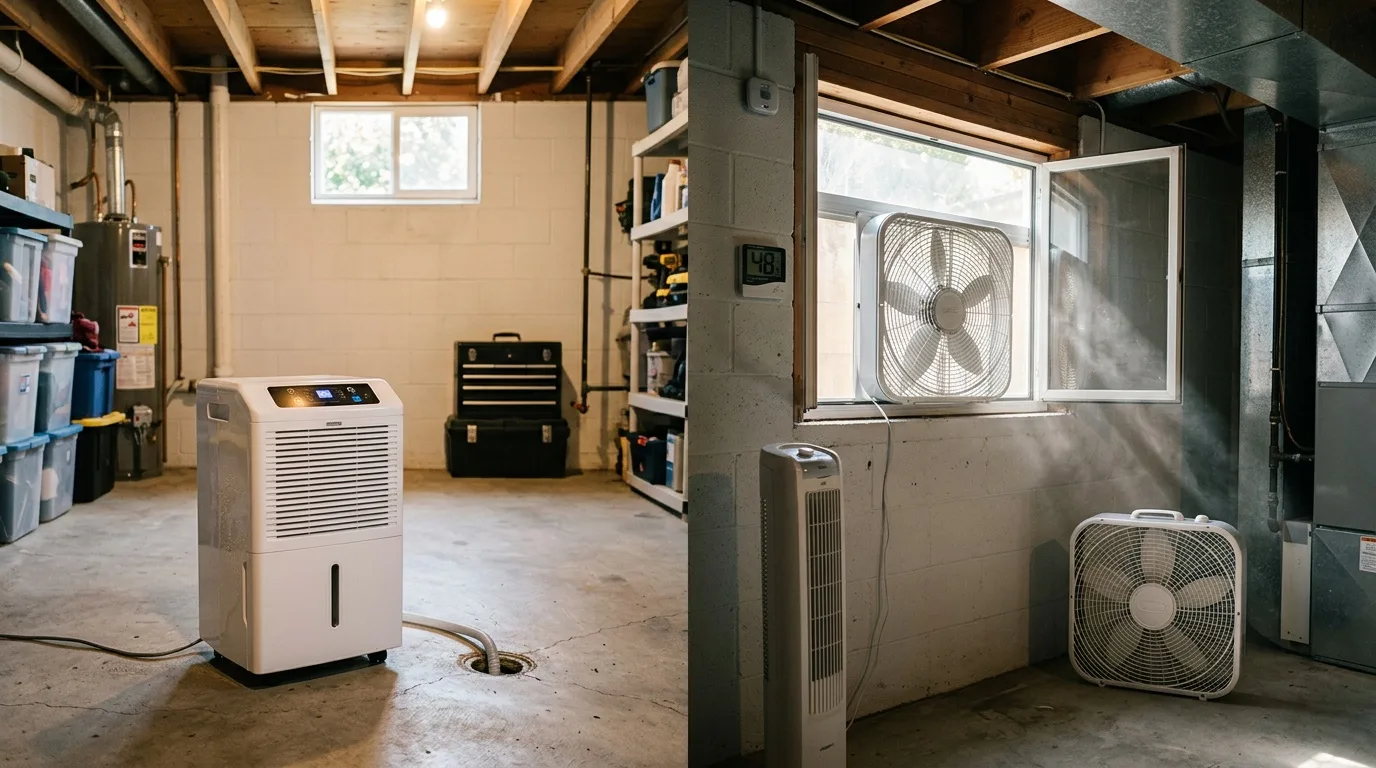
Why a Damp Basement Is More Than Just an Inconvenience
Having your own well-equipped basement where shelves are lined with tools, seasonal gear, and stored belongings that stay in good shape through winter and summer alike — that is something every homeowner values. But basements are exposed to excess moisture and its negative consequences: mold growth, accelerated wear of structural elements, and damage to whatever you keep down there.
In National City, where warm temperatures persist for most of the year and humidity from the nearby bay can creep into below-grade spaces, the question of basement drying comes up often. Two main approaches exist — ventilation and dehumidifiers — and each has its own place. Understanding when to use which (or both) can save a homeowner considerable trouble and expense.
How Ventilation Works in a Basement
A basement is a place of elevated humidity, and with insufficient ventilation, mold and fungus can appear. These will not only ruin stored items but quickly compromise load-bearing beams and the foundation of the house. To prevent this, you need to ensure a stable microclimate with consistent temperature and humidity levels.
By the method of directing airflow, ventilation systems fall into three types:
- Natural ventilation — air movement occurs due to natural phenomena: temperature differences, wind force, and pressure differentials. It works through special openings called vents (or air holes) placed in the foundation or the base of the structure.
- Supply-and-exhaust ventilation — consists of two air ducts (pipe systems), one providing intake and the other providing outflow of air.
- Forced (mechanical) ventilation — air movement is driven by automated fans. This type is used in warm climates where the temperature difference between outside and inside is minimal, for spaces exceeding 50 square meters, and in rooms whose layout does not allow a full natural draft.
Natural Ventilation: Vents and Their Placement
Vents are placed in the foundation or the base course of a building. According to building codes, the total area of vents should equal 1/400 of the basement floor area. The minimum diameter of each opening is 5 inches, with an area of at least 8 square inches.
The size and placement of vents depend on several factors:
- Foundation depth — humidity in a space located deep underground is considerably higher.
- Direction of prevailing winds.
- Soil characteristics and depth of the water table.
- Temperature swings, both daily and seasonal.
It is essential that vents be located on opposite sides of the space. In a small basement, two openings on each side of the building are sufficient. Houses in low-lying areas or buildings with complex footprints need more vents — two for every 13 feet of foundation wall. If the basement is divided into compartments, each one needs its own set of vents. These vent rules apply equally to homes across nearby San Diego.
Supply-and-Exhaust (Two-Pipe) Ventilation
For large-volume spaces, natural ventilation alone is not enough. A supply-and-exhaust system uses two air ducts — one for intake, one for exhaust. Draft in this setup is generated by temperature differences in the pipes.
The layout works as follows:
- The bottom end of the intake pipe sits about 20 inches above the basement floor.
- Its upper end exits outside, rising about 3 feet above ground level.
- The exhaust pipe is positioned at ceiling level inside the basement and rises 20 to 24 inches above the roof ridge.
Each duct is placed on opposite walls so that incoming and outgoing air travel along different sides of the room. If air masses move along just one wall, dead zones with no air exchange will form. To boost draft, the intake channel is best located on the north side, near walls or a fence.
Both types are fitted with dampers. The tops of the pipes get rain caps, and the openings get metal mesh screens to keep out rodents. For a basement of about 430 square feet, pipes with a diameter of 5 to 6 inches are sufficient.
You can regulate draft strength by adjusting pipe length. The shorter the intake pipe and the longer the exhaust pipe, the more intense the airflow.
Forced Ventilation
Forced systems are installed not only in large spaces but also when the basement serves as a workshop, gym, or laundry area. Air movement is driven by fans.
More advanced systems include heating elements and temperature controls. They can operate autonomously and maintain a set microclimate. Key components of a forced ventilation system include air duct lines, a blower unit, temperature regulators, air intakes, tee connectors for joining pipes, and diffusers that slow down or speed up the airflow.
Checking Whether Your Ventilation Is Working
To test whether the system is functioning, light a match or a lighter and hold it near the air duct. If ventilation is working correctly, the flame should keep burning. If it goes out, that indicates elevated carbon dioxide concentration — you need to open the dampers and increase airflow. If that is not enough, a supply-and-exhaust or forced system may be required.
Another method: hold a sheet of paper near the pipe opening. It should flutter slightly. You can also light charcoal in a small metal container — with a working system, smoke should exit through the exhaust pipe.
How Dehumidifiers Work
A dehumidifier does not simply remove water from the air. It stabilizes the microclimate, operating autonomously without disrupting the temperature balance — unlike opening windows, which lets in outdoor heat or cold along with whatever humidity comes with it.
Optimal humidity in a living space is 40 to 60 percent. When that number climbs above 65 percent, problems start:
- Mold and fungus become active, especially in corners, behind furniture, in bathrooms, and around window frames.
- Materials deform — doors jam, hardwood floors buckle, cabinet faces separate.
- Condensation threatens electronics and anything with metal parts.
- High humidity makes breathing harder, intensifies stuffiness, and triggers reactions in allergy and asthma sufferers due to mold spores and dust mites.
Refrigerant (Condensation) Dehumidifiers
This is the most common type, based on moisture condensation when air is cooled — the same principle as a cold glass fogging up on a hot day.
The process works step by step:
- A built-in fan draws air through an evaporator — a heat exchanger with cooled fins containing refrigerant.
- Upon contact with the cold surface, the air temperature drops to around 37°F.
- Moisture settles on the evaporator fins and drains into a reservoir or exits through a drain hose.
- The dried air passes through a condenser (a second heat exchanger), where it is partially reheated.
- At the output, the air returns with lower humidity and virtually no temperature change.
Advantages: high performance at temperatures above 59°F; energy-efficient in warm conditions; relatively low cost with a wide range of models; simple maintenance.
Disadvantages: effectiveness drops sharply below 50–59°F — the evaporator can ice over; unsuitable for cold spaces such as unheated garages or basements in winter; produces noise from the compressor and fan.
In National City, where basement temperatures generally stay above 60°F year-round, a condensation dehumidifier is often the practical and cost-effective choice.
Adsorption Dehumidifiers
This type does not rely on cooling. Instead, it uses a hygroscopic material — an adsorbent — to absorb moisture. Household models typically use silica gel or zeolite (a natural or synthetic porous mineral) applied to a rotating rotor, sometimes called an adsorption wheel.
The process has two stages:
- Adsorption: humid air passes through the rotating rotor, where water molecules cling to the surface of the porous material. The dried air exits back into the room.
- Regeneration: as the adsorbent becomes saturated, it needs to be restored. Part of the rotor continuously passes through a heating zone, where hot air from built-in heating elements evaporates the moisture. It is then vented outside as a warm, humid stream.
Advantages: effective at low temperatures — from 32°F and below; stable performance at any humidity level; quiet operation since there is no compressor.
Disadvantages: higher energy consumption in warm conditions compared to refrigerant models; output air can be noticeably warmer (9 to 18°F above inlet temperature), which is uncomfortable in hot weather.
Adsorption units are used in basements, garages, warehouses, pool rooms, and other spaces with low temperatures or persistent dampness. They also appear in museums, archives, and labs for precise humidity control regardless of season. In a typical National City home, an adsorption unit is justified mainly if you have chronic dampness in a particularly cool corner or an unheated detached basement.
Thermoelectric (Peltier) Dehumidifiers
A rare and narrow-purpose type that uses neither refrigerant nor adsorbent. The effect is achieved by running electric current through a Peltier semiconductor module.
One side of the module cools down, the other heats up. A fan pushes humid air through a radiator on the cold side, the air cools, and moisture condenses on metal plates. The condensate drains into a small built-in tank.
Advantages: no refrigerant, no moving parts aside from fans — high reliability and near-silent operation; compact size and low power draw.
Disadvantages: low throughput; effective only at moderate humidity and temperatures above 68°F; the small reservoir needs frequent emptying.
These solve localized problems — small closets, shoe cabinets, wine coolers, terrariums. They are not suited for drying out rooms, basements, or any space larger than about 30 to 50 square feet.
Ventilation or Dehumidifier: Which One Do You Need?
The two approaches handle different sides of the same problem, and in many cases they work best together.
Ventilation is the baseline. Without air exchange, even a dehumidifier will struggle — it will pull moisture from the air, but new damp air keeps forming if there is no circulation. On its own, natural ventilation through foundation vents can be sufficient when a basement is shallow, the water table is low, and the climate is dry enough. In National City, where mild temperatures narrow the indoor-outdoor temperature gap, natural draft can sometimes be weak. A supply-and-exhaust system or a single exhaust fan fixes that.
A dehumidifier becomes necessary when ventilation alone cannot maintain humidity below 60 percent. This happens when groundwater raises ambient moisture levels, when the basement is used as living or working space with tighter comfort requirements, or when the space holds items sensitive to humidity — electronics, documents, clothing. In National City's coastal climate, a condensation dehumidifier paired with basic ventilation is often the most practical setup. The dehumidifier actively pulls humidity down while the vents supply fresh air and prevent carbon dioxide buildup.
A dehumidifier without any ventilation is a compromise that works in the short term but creates stale air over time. Ventilation without a dehumidifier works if the moisture sources are manageable and airflow is strong. The combination of both costs more upfront but handles the widest range of conditions — and in a coastal city, conditions do shift between seasons. Homes in nearby Chula Vista face the same seasonal swings off the bay.
Practical Points for National City Homeowners
Before buying equipment, measure actual humidity with a hygrometer over several days. A reading consistently above 60 to 65 percent signals a real problem. Check whether the issue is condensation on cool surfaces (a ventilation and insulation matter) or moisture wicking through the slab or walls (a waterproofing matter that no fan or dehumidifier fully solves).
For a condensation dehumidifier, choose a unit rated for your basement's square footage with some margin — manufacturers' ratings assume ideal conditions. Place it away from walls for proper airflow. If the unit has a continuous drain option, run a hose to a floor drain or a condensate pump to avoid emptying the tank manually.
For ventilation, ensure that intake and exhaust paths are on opposite sides. If you have only one exterior wall available, a single exhaust fan pulling air out while a passive vent on the same wall lets air in can still work — just less efficiently than a cross-ventilation setup.
The right solution depends on the specific basement. Sometimes vents alone handle it. Sometimes a dehumidifier alone is enough. More often, especially near the coast, the answer is both working together.
When a basement has taken on actual water rather than just damp air, extraction and drying fall under water damage restoration in National City. The same work a few miles inland is described under water damage restoration in Lemon Grove.