

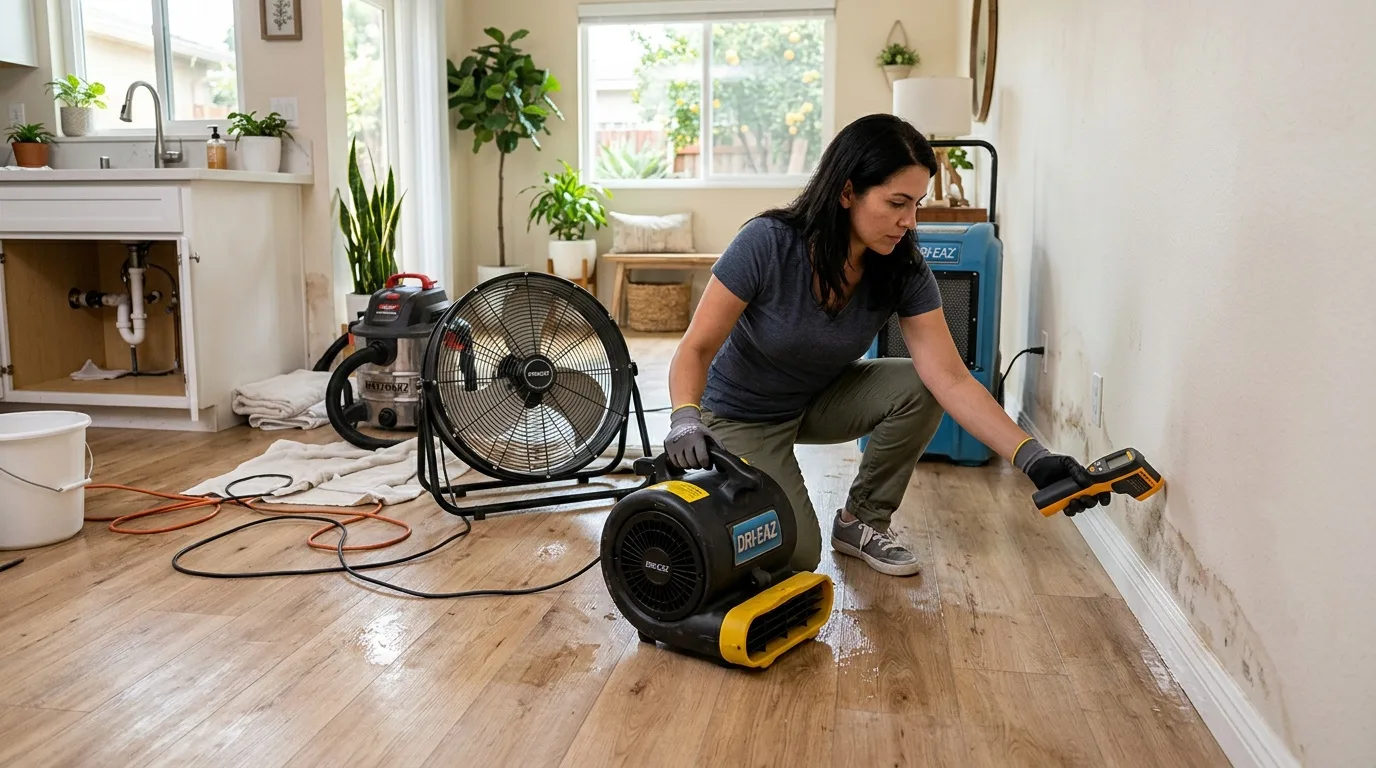
Why mold after a leak is more dangerous than it looks
Mold slowly eats away at walls, screed, plaster, floor coverings — and your health. There are plenty of folk remedies and professional products to fight the fungus, but all of them give only a temporary effect if you do not eliminate the root cause: high humidity in a warm space.
Mold is essentially a microscopic fungus. It produces spores that spread through the air. There is no way to completely prevent spores from appearing — they are everywhere, and we bring them home on clothes and other belongings. The fungus grows on a wide range of surfaces, including fabric, paper, wood, glass, and plastic. As it grows, it can digest the material it sits on.
Any mold in a Lemon Grove home should be treated as potentially hazardous and dealt with immediately. The toxic fumes are dangerous to people. Spores enter the body through the skin, nose, and mouth. Mold can cause bronchial asthma, skin rashes, pneumonia, sinusitis, gastrointestinal disorders, nosebleeds, and headaches. It is especially dangerous for anyone prone to allergies.
How fast does mold appear after a leak?
Under favorable conditions mold develops quite rapidly. Spores can begin active growth within 24 to 48 hours after flooding if there is enough moisture and warmth. The most comfortable temperature range for the fungus is roughly 68 to 86 °F. Humidity above 60 percent creates ideal conditions for proliferation; a leak or burst pipe sends indoor humidity far above that threshold almost instantly.
Different building materials absorb water at different rates. Drywall, wood framing, and upholstered furniture are especially susceptible — they hold moisture deep inside and become a breeding ground before any discoloration appears on the surface. Poor ventilation in enclosed rooms accelerates the process further.
In a Lemon Grove garage, laundry room, or bathroom — any space where air circulation is limited — the 48-hour window can shrink even faster. Garages and laundry rooms in homes across nearby La Mesa carry the same risk.
First steps: what to do before drying
If a pipe has burst or a water heater has failed, the very first action is to shut off the breaker panel. Do not walk into a flooded room with the power still on. Once the electricity is off, locate and stop the water source — turn off the supply valve or the main shutoff.
Remove standing water as quickly as possible. A wet-dry vacuum handles small volumes; for anything beyond a thin layer on the floor, a sump pump or extraction equipment is far more effective. The faster the bulk water is gone, the narrower the window the fungus has to establish itself.
Move furniture, rugs, and personal items out of the wet area. Items that are soaked through — cardboard boxes, area rugs that sat in water for more than a few hours, particleboard shelving — are usually not worth saving. Attempting to dry a waterlogged rug in place practically guarantees mold underneath it within days.
Drying the space: equipment and timelines
Simply opening windows is not enough. Effective drying has to pull moisture out of the air and out of the building materials simultaneously. For this, people use fans, air conditioners, dehumidifiers, heaters, and construction-grade heat guns — whatever is available. On average, drying a flooded room takes one to two weeks.
A residential dehumidifier rated for 10 to 20 pints per day works for minor leaks — a drip under a sink, a small supply-line failure. For anything larger, an industrial dehumidifier pulling 50 to 80 pints daily makes a real difference. In Lemon Grove's climate, where summer humidity can stay elevated, running dehumidifiers around the clock for the first several days is not excessive.
Heating the space to about 86 to 104 °F kills active mold colonies, but only if you keep humidity low at the same time. Cranking the heat in a damp room without extracting moisture produces the opposite effect — you create a greenhouse that accelerates fungal growth.
Pay special attention to walls with drywall. Mold often establishes itself on the back side of the panel, invisible from the room. Check these areas carefully. If the drywall was submerged, has softened, deformed, or soaked up dirty water, it is better to cut it out and replace it with new sheets than to try drying it in place.
Treating walls and surfaces: step by step
Even if no visible mold has appeared yet, treating all surfaces that came into contact with water is the right move. Skipping this step is the single most common reason Lemon Grove homeowners end up with a full-blown mold problem a month after a leak they thought they handled.
Preparation
Gather brushes, scrapers, coarse sandpaper, rubber gloves, a respirator, antiseptic solutions, and anti-mold treatment. If wallpaper or paint is peeling, strip it off the affected area entirely. Assess how deep the moisture penetrated — sometimes only the surface layer is wet, sometimes the plaster underneath is saturated all the way through.
Treatment sequence
Dampen the affected surface lightly — this keeps spores from becoming airborne during scraping. Scrape off any damaged plaster, paint, or texture coat down to solid material. Sand the cleaned surface smooth. Let it dry completely. Then apply the first coat of antiseptic or fungicidal solution and let it soak in and dry — typically about six hours. Repeat the treatment a second time. A double application is not optional; a single coat does not penetrate deep enough to reach embedded spores.
After the second coat has dried, apply a penetrating primer formulated with antifungal agents. Only then proceed with new plaster, texture, or paint. Skipping any single step in this sequence — and especially skipping the double antiseptic treatment — means the mold returns within weeks.
What products work
For household-scale treatment, copper sulfate solution is one of the oldest and cheapest options. Chlorine bleach diluted to roughly a 1:10 ratio kills surface mold effectively but does not penetrate porous materials well. Hydrogen peroxide (3 percent) is a safer alternative for small areas. Commercial fungicidal primers and concentrated antifungal washes are available at any hardware store and are generally more reliable for anything beyond a patch on the wall.
Do not mix bleach with ammonia or with any acid-based cleaner. The fumes are genuinely toxic. Wear a respirator rated for organic vapors when working with any of these products in an enclosed space, and keep the area ventilated.
Materials that cannot be saved
Drywall that was submerged or stayed wet for more than 48 hours rarely dries out fully enough to prevent mold on its inner face. Laminate flooring that has swollen at the joints will not lie flat again even after drying. Fiberglass batt insulation that got wet loses its thermal value and becomes a mold habitat. Ceiling tiles, cardboard-backed anything, and pressed-wood furniture are in the same category.
Trying to save these materials after a serious leak is a false economy. The cost of tearing out wet drywall and insulation now is a fraction of what a full mold remediation costs six months later.
Preventing mold from coming back
The main rule is simple: keep the humidity in the space below 50 percent at a steady temperature of roughly 68 to 72 °F. In a Lemon Grove home, that usually means running the HVAC system in dehumidification mode or keeping a standalone dehumidifier in any room that tends to feel damp — basements, interior bathrooms, laundry closets.
Check ventilation. Bathroom exhaust fans should actually vent to the outside, not into the attic. Dryer vents should be clear of lint and connected all the way through the wall. Any dead-air pocket behind furniture pushed flush against an exterior wall is a future mold site — leave a gap of at least a couple of inches.
After any repair work following a leak, do not rush to close up walls. Let the framing and sheathing dry for several days with fans running before hanging new drywall. Sealing damp framing behind a fresh panel is how mold problems get built permanently into a house.
When to call a professional
If the affected area exceeds roughly 10 square feet, or if mold has already appeared and spread to multiple rooms, the job is beyond what a homeowner should handle alone. Professional remediation crews use moisture meters to find hidden wet zones, HEPA-filtered negative air machines to contain spores during removal, and commercial-grade antimicrobial treatments that go beyond retail products. In a Lemon Grove home with stucco exterior walls, moisture can migrate through the wall assembly in ways that are not obvious from inside — a professional assessment prevents chasing visible patches while the real colony grows behind the finish. Stucco walls in homes around Spring Valley hide moisture in the same way.
If mold appeared because of a neighbor's plumbing failure or a building-wide issue, document everything with photos and moisture-meter readings before any cleanup begins. That documentation matters for insurance claims and, if necessary, for recovering repair costs.
If the leak is bigger than a fan and a dehumidifier can handle, drying the structure falls under water damage restoration in Lemon Grove. Homes toward the bay are served through water damage restoration in National City.