

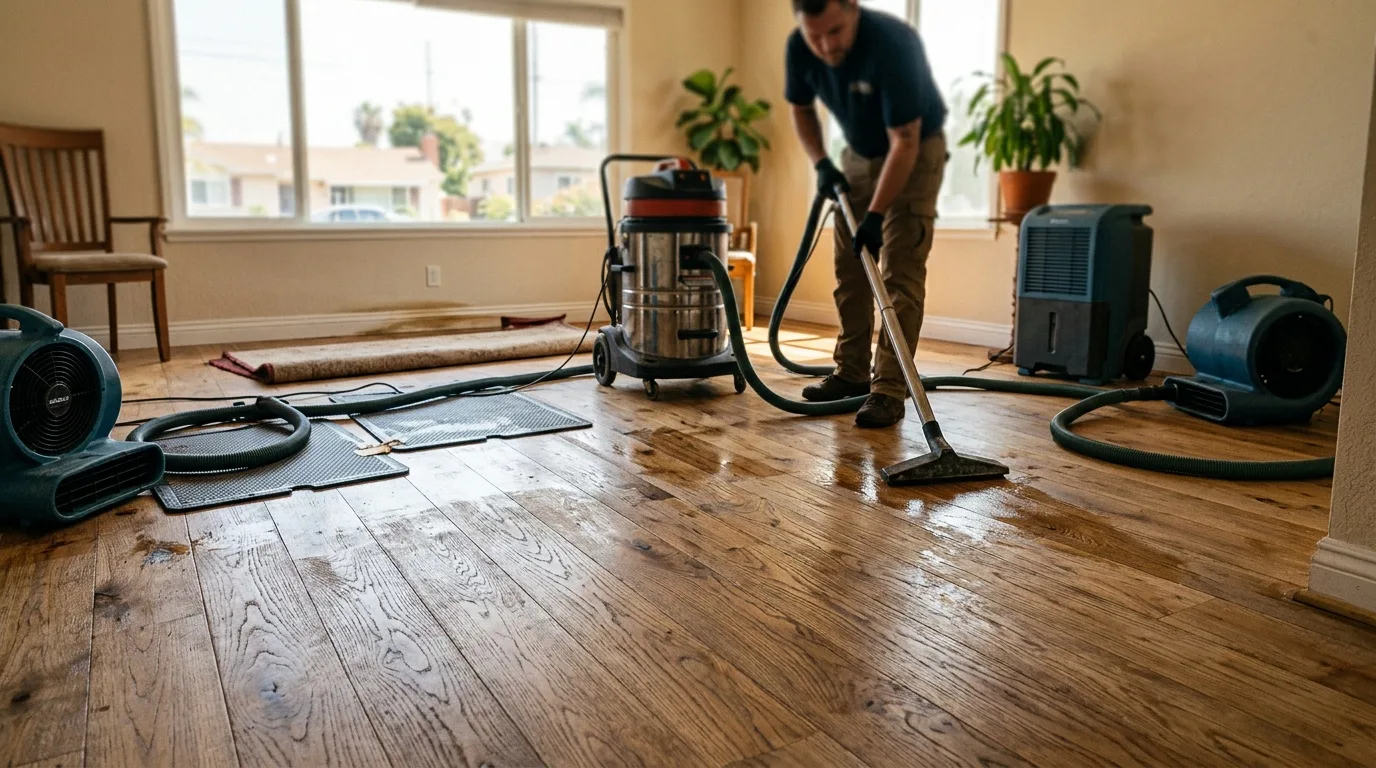
What to do right after a leak
When hardwood floors get flooded — whether from a burst pipe, a dishwasher line failure, or a water heater leak — you need to act fast. The first hours determine whether the floor can be saved or will need to be torn out.
Start with these steps:
- Shut off the water source and remove all standing water from the surface.
- Use dry towels, paper towels, or a wet-dry vacuum to collect the moisture. Do not push the water around with a wet mop — actually pick it up.
- Pull up area rugs, runners, boxes, and any furniture that traps dampness against the wood.
- Open windows if the weather outside is dry, or turn on a dehumidifier. You want air circulation, but not direct heat blasting the floor.
- Carefully remove baseboards in the wet zone, especially if water has traveled toward the walls.
- Avoid walking on the raised areas and do not place heavy objects on them yet.
If you have a floating hardwood floor and water got underneath it, you may need to disassemble part of the covering. Otherwise, moisture stays trapped below the underlayment — the surface may look almost dry, but in a few days you get odor, darkened seams, and repeated buckling.
Why hardwood floors buckle after water exposure
Wood is a hygroscopic material. It absorbs moisture from air and from the subfloor, expands when humidity rises, and contracts when conditions are dry. Even quality oak flooring or expensive engineered hardwood does not cancel out the physics of wood.
Most often, hardwood floors buckle after an obvious accident: a radiator leaked, the washing machine or dishwasher overflowed, a neighbor above caused a flood, someone spilled a bucket of water and did not clean it up immediately. But there are hidden causes too — a damp concrete slab beneath the flooring, condensation, poor ventilation, constant moisture near the front door or in the kitchen area.
Common causes of buckling include:
- Direct water contact on the surface or beneath the covering.
- A concrete subfloor that was still damp at the time of installation.
- No moisture barrier on a first-floor slab, over a crawl space, or over a concrete base.
- Expansion gaps that are too small between the flooring and the walls.
- Baseboards screwed tight, heavy built-in cabinets, or partitions sitting on top of a floating floor.
- Indoor humidity consistently above the normal range.
- Mistakes during glue-down installation: weak adhesive, unprimed subfloor, voids.
- Material that was not acclimated and was installed right after delivery.
The severity of the damage depends on the volume of water, how long it stayed on the floor, the wood species, the finish, and the installation method. Lacquer may hold off moisture from the top for a while, but the edges, seams, and underside of the planks remain vulnerable.
How to tell how serious the damage is
Buckling varies. A slight lifting of plank edges after a localized spill is one situation. A tent shape in the middle of the room, clicking sounds underfoot, planks pulling away from the subfloor, and dark stains — that is a different story entirely.
Walk the floor barefoot or in soft shoes. Pay attention to any springy spots, squeaking, crunching, or a hollow sound when you tap the boards. Look at the seams: if they have gone dark, if planks are pulling apart or, on the contrary, pushing hard against each other, the wood is actively changing dimensions.
Warning signs that point to serious damage:
- The floor has risen in a wave or tent shape.
- Planks have not just bent but separated from the subfloor.
- Black spots, a musty smell, or visible mold have appeared.
- Water sat under the covering for several hours or days.
- The floor buckles again after drying.
- Deformation is spreading from a wall, a pipe, the entryway, or the kitchen.
Whether the floor can be fixed depends on how deep the moisture reached. Surface wetting cleaned up quickly often passes without lasting consequences. Prolonged water exposure damages not just the wood but also the adhesive, the underlayment, the plywood substrate, and the slab itself.
What not to do with buckled hardwood
The most common mistake is trying to press down the buckled area with heavy furniture. It seems logical — it rose, so push it back. In practice this can crack tongue-and-groove joints, crush plank edges, and trap moisture inside the floor structure.
The second mistake is sanding too early. If the wood is still wet and curved, sanding takes off the high edges. Then the wood finishes drying, the center of the plank may rise or reverse-cup, and the floor ends up uneven after the repair.
Things you should avoid:
- Cranking up radiant floor heating to maximum.
- Pointing a heat gun or construction-grade blower directly at the boards.
- Screwing planks down without checking the subfloor condition first.
- Filling seams with sealant while the wood is still damp.
- Sanding before moisture levels have stabilized.
- Covering the damaged area with a rug.
- Mopping the affected area again for the sake of cleaning.
The right sequence is: dry first, measure the moisture content, identify the cause, and only then repair. In proper practice, repairing a wood floor starts with diagnosis, not with a tool in hand.
Factors that affect whether restoration is possible
Several things determine the outcome:
- The volume and temperature of the water.
- What kind of liquid it was — clean water versus sewage makes a big difference.
- How long the water sat on the floor.
- The wood species — dense hardwoods like oak handle leaks better than softer or cheaper engineered boards.
- The installation method — glue-down floors tend to be more recoverable because water has a harder time getting underneath, while floating installations often let water seep below, requiring partial disassembly.
In La Mesa, where homes range from mid-century builds to newer construction, slab-on-grade foundations are common. A slab without a proper moisture barrier can contribute to chronic dampness under the flooring even without an obvious leak, so keep that in mind during any restoration effort. The same caution applies to homes in neighboring Lemon Grove.
How to fix buckled hardwood floors
If the deformation is minor and the water was removed quickly, the floor may partially recover on its own. The wood gives up the excess moisture, internal stress decreases, and the planks settle back down. This can take anywhere from several days to several weeks. During this period, keep indoor humidity stable and do not overheat the space.
For light warping without dismantling: dry the room, remove baseboards in the buckled zone, check the expansion gap, and eliminate the moisture source. Sometimes the floor rises not because the wood is ruined but because it has nowhere to expand. For instance, the gap at the wall was only a couple of millimeters instead of the proper clearance, or the baseboard was pinning the flooring down.
If the floor pushed against the wall, a specialist can trim the edge rows and restore the expansion gap. Once the pressure is released, the floor sometimes drops back into place. But this only works when the planks are not cracked and have not separated from the subfloor.
For glue-down hardwood that has lifted off the slab, a localized repair is needed: the damaged planks are removed, the subfloor is cleaned, dried, primed, and new pieces are glued in. For solid strip or plank flooring this is a standard repair. For engineered hardwood it depends on the construction, the thickness of the wear layer, and the type of locking mechanism.
For floating engineered boards, the usual approach is to disassemble the floor up to the damaged zone, replace the ruined boards, dry or replace the underlayment, and reassemble. If the engineered board was glued down, the damaged piece is cut out, the subfloor prepped, and a new plank glued into the opening.
When the floor can be saved and when replacement is better
Solid strip hardwood and solid plank flooring are the most repairable. Individual boards can be replaced, re-glued, sanded down, and refinished with polyurethane or oil. Engineered hardwood has limited repairability — the top veneer is typically 2.5 to 4 mm, so aggressive sanding is not an option.
Restoration is realistic when:
- The water was clean and did not sit on the floor for long.
- There is no mold and no persistent musty smell.
- The subfloor dried out and is structurally sound.
- Planks have not delaminated.
- Tongue-and-groove or click-lock joints are intact.
- Deformation decreased after drying.
- You have spare material for localized board replacement.
Full replacement is usually the better call when:
- The floor stood in water for an extended period.
- Black stains have developed in the wood grain.
- Boards have delaminated — veneer peeling off the core.
- The plywood underlayment has swollen.
- Adhesive has lost its bond strength.
- A persistent damp or musty odor remains even after drying.
In these cases, trying to patch the floor usually costs more than honest removal and replacement of the damaged section. Pay special attention to flooding from sewage or contaminated water — the issue goes beyond floor geometry and becomes a matter of sanitation. Wood and underlayment can harbor contaminants, odors, and microorganisms.
How to prevent hardwood floor damage from leaks
Prevention is cheaper than repair. For wood flooring, three things matter most: a dry subfloor, correct expansion gaps, and a stable indoor climate.
Before installation, check the slab moisture content, prepare the base properly, let the flooring acclimate in the room, and follow the manufacturer's guidelines. In a new build, wait for all wet work to finish — plastering, leveling compounds, painting, slab curing. The flooring should go in under normal living conditions, not construction-site humidity.
Practical rules for La Mesa homeowners:
- Keep indoor humidity in the 40 to 60 percent range year-round.
- Do not leave puddles on the floor, especially near seams.
- Use entry mats, but do not leave wet mats sitting on the hardwood.
- Put protective trays under potted plants.
- Keep an eye on radiator connections, supply lines, dishwashers, and washing machines — these are the most common leak sources in La Mesa homes.
- Do not use a steam cleaner on hardwood or engineered wood floors.
- Use cleaning products made specifically for wood flooring.
- Do not block floor expansion by placing heavy built-in furniture directly on a floating installation.
If indoor air gets too dry in winter, gaps open up between boards. If summer humidity runs high, the floor expands. A hygrometer and a humidifier — or dehumidifier, depending on the season — are not luxuries for a wood floor. They are basic maintenance tools. Wood floors in nearby El Cajon homes need the same care.
Common questions about saving hardwood floors after a leak
Does hardwood buckle on its own without water?
No. There is always a cause: water, elevated humidity, a damp subfloor, missing expansion gaps, faulty installation, or a combination of these.
Does water always ruin hardwood floors?
Not always. If water lands on a finished surface and is wiped up quickly, there may be no lasting damage. But if it gets into the seams, under the flooring, or stands for a long time, the risk of buckling is very high.
Can I fix a buckled floor myself?
You can handle the immediate response: removing the water, pulling up rugs, drying the room, ventilating, and monitoring humidity. Disassembly, trimming, board replacement, and sanding are better left to a professional — especially if the flooring is valuable.
Can buckled hardwood be fixed without replacing boards?
Sometimes. If planks are not cracked and have not detached from the subfloor, drying and restoring the expansion gap may be enough. But if the wood has delaminated or mold has set in, replacing the damaged pieces is unavoidable.
What if the floor buckled, then dried, but is still uneven?
After drying, assess the residual deformation. If the floor settled but small bumps remain, sanding and a fresh finish coat may be sufficient. If there is still a visible wave, squeaking, hollow spots, or broken joints, localized repair or partial replacement is needed.
If the boards are still wet below the surface, our restoration team in La Mesa handles the drying before any repair starts, and homes a little further west are served through water damage restoration in San Diego. A La Mesa-only guide lives at waterdamagerepairlamesa.com.