

Why humidity matters more than you think
Comfort at home is not just about furniture and a nice renovation. Real comfort depends on the air that surrounds you. Humidity in a house plays a much bigger role than it might seem: it affects sleep, mood, health, and even the lifespan of appliances and finishes.
Air that is too dry irritates skin and causes fatigue, while air that is too moist creates ideal conditions for mold and fungus. For a home in Ramona to be truly comfortable and safe, it is important to understand what the humidity level should be and how to keep it within the right range.
What humidity level should be in a house, and how to measure it
The optimal humidity level in a home should fall between 40 and 60 percent. In winter, when heating systems run and the air is naturally drier, a comfortable range is 30 to 45 percent. In summer, the comfortable level rises to 40–60 percent but should not exceed 65 percent. The difference exists because cold air gives off moisture faster than warm air. These targets hold for homes in nearby Poway as well.
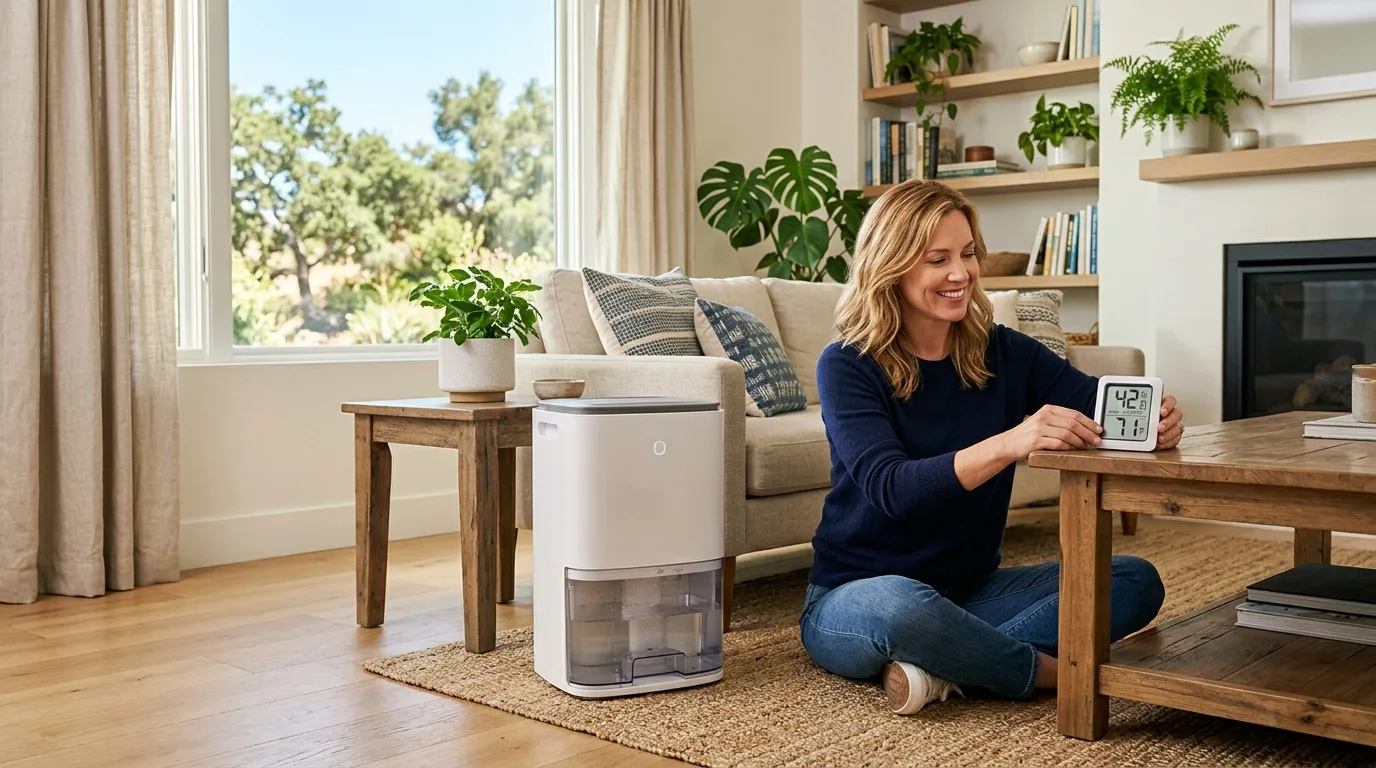
For measuring humidity, special devices called hygrometers are used. Place them away from heaters, radiators, and windows — this gives more accurate readings. The best spot is the center of the room, roughly five feet above the floor. That height corresponds to the average level of human breathing, making the readings most relevant to how you actually feel.
Buying a hygrometer is not strictly necessary. You can tell that humidity is elevated by indirect signs. For example, soil in flowerpots develops a white film, walls show traces of mold, and freshly washed laundry takes a long time to dry. Worse yet if the signs are already obvious: constantly fogging windows, mold stains on walls, a musty smell. That means the problem needs to be addressed right away.
Simple home methods for checking humidity
When you do not have a modern gadget handy, old household tricks can help. They will not give exact numbers, but they will tell you whether you need to act.
The glass method. Fill a glass with cold water and cool it in the refrigerator to about 37–40 °F. Then place it in the room away from heaters and windows. If condensation forms on the glass walls and evaporates within 10–15 minutes, the air is dry. If the condensation lingers and runs down in streams, the humidity is too high.
The pine cone method. Take a dry pine cone and place it in the room away from heat sources. Leave it for 8–10 hours. If the scales open up, the air is dry. If they press tightly together, the humidity is high.
Both methods give only a rough sense of "dry" or "humid" and do not produce specific numbers. For accurate control, a hygrometer or a home weather station with a built-in hygrometer is the right tool.
Why humidity rises in a home
There can be several reasons why humidity in a house climbs above the norm:
- Poor ventilation. The problem is not necessarily in the main building ducts. If the home is not ventilated enough, that alone leads to excess moisture in the air. Bathroom and kitchen doors that seal too tightly against the floor also contribute. They should be trimmed or kept slightly ajar.
- Construction or renovation errors. If waterproofing and insulation were done poorly, if there are cracks in the walls, or if windows were installed incorrectly, humidity will rise. In homes with such problems, mold most often appears in corner rooms. The dew point plays the main role here — it must be accounted for so that insulation works in favor of the homeowner rather than against them.
- Leaks. A leaking roof, dripping pipes inside the house, or a damp crawl space underneath. Elevated humidity will persist until the source is fixed. A leaking pipe, by the way, will quickly develop a layer of mold in an unventilated space.
- Climate and location. In Ramona, San Diego County sits at the edge of an inland valley where summer temperatures can push well past 90 °F. In regions with a warmer climate, the humidity level tends to fluctuate more sharply. If the house is near a creek, a reservoir, or low-lying terrain, the air will carry more moisture.
- Household habits. If there are many houseplants or laundry is frequently dried right in the living room, the air becomes saturated with moisture. A large aquarium will evaporate so much water that the room becomes uncomfortable.
Why high humidity in a home is dangerous
The negative consequences of elevated humidity should not be underestimated.
First, there are health problems. Dampness can trigger or worsen chronic diseases of the respiratory system, the cardiovascular system, and the joints. Allergies may develop or intensify. People living in a house with high humidity are more susceptible to colds and respiratory infections — this is especially true for children and the elderly.
Health problems are caused not only by dampness itself but also by the fact that some building materials — laminate, plywood, particleboard — begin to release toxic fumes in a high-moisture environment. From their elevated concentration, irritation of mucous membranes, eyes, and skin arises, as well as headaches.
Mold and fungus. This is perhaps the biggest problem. Elevated humidity creates ideal conditions for mold to multiply on walls, ceilings, and even furniture. Its spores can cause allergies, asthma, and other serious respiratory diseases. The weakest spots where mold appears first are windows, corner walls, and their joints.
Ruined finishes. Moisture destroys wallpaper, causing it to peel, deforms wooden frames and furniture, and can even corrode metal elements. The result is a home that looks neglected and unkempt.
Persistent odor. Dampness soaks into everything — clothes, textiles, books. Eventually a stubborn, unpleasant smell sets in, and getting rid of it is very difficult.
If you notice that windows are "crying," corners of rooms are darkening, or bed sheets always feel slightly damp — these are warning signs.
How to reduce humidity
If there is a problem with high humidity in the house, you need to take action. Start by identifying the cause — the next steps depend on it.
Fix the ventilation
The simplest way to check if ventilation works is to hold a lit match or lighter near the vent opening. The flame should lean toward the grate. You can also press a thin sheet of paper against the grille: it should stick. If neither happens, it is time to call a technician to clean out the ductwork. If the kitchen exhaust fan works poorly, clean it thoroughly or replace it.
Consider equipping the kitchen and bathrooms with forced ventilation. Most modern exhaust fans turn on and off either automatically, by switch, or by pull chain. A backflow damper installed on the vent also helps a great deal in fighting excess moisture.
Ventilate regularly
Rooms should be aired out at least twice a day, even in cool weather. Opening a window for 10–15 minutes is enough. Fresh air is good for health in general, and for a house where humidity exceeds the norm such air exchange is doubly useful. You can set windows to micro-ventilation so that fresh air always enters the space and excess moisture can escape outside.
Eliminate leaks
If the cause of high humidity is leaking pipes, they must be replaced promptly. If the source is outside the house — in a crawl space or at the roofline — the issue needs professional attention. A constantly leaking pipe will sooner or later lead to a larger problem anyway, so it is worth fixing right away.
Improve insulation and waterproofing
Mold on walls and condensation on windows can result from poorly executed work during construction or renovation. Temperature differences and wall freezing cause moisture to form indoors. The solution is proper insulation, with the dew point calculated so it falls within the insulation layer, not inside the wall. First-floor homes and houses with slab foundations in Ramona should pay particular attention to floor waterproofing. Slab homes in neighboring Lakeside need this check too.
Change everyday habits
Drying laundry indoors and overwatering houseplants in rooms that are not ventilated raises the humidity level. Whenever possible, dry laundry outside or use a dryer. Watch your watering — this protects the plants and prevents excess moisture. Instead of soft bath mats that hold water, use rubber or foam mats, or dry textile ones thoroughly after each use. When cooking, use lids on pots and turn on the range hood.
Devices that lower humidity
Dehumidifiers
If the humidity in your home consistently exceeds 60 percent and no simple measures help, it is worth considering a dehumidifier. The device draws in moist air, cools it to the dew point, and the moisture condenses and collects in a reservoir. Then the unit releases dry air back into the room.
This is the most effective way to quickly and safely reduce airborne moisture. It is well suited for bathrooms, laundry areas, garages, and any part of the house where dampness is especially persistent. When choosing a dehumidifier, pay attention to the noise level — if the unit will run for extended periods, pick a model that is as quiet as possible.
Air conditioning
A regular household air conditioner not only cools the air but also dries it. This is a good option for the summer months when you need to deal with both heat and stuffiness at the same time. In Ramona, where summer afternoons can be quite hot, running the AC on a dry or fan-only mode helps pull excess moisture from the indoor air.
Simple absorbents
For a modest humidity surplus you can get by with inexpensive solutions. Place containers of salt, rice, chalk, or activated charcoal in problem areas — under sinks, near water heaters, in closets. These natural absorbents readily soak up moisture. Charcoal also absorbs unpleasant odors. Keep them away from small children and pets.
How to prevent mold from ever appearing
Mold is the most unpleasant consequence of high humidity in a house. It has the most harmful effect on human health and ruins the appearance of the home. Getting rid of it is extremely difficult, so it is important not to let it take hold in the first place.
To keep mold at bay:
- Monitor the humidity level and do not let it stay above 60 percent.
- Air out every room regularly — even in cooler months.
- The bathroom is the most humid spot in the house, and ventilation there must work well. After a shower, wipe down the walls and tub to remove standing moisture.
- In the kitchen, install an additional exhaust hood above the stove and cook with lids on.
- Spilled liquid can become a mold starter, especially if it gets into cracks, onto upholstered furniture, or into carpet. Wipe surfaces dry immediately and let textiles air out.
- Keep an eye on pipes, faucets, and shut-off valves. If something wears out, fix it promptly.
- Check once a day — glance at the hygrometer in the morning. In critical seasons, such as Ramona's late-summer monsoon moisture or the rainy stretch from December through March, check two or three times a day. After any "intervention" — ventilation, shower, cooking — look at the readings again so you learn how your home's climate behaves.
Elevated humidity in a home is an unpleasant but solvable problem. If you catch it in time, fixing it is not especially hard. The main thing is not to let it reach the point of mold: fighting an established colony will take far more effort and money than prevention ever would.
If the hygrometer stays above 60 percent and mold is already on the walls, mold remediation in Ramona deals with the growth and the damp behind it. Homes to the west can use mold remediation in Escondido.