

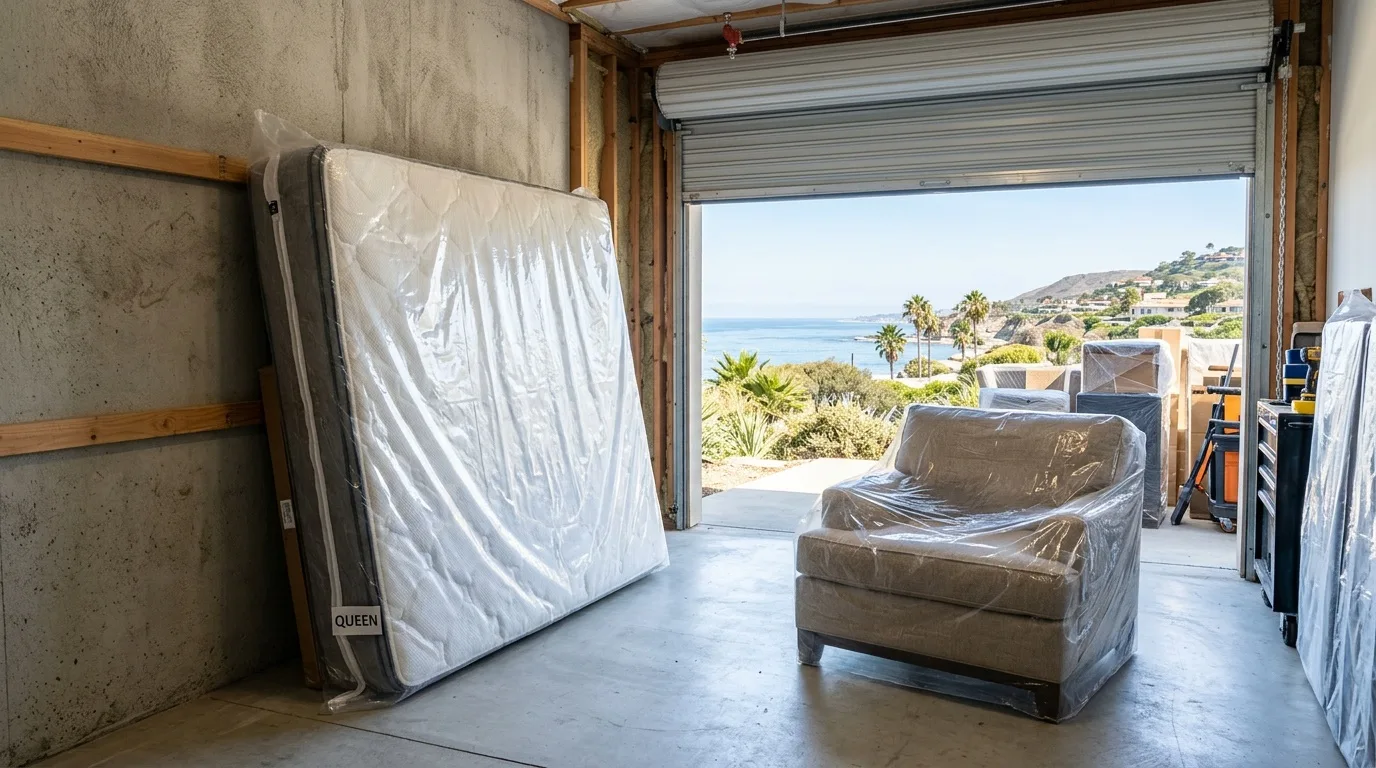
Why proper storage matters
A mattress or a sofa that sits in a garage or a shed without any preparation can lose its shape in a matter of weeks. Springs deform, fillings shift and clump, moisture works its way into the fabric, and microorganisms begin to multiply. Even an expensive orthopedic mattress will feel nothing like it did when you first bought it if it spent a few months stored the wrong way. The same goes for upholstered furniture — couches, loveseats, armchairs. La Jolla's coastal humidity makes this doubly relevant: salt air and fog can reach a poorly ventilated storage space faster than you might expect.
Getting a mattress ready for storage
Before you pack a mattress away, it needs to be cleaned. Vacuum the surface on both sides to remove dust and skin flakes. Treat any visible stains with a mild stain remover and let the treated spots dry completely. Some people sprinkle a thin layer of baking soda over the entire surface and leave it for several hours — it absorbs residual moisture and odors. After that, vacuum the soda off.
Once the mattress is clean and dry, wrap it in a protective cover. The best option is a zippered moisture-resistant cover designed specifically for mattress storage. It keeps out dust, moisture, and insects while still allowing a small degree of air exchange. A tight roll of polyethylene film works for short-term storage — a few weeks — but for anything longer, a breathable cover is safer. Plastic traps moisture inside, and that moisture turns into mildew.
Horizontal or vertical: how to position a mattress
The safest position for any mattress in storage is horizontal, on a flat, rigid surface. When the mattress lies flat, the load distributes evenly across the springs and the filling. Nothing sags, nothing shifts.
Vertical storage is tempting because it saves floor space, but it is risky. More than 48 hours standing on its side is enough to start bending the spring block and displacing the comfort layers. Over several weeks the damage becomes permanent — you end up with a mattress that has a noticeable lean to one side and no longer supports your spine properly.
If vertical storage is absolutely unavoidable, keep the duration under two days. For anything longer, find a way to lay the mattress flat.
A few additional rules:
- Never place heavy objects — boxes, appliances, bins — on top of a stored mattress. Even moderate weight can leave dents that do not spring back.
- Do not fold a mattress in half unless the manufacturer explicitly says it is safe to do so. Most innerspring and hybrid mattresses cannot be folded without damaging the coil unit.
- If you are storing the mattress for four or five months or longer, flip it to the other side at least once during that period. This prevents prolonged pressure on one set of springs.
Temperature and humidity
Air temperature in the storage space should stay below 30 °C (86 °F). Humidity should not exceed 70 %. At higher humidity levels, mold and mildew begin colonizing fabric and foam, and at lower temperatures condensation can form on the mattress surface when warm air meets a cold object.
What this means in practice for La Jolla: an interior closet in an air-conditioned home is fine. A detached garage without climate control is risky during the foggy months. A climate-controlled self-storage unit is the most reliable option if you do not have room indoors. That advice holds for detached garages in nearby Del Mar as well.
Keep the mattress away from windows and direct sunlight — UV degrades foam and bleaches fabric. Keep it away from heaters and radiators as well; excessive heat dries out latex and memory foam, making them brittle over time.
Preparing upholstered furniture for storage
Sofas, loveseats, and armchairs need more preparation than a mattress because they are bulkier, harder to wrap evenly, and often contain wood frames that react to humidity differently than steel springs.
Deep cleaning before storage
Vacuum all surfaces — the seat cushions, the back, the armrests, and especially the crevices between cushions where crumbs and dust accumulate. If the upholstery allows it, go over the fabric with a steam cleaner. This kills dust mites and bacteria living in the textile fibers. After cleaning, let the furniture dry thoroughly. A minimum of 48 hours of drying time is recommended before wrapping anything up. Packing furniture that is even slightly damp is practically an invitation for mold.
Choosing the right cover
This is the point where many people make a mistake. Wrapping a sofa tightly in plastic stretch film seems logical — it keeps dust and moisture out. But polyethylene is not breathable. Over days and weeks, residual moisture in the upholstery has nowhere to go. Condensation forms on the inside of the film, and that is where mold starts.
A better choice is a cover made from spunbond (non-woven polypropylene) or plain cotton fabric. These materials let air pass through while still blocking dust. If you cannot find furniture-sized spunbond covers at a local store in La Jolla, you can order them online or use old cotton bedsheets as a workable substitute.
For leather furniture, wrap it first in soft cloth — an old bedsheet works — and only then in a protective outer layer. Leather scratches easily against rough materials, and direct contact with plastic can cause the surface to sweat and crack.
Handling hardware and small parts
If the furniture can be partially disassembled — removable legs, detachable cushions, bolts — take it apart. Label every bag of hardware and mark which piece it belongs to. This seems tedious at the time, but it saves real confusion when you reassemble everything months later.
Where and how to place furniture in storage
The rules for placement are straightforward but important:
- Leave 10–15 cm (4–6 inches) of clearance between the furniture and the walls. Air needs to circulate around the piece, not just over the top of it.
- Raise furniture off the floor by 5–10 cm (2–4 inches). Wooden pallets work well for this. Direct contact with a concrete floor — common in garages and storage units — wicks moisture into the bottom of the upholstery.
- Avoid stacking heavy items on top of upholstered furniture. A couch is not a shelf.
- Keep furniture away from heating ducts and water pipes.
If the storage unit or room has no ventilation, crack a door or install a small fan on a timer. Stagnant air accelerates mold growth, especially during La Jolla's warmer months when humidity can spike overnight. The same overnight dampness reaches homes in nearby Pacific Beach.
Protecting against mold and odors
Even with clean, dry furniture and a breathable cover, long-term storage carries mold risk. A few additional measures help:
- Place silica gel packets or commercial moisture absorbers near (not on) the stored items. Replace them every few months.
- Sachets of dried lavender tucked into cushion folds deter moths and add a neutral scent that masks the stale smell storage spaces tend to develop.
- If the furniture has wooden elements — legs, armrests, a frame — wipe them down with a diluted vinegar solution before storage. This discourages mold spores from settling into the grain.
- Activated charcoal placed in open containers near the furniture absorbs odors without adding any fragrance of its own.
Checking stored items periodically
Do not pack furniture away and forget about it for a year. A brief inspection every two to four weeks catches problems early — a small patch of mold, a moisture stain, a pest that found its way in. Catching these things early means a wipe-down and a new moisture absorber rather than professional cleaning or, worse, disposal.
If you are using a self-storage facility, most places in the La Jolla area allow access during business hours at minimum. Build a quick check into your routine.
Common mistakes to avoid
A short list of things that frequently go wrong when people store mattresses and upholstered furniture:
- Storing without any cover at all. Dust, insects, and moisture have unrestricted access.
- Wrapping in airtight plastic for long periods. Condensation and mold follow within weeks.
- Placing a mattress on bare concrete or dirt. Moisture migrates upward through capillary action.
- Storing in an unheated, unventilated garage through the winter. Temperature swings cause condensation cycles that ruin foam and fabric alike.
- Stacking boxes on top of a mattress. The dents become permanent.
- Skipping the cleaning step. Dirt and organic residue feed mold even in otherwise favorable conditions.
A few words about professional storage
If your home in La Jolla does not have the space or the conditions for safe storage, professional storage facilities are a practical alternative. Climate-controlled units maintain stable temperature and humidity year-round, which removes most of the risk. Many facilities also offer insurance, security, and flexible access hours. The cost depends on the size of the unit and the rental term, but for a mattress and a couple of pieces of furniture, a small unit is usually enough.
Whether you store at home or rent a unit, the principles stay the same: clean everything first, use breathable covers, keep items off the floor, maintain airflow, and check on your belongings regularly. Mattresses and upholstered furniture are not cheap to replace, and a little preparation goes a long way toward keeping them in usable condition.
When there is no dry, roomy spot at home, our crew and storage facility can take in mattresses and sofas from La Jolla and homes across San Diego. For a La Jolla-only take, the local site covers it: their pack-out service.