

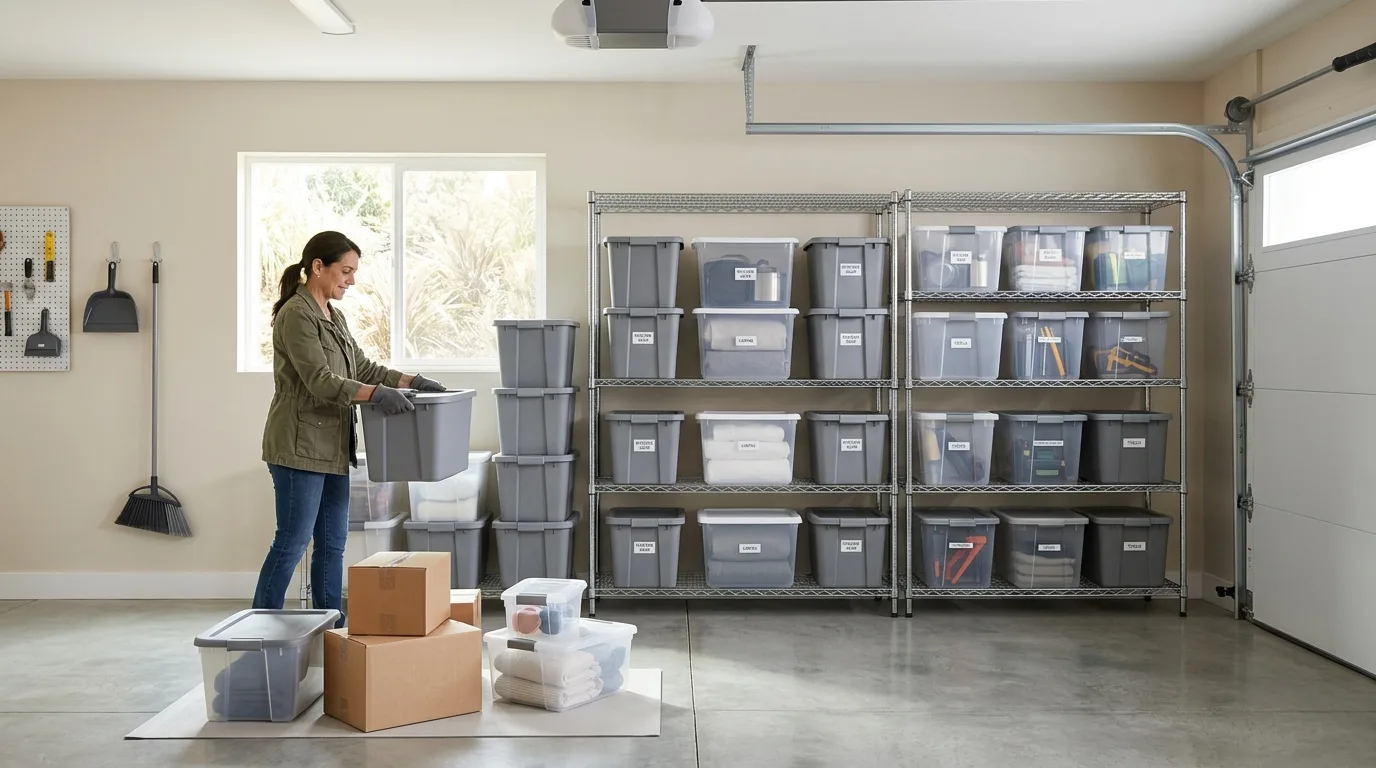
Why a garage is not the same as a storage room
A garage is the first place things end up when there is not enough room in the house. Tools, seasonal clothing, old books, furniture, children's outgrown stuff — it all goes to the garage. But a garage is not a storage unit, and conditions inside it are radically different from what you have indoors. Temperature swings, humidity, rodents, lack of ventilation — all of this destroys belongings in one or two seasons. In Escondido the climate is milder than in many parts of the country, but summer heat in a closed garage easily pushes past 110 °F, and overnight lows in January can drop into the high thirties. That range is enough to crack plastics, warp wood, and yellow paper.
Conditions inside a typical garage
Temperature
In an uninsulated garage the air temperature tracks the outside. In summer it climbs well above outdoor readings because of radiant heat through the roof. In winter it falls close to the outside low. This kind of swing — sometimes sixty or seventy degrees over a year — breaks down adhesives, makes plastic brittle, yellows paper, and thins fabric. Stored belongings in Ramona homes face the same summer garage heat.
Humidity
In a garage without ventilation, humidity can reach eighty or ninety percent. Condensation forms on walls, ceiling, metal surfaces. Items sitting on the concrete floor wick moisture from below. Wooden furniture swells, metal tools rust, books grow mold, clothing picks up a stale smell. Escondido sits inland and the air is generally dry, but a sealed garage traps whatever moisture it gets — morning dew, a garden hose dripping nearby, a washing machine in the corner — and has no way to let it out. Garages in homes around San Marcos trap moisture the same way.
Ventilation
Most garages either have no ventilation at all or have openings that are far too small. Air stagnates, humidity stays put, odors build up. Without supply and exhaust airflow, anything stored in the garage is headed for dampness. A supply opening sits low on the wall. An exhaust opening goes on the opposite wall near the ceiling. The temperature difference between the two creates a draft and air circulates on its own.
Pests
Mice, rats, carpet beetles, clothes moths. Rodents get in through gaps in walls, around the garage door, along the foundation. They gnaw paper, fabric, wood, even soft plastic. Powder-post beetles work through wooden furniture. Moths eat wool. Without countermeasures, a garage is an open buffet.
What survives in a garage
Hand tools — hammers, screwdrivers, wrenches, power tools. Metal hand tools handle temperature swings but rust in humidity. Store them in closed metal cabinets, spray with an anti-corrosion treatment, drop silica gel packets into drawers. Power tools go back into their factory cases with silica gel.
Auto parts and tires — spare parts, tires, oils, car-care chemicals. Tires go on a rack, either upright or stacked flat, away from heat sources. Motor oil stays in sealed containers — at very low temperatures it loses its properties, though that is rarely a concern in Escondido. Car chemicals stay in original packaging, away from ignition sources.
Yard tools — shovels, rakes, pruners, hoses, fertilizer. Clean metal tools of dirt, dry them, wipe with oil, and hang on the wall. Coil hoses, hang them up, drain the water. Keep fertilizer in sealed bags on a shelf away from moisture — some fertilizers are hygroscopic and cake up.
Sports gear — dumbbells, barbells, benches, balls. Metal equipment tolerates temperature changes but not humidity. Rubber balls lose elasticity and crack in freezing temperatures, though Escondido rarely drops that low.
Building materials — tile, brick, lumber, steel stock. These are rated for outdoor storage, with conditions. Tile goes on a pallet, not on bare ground. Lumber is stacked with spacers between boards for air circulation. Steel stock sits on stands, not on the floor, and gets an anti-corrosion coat.
What does not survive
Documents and books. Paper yellows, ink bleeds in humidity, books grow mold. One season in a damp garage turns a book into scrap. For documents, use a fireproof safe or a climate-controlled archive box.
Electronics. Televisions, computers, audio equipment, routers. Temperature swings create condensation on circuit boards; humidity corrodes contacts. After one winter in an unprotected garage, electronics fail beyond repair.
Clothing and textiles. Fabric gets damp, molds, picks up a musty smell. Wool is eaten by moths. Leather cracks from temperature changes. Fur matts. For clothing, a closet inside the house or vacuum-sealed bags (for synthetics) are the right choices.
Furniture. Solid wood swells from humidity. Particleboard delaminates. Upholstery grows mold. Metal furniture rusts. Plastic cracks in heat. If you must keep furniture in the garage, raise it on stands, cover with a breathable drop cloth, and treat the wood with a protective finish.
Paint and finishes. Water-based paints freeze, the emulsion breaks, and the product is ruined. Store paints and coatings above about 40 °F — usually not a problem in Escondido, but worth checking on cold nights.
Setting up the garage for storage
Shelving
Shelving is the backbone of any organized garage. Metal shelving is strong, indifferent to humidity, and carries heavy loads. Wooden shelving is cheaper but does not tolerate moisture. Keep the bottom shelf at least eight inches off the floor so items do not wick dampness from the concrete. Space shelves twelve to twenty inches apart depending on what you are storing.
Ventilation
The minimum is two openings. A supply opening in the lower part of one wall, roughly four to five inches in diameter. An exhaust opening on the opposite wall near the ceiling, same diameter. For a two-car garage — around four hundred square feet — two openings are enough. If the garage is unusually long, add intermediate openings. A metal duct run to a rooftop exhaust with a wind-driven deflector improves the draw and costs little.
Pest control
Seal every gap — expanding foam, hardware cloth, or mortar. Place bait stations in corners out of reach of children and pets (use enclosed tamper-resistant stations). Ultrasonic repellers have mixed reviews but work as an additional layer.
Moisture control
Silica gel packets in boxes and bins, a plug-in dehumidifier if you have an outlet nearby, and regular airing. Never store anything directly on the floor — always on shelves or risers. If the garage is prone to flooding, raise the bottom shelf to at least eighteen inches.
Zoning
Divide the garage into areas: tools near the workbench, auto parts near the door, yard tools along the far wall, seasonal items on the top shelves. Zoning saves time when you need something and keeps the space from turning into a pile.
Preparing a basement for temporary storage
Step one — clean out and sort
A full inventory of what is already down there. Divide everything into three piles: things you need, things to sell or donate, and trash. Bring a helper — the job goes faster with two people and a clipboard.
Step two — deep clean
Sweep, mop the floor and walls. If there is mold, treat it with a mold-killing solution. Air the space out to clear any stale smell before bringing anything new in.
Step three — deal with moisture
Waterproofing the walls and floor is the first priority. In Escondido the water table is generally low, but seasonal rains and irrigation runoff can still push moisture through a foundation. Bitumen mastic applied in two to four coats is a common approach. The process is: fill any pits in the concrete with a fine-grained morite mix, clean and dry the surface, prime the lower portion of the walls with a quick-evaporating bitumen solution, then brush or roll on the mastic. Reinforce any wall-to-floor joints with fiberglass mesh tape before coating.
For lighter dampness, simpler measures help: a container of quickite (calcium oxide) on the floor absorbs excess moisture from the air. A plug-in dehumidifier with a built-in hygrostat keeps the humidity at a set level automatically — useful in fall and spring when moisture tends to spike.
Step four — ventilation
Natural ventilation works well for most basements. The rule of thumb: for every ten square feet of floor area you need about four square inches of vent opening. Mount the exhaust duct on the roof near existing chimney or vent stacks — the warm air rising around them improves the draw. Place the supply duct on the opposite side of the room, at least twenty inches above the floor. Test the system with a lit match at the supply opening — the flame should pull inward, confirming airflow direction.
Step five — organize the space
Install tall shelving units that reach the ceiling to use every square foot. Divide the basement into zones and label each one: seasonal items in one corner, tools in another, household goods in a third. Use clear plastic bins so you can see what is inside without opening every box. Label every container. Avoid cardboard — cellulose absorbs moisture, the bottom of the box gets soft, and it becomes a home for mold and insects. Plastic bins with snap-on lids, or sealed containers with a silica gel packet inside, are the right choice.
Step six — lighting and safety
Good lighting makes a basement usable. Use bright, cool-white LED fixtures rated for damp locations. Keep flammable materials — solvents, paints, fuels — in a separate, ventilated cabinet away from heat sources. A smoke detector and a small fire extinguisher on the wall cost almost nothing and cover the basics.
Things to keep out of the basement
Even with working ventilation and a dehumidifier running, certain items do not belong in a basement. Pillows, blankets, rugs, bed linens, and other textiles absorb ambient moisture and develop mildew that is very hard to remove. Important documents, photographs, and electronics are better kept upstairs. Food — even canned goods — attracts pests and is difficult to temperature-control in a space that sits partly underground.
When to call a professional
If the floor stays wet after rain, if water seeps through cracks in the foundation, or if you see white mineral deposits (efflorescence) on the walls, the problem is beyond what silica gel and a dehumidifier can handle. A waterproofing contractor in the Escondido area can evaluate the foundation, install interior or exterior drainage, and apply commercial-grade coatings. Getting the envelope right first means everything you store afterward stays dry.
If the garage cannot hold everything safely, our crew can pack out and store your belongings until the space is ready — see pack-out and restoration in Escondido. Escondido homeowners can also visit waterdamagerepairescondido.com.