

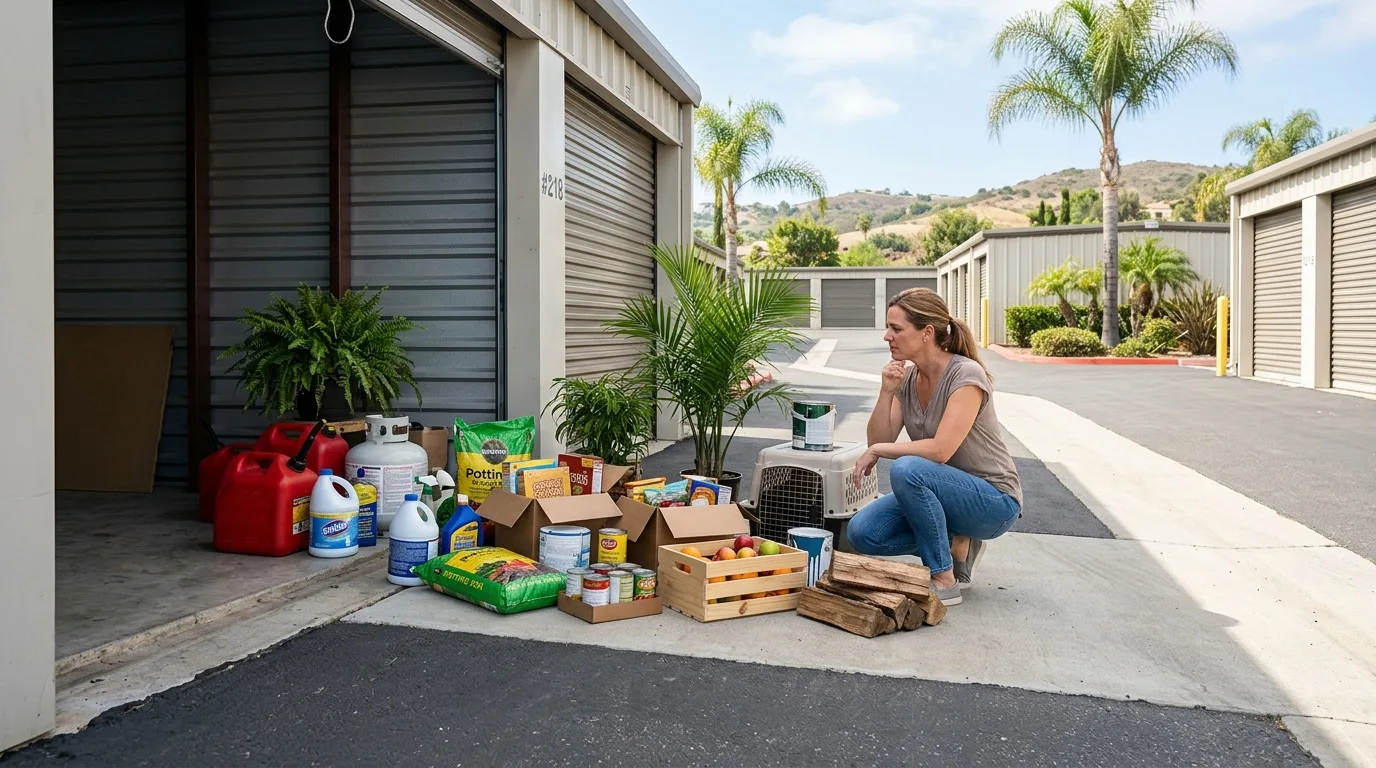
Why Storage Units Have Restrictions
Choosing a storage unit is a responsible decision. Many people focus only on price and location, forgetting the main thing: not everything can be placed in a standard storage facility. Violating storage rules threatens not just damage to your belongings, but also serious consequences from regulatory authorities.
Fire safety requirements and industry regulations clearly spell out which materials and substances are prohibited in general-purpose storage facilities. Operators of storage units, including those here in Rancho Bernardo and throughout San Diego County, carefully monitor compliance with these rules to guarantee the safety of all tenants and the integrity of stored property. Below is a detailed breakdown of what not to keep in a storage unit, what happens when rules are broken, and what inspectors look for. The same list applies to households in neighboring Poway.
What Items Are Prohibited in a Storage Unit
Storage facility rules divide all goods into categories based on their physical and chemical properties. Items prohibited from storage are those that can harm people, property, or the environment. Standard units that lack specialized equipment are simply not designed for hazardous substances.
Flammable Liquids and Gases
You cannot store flammable liquids in a regular storage unit: gasoline, acetone, alcohols, paint thinners, and oils. Storing gas cylinders — propane, butane, oxygen — is also strictly forbidden. Fire safety standards require that such substances be kept in specially isolated spaces with dedicated temperature control and ventilation.
Explosives and Pyrotechnics
This includes gunpowder, ammunition, and pyrotechnic products like fireworks, firecrackers, and flares. Storing explosives improperly can lead to criminal liability. Most Rancho Bernardo storage facilities will not accept these items under any circumstances.
Toxic, Poisonous, and Radioactive Substances
Any chemicals containing mercury, chlorine, acids, or poisons fall under this category. Storing chemicals in a storage unit requires isolation and specialized ventilation — otherwise the vapors contaminate the air and make it dangerous for anyone in the building.
Self-Heating and Easily Oxidized Materials
Some substances can ignite on contact with air or moisture. For instance, storing lithium-ion batteries in a unit requires special conditions: when damaged, they heat up severely and cause fires that are practically impossible to extinguish with standard means. This applies to standalone batteries and batteries inside devices — they can leak, catch fire, or release hazardous fumes.
Perishable Food Without Proper Refrigeration
Health codes prohibit placing perishable products — meat, fish, dairy — in a unit without refrigeration equipment. For temporary storage of food during a move, choose a different solution. Otherwise you risk finding rotten, foul-smelling food among your belongings, not to mention insects and larvae. Canned goods with a long shelf life are sometimes accepted, but many facilities ban food products altogether because they attract rodents.
Medications and Pharmaceuticals
Prescription drugs and over-the-counter medications in any form require special storage conditions and temperature-humidity control. They also attract rodents. Veterinary and biological preparations fall under the same restriction.
Items That Do Not Belong in a Storage Unit for Other Reasons
People
It may sound obvious, but living or working out of a storage unit is not permitted. The space is designed solely for storing personal belongings and household items, not for habitation. Temperature inside can become incompatible with safety — the roof heats up in summer, and there is no climate control in winter.
Animals
Leaving pets in a storage unit, even briefly during loading and unloading, risks animal cruelty charges. The air temperature inside can swing to dangerous extremes. Never, not even for a minute, lock any living creature in a storage unit.
Plants and Seeds
Potted plants are also living things, though facilities rarely introduce formal restrictions for them. Just keep in mind that storage units have no sunlight, fresh air, or water. Plants raise the humidity level inside the unit, promote mold growth, and attract insects and other pests. If your new Rancho Bernardo home has no room for large planters, consider giving them to friends, selling them, or donating them to a local school or community center.
Firearms and Weapons
Whether you can store firearms among personal belongings depends on the policies of the specific storage company, but most facilities do not allow weapons, ammunition, or self-defense devices like pepper spray or stun guns. The primary concern is the safety of other tenants' property and health.
Cash, Valuables, and Important Documents
There is no formal prohibition on storing expensive items. However, it is strongly not recommended to leave cash, jewelry, or valuable antiques in a storage unit, especially during a move. Despite round-the-clock video surveillance and enhanced security measures, the risk of a break-in does exist. Some storage facilities offer insurance for stored property, but insuring cash is difficult. For money and securities, a bank safe deposit box is a better fit. The same goes for government awards, blank official documents, and identification papers.
Wet or Strong-Smelling Items
Everything placed in your unit should be dry and odor-free. Wet items are the fastest way to spread mold or attract pests. If something got soaked during a move, dry it thoroughly before placing it in storage.
Product Proximity Rules
Even permitted items cannot always be stored together if one can spoil another. For example, storing household cleaning products next to anything that absorbs odors is a problem: detergents and cleaning agents release fumes that get absorbed into porous materials and can ruin textiles, upholstery, or paper goods sharing the same unit.
Household chemicals in sealed, factory-original containers are generally allowed. But health standards require isolating them from food products and from goods that absorb odors.
Vehicles and Motorized Equipment
Motorcycles, scooters, lawn mowers, and other equipment containing fuel and lubricants are typically not allowed. They are flammable and disrupt the climate inside the facility. For vehicle storage, the vehicle must generally be registered, insured, and in working condition. An unregistered car without plates is treated as a serious problem and may be reported.
Generators and engines containing fuel or oil fall under the same restriction. If you need to store a piece of motorized equipment, drain all fluids first and check with your Rancho Bernardo storage provider about their specific rules. Families storing garden equipment in nearby Escondido homes can follow the same steps.
Waste and Construction Debris
Waste of any hazard class is prohibited and requires specialized disposal. This includes construction debris, industrial waste, and any refuse. Storage units are not dumpsters — other tenants share the space and deserve a clean, safe environment.
What Happens If You Store Prohibited Items
Ignoring storage rules always carries consequences. Facility management can inspect units and, if prohibited items are discovered, the operator has the right to dispose of hazardous materials without compensation to the tenant if they pose a threat. If the facility suffers damage — fire, contamination, pest infestation — because of hidden dangerous cargo, the tenant is obligated to cover all losses in full.
Financial penalties are just the beginning. If a fire breaks out in a unit containing flammable liquids or gas cylinders, putting it out becomes nearly impossible. In that case, the tenant's liability is at its maximum, and every other renter's property in that building is at risk.
Quick Checklist Before You Pack
- Flammable liquids: gasoline, solvents, paint thinner, lighter fluid — no.
- Gas cylinders and aerosol cans — no, even empty ones (residual gas stays hazardous).
- Batteries of any type, especially lithium-ion — no.
- Ammunition, firearms, explosives, fireworks — no.
- Perishable food, even canned goods at many facilities — no.
- Medications in any form — no.
- Live animals, fish, plants — no.
- Toxic chemicals, pesticides, herbicides — no.
- Wet, dirty, or foul-smelling items — no.
- Cash, passports, irreplaceable documents — use a bank instead.
- Unregistered vehicles or engines with fuel — no.
- Waste or construction debris — no.
Before signing a lease at any storage facility in Rancho Bernardo or the surrounding San Diego area, read the contract carefully. The exact list of restrictions varies between operators, but the core prohibitions above are nearly universal. When in doubt, call the facility and ask — it takes a minute and can save you from fines, liability, or the loss of your belongings.
Need a place for furniture and boxes while the house is being repaired? The crew and our storage facility handle that for Rancho Bernardo and for homes in nearby Rancho Santa Fe.