

Why furniture needs to leave the house during renovation
A renovation is an event that leads to a pleasant result but comes with plenty of complications along the way. One of the more significant headaches is figuring out where to keep your belongings temporarily. This applies to both a kitchen remodel and a full-scale gut renovation of a Carmel Valley home.
When preparing for construction or finishing work, you need to remove the following from the space:
- Upholstered furniture — it actively absorbs dust and may later require professional cleaning.
- Case goods — dressers, bookshelves, and cabinets are equally susceptible to construction dust settling into crevices and finishes.
- Electronics and appliances — fine particulate matter is harmful to internal components of TVs, computers, and kitchen equipment.
- Fragile and valuable items — antiques, mirrors, crystal, and artwork face a real risk of damage from vibration, paint splatter, or accidental contact with tools.
- Clothing and shoes — fabrics absorb the odors of paints, solvents, and adhesives, and getting those smells out is not straightforward.
Ideally, renovation should be carried out in a completely empty space. If you can temporarily move in with relatives or rent a short-term place while the work is underway, you spare yourself both worry and the cost of potential damage.
Storage options to consider
Other rooms in the house
The simplest option: push everything into a room that isn't being touched yet. Advantages — it's free, things are at hand. Disadvantages — the space becomes extremely cluttered, and there is no way to fully protect items from dust. Construction dust travels through doorways and ventilation, and it gets into upholstery no matter how carefully you drape things.
Garage
Your own garage in Carmel Valley can accommodate furniture with minimal expense. But there are serious drawbacks. Wood is prone to swelling in an uncontrolled environment; polymers can crack, and metal hardware can rust. Garages often lack climate control, so summer heat in San Diego County or occasional damp spells can do more harm than the renovation itself. There are also no guarantees against break-ins or roof leaks.
Friends and relatives
Distributing items among acquaintances simplifies delivery, and the storage itself is free. The downsides: your belongings end up scattered across several addresses, which complicates access. There is no guarantee of proper conditions — a friend's garage or spare bedroom may be just as dusty. And if something gets damaged, there is no compensation.
Balcony or patio
Suitable only for small, weather-resistant items. The main problems are temperature swings, sun exposure, and moisture. Wooden furniture left on an uncovered patio can warp or develop mildew within weeks. Narrow doorways also limit what you can move out to these spaces.
Shipping container
A steel shipping container allows you to stack a large volume of furniture in several tiers. The cost is relatively low and the container can sometimes be placed right in the driveway. Disadvantages: no ventilation, no climate control, and difficult access to items buried in the back. If the renovation stretches over several months, the lack of airflow can lead to mold on upholstered surfaces and a musty odor that is hard to remove.
Self-storage unit
A dedicated unit at a storage facility is a guarded space on a specialized lot with video surveillance. Many self-storage companies in the Carmel Valley area offer units ranging from small closet-sized cells to rooms large enough for a full household. These facilities typically provide climate-controlled options, which is the critical advantage over a garage or shipping container. The drawback is cost, and you usually need to load and arrange the unit yourself.
Full-service storage
The most thorough option, providing maximum safety and complete security for your possessions. This typically includes insurance of the stored property, climate control through specialized equipment (temperature and humidity monitoring), the ability to check on condition remotely or through periodic reports, a large enough footprint to accommodate even oversized items, and services like furniture disassembly, packing, and transport. The only real downside is the price, but it is offset by the protection against damage and theft.
What to get rid of before storing anything
Before you start hauling things to a storage unit or a friend's spare room, it makes sense to do a thorough inventory of what you own. A renovation is a natural moment to sort through the house. Consider discarding or donating:
- Old furniture that will not fit the new interior or that has already served its useful life.
- Outdated or broken appliances — that coffee maker from 2009 is not getting repaired.
- Clothing and accessories you have not worn in a year or more.
- Duplicate household items that somehow multiplied over the years.
You can sell items through online marketplaces, donate to local Carmel Valley thrift stores, or simply set things at the curb for pickup. Reducing the volume before you move anything into storage saves both space and rental cost.
How to prepare furniture for short-term storage
Proper preparation determines whether your furniture comes out of storage in the same condition it went in. These rules apply regardless of whether you are using a climate-controlled unit, a garage, or a friend's basement.
Surface preparation
Check the spot where the piece will sit — whether it's a concrete floor, a wooden pallet, or a raised platform. It is best to place furniture on special stands or wooden pallets to avoid direct contact with the floor. Otherwise, ground moisture can wick up into the wood. Avoid placing anything near heating pipes, radiators, or spots where temperatures can shift abruptly.
Disassemble what you can
If a piece of furniture can be taken apart — remove shelves, detach legs, take off doors — do it. Disassembly reduces the risk of damage and saves considerable space in the unit. Put all hardware — screws, bolts, cam locks — into a labeled bag and tape it to the corresponding piece so you are not hunting for fasteners later when it is time to reassemble.
Control temperature and humidity
This is the key factor. Humidity should sit between 40 and 60 percent; temperature in the range of roughly 60 to 77 degrees Fahrenheit. When humidity is too high, wood swells and joints loosen. When it is too low, wood dries out and cracks appear. Polished, lacquered, or painted surfaces should be kept in a closed space away from direct sunlight. Veneered, inlaid, or carved pieces need a space that stays above freezing and doesn't swing wildly in temperature.
Paint and enamel coatings can peel when exposed to sudden temperature changes, so avoid placing pieces near HVAC vents or in areas with drafts. If you are storing for more than a month, ventilate the unit or open the door periodically — at least once a month — to let fresh air circulate.
Proper placement inside the unit
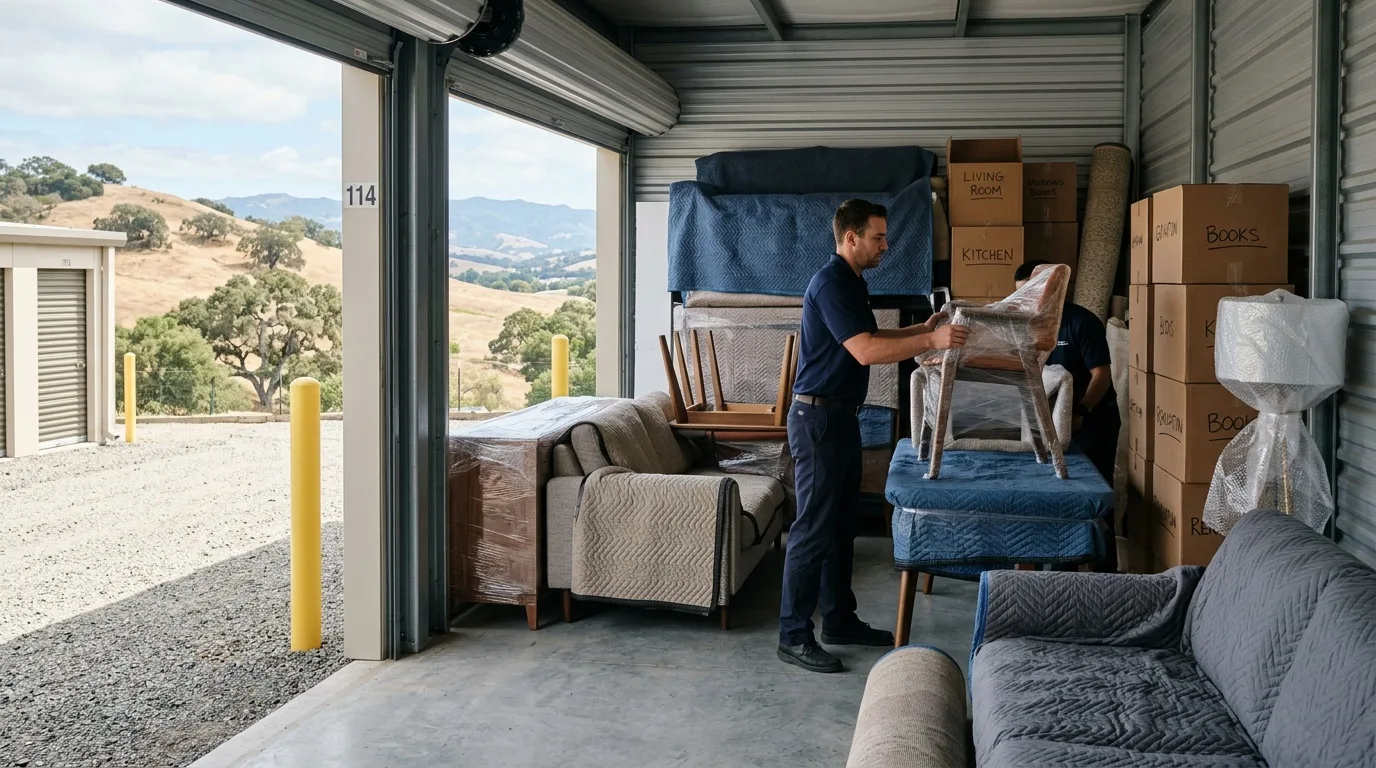
Start with the heaviest items. Wardrobes, dressers, and tables go on the bottom; lighter items — chairs, lamps, boxes — on top. Chairs can be flipped upside down or stacked, with padding between them. Tables can stand on end if space is tight. Sofas and beds go horizontal. Always use soft padding — moving blankets, old sheets, or bubble wrap — between pieces that touch each other.
Leave a gap of four to six inches between items to allow air circulation. If the combined weight of stacked items exceeds about 40 or 50 pounds, make sure the base piece or pallet can handle the load. Keep things away from the walls, where moisture can accumulate in some facilities.
Protection from dust and pests
Do not leave furniture uncovered. Use proper protective covers — fabric drop cloths or furniture covers breathe better than plastic wrap, which can trap moisture underneath and promote mildew. Before covering, clean each piece so you are not locking in dust or crumbs that attract insects. Inspect corners, joints, and crevices for signs of bugs or mold before you seal things up. In a Carmel Valley storage unit, pest risk is generally low, but it pays to be thorough, especially if the unit is ground-level or near landscaping.
Fragile items deserve separate handling
Mirrors, glass tabletops, light fixtures, and decorative objects should be packed individually. Wrap each one in corrugated cardboard and then in something soft — a moving blanket or specialized foam. Mark the boxes as fragile and keep them on top of stacks, never underneath heavy items.
How long does short-term storage typically last?
A kitchen remodel might run four to six weeks. A whole-home renovation can stretch three to five months — sometimes longer if permits or contractor schedules slip. Most Carmel Valley self-storage facilities rent by the month with no long-term commitment required, so you can extend as needed without a penalty. Some companies offer tiered discounts — the longer you rent, the lower the monthly rate.
For genuinely short stints — under a month — a shipping container in the driveway or a neighbor's garage might suffice. For anything beyond that, a proper storage unit with climate control is the safer choice, especially for wooden furniture and upholstered pieces that are sensitive to San Diego's dry heat. Homes in San Diego proper face the same trade-off during a remodel.
A few final points
If you are renovating a Carmel Valley home and facing the question of where to put your furniture, take time to evaluate how long the project will really last, how much furniture you actually need to store, and which items are worth the cost of a climate-controlled unit versus which can tolerate a garage or patio for a few weeks. Reduce the volume first by discarding what you no longer need, then prepare and pack what remains properly, and choose a storage option that matches the duration and sensitivity of your belongings. That approach saves both money and the condition of your furniture. It works the same way for remodels of homes in nearby Del Mar.
When a Carmel Valley remodel means the furniture has to leave for a few weeks, our crew can pack it, move it to our storage facility and bring it back. We do the same for homes in Rancho Santa Fe.