

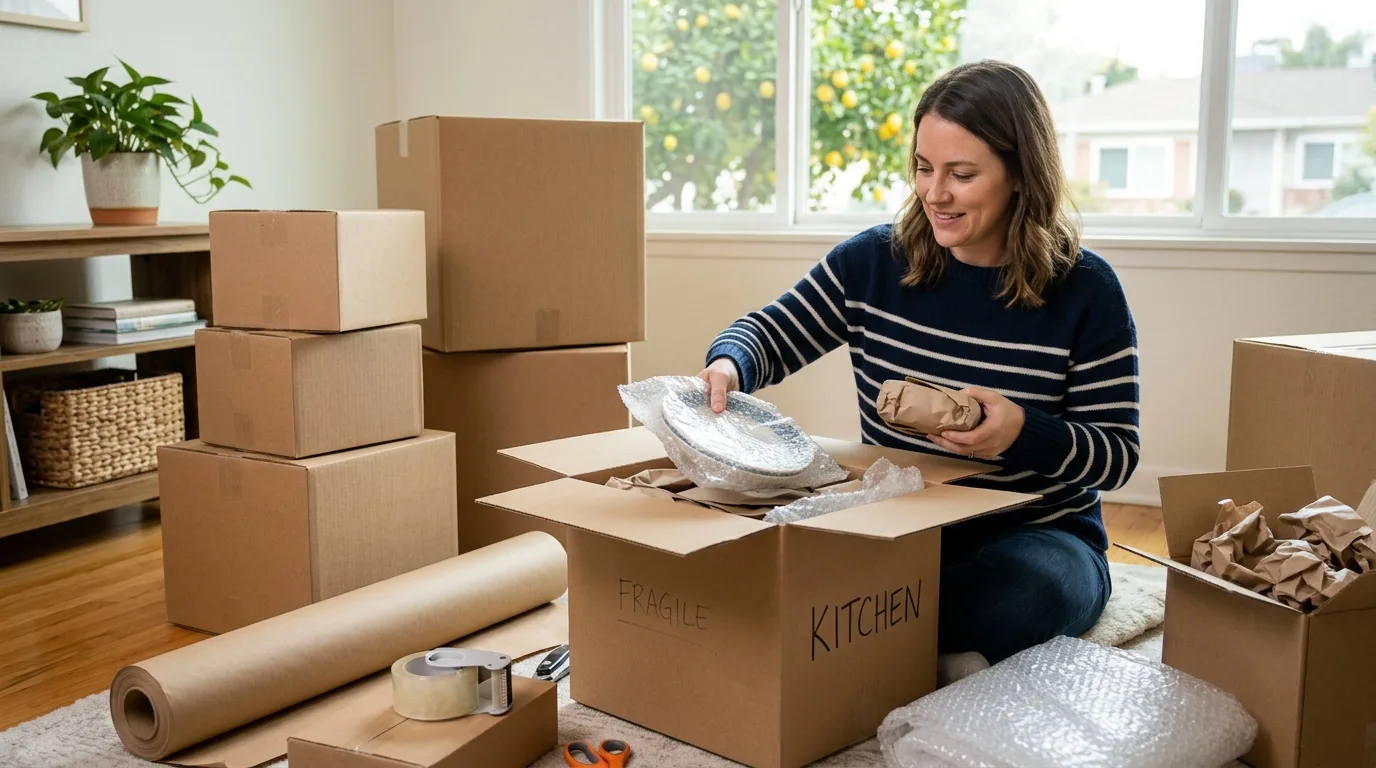
Why the right boxes and packing supplies matter
Any move eats up time and energy. Making a list, packing everything, sorting it out, hauling it to a new place — the whole thing demands attention to small details. And the hard part is not getting every item from point A to point B. The truly difficult thing is getting your belongings there in one piece. That goes double for appliances, dishware, and other fragile items that break easily in transit.
To keep your Lemon Grove move from turning into a headache, you need to organize it properly. Below we go through the main packing materials and the rules for wrapping household goods. These pointers will protect your property and cut your packing time considerably. They apply just as well to households in neighboring La Mesa.
Picking the right box size
Packing mountains of dishes, books, clothes, and assorted keepsakes is manageable with proper cardboard boxes. Quality corrugated cardboard shields contents from impacts and compression, and the range of sizes simplifies loading and hauling. Boxes are easy to carry, stack in the truck, and store.
Small boxes — up to about 8 gallons
These are for heavy items: books, documents, tools, bottles. They are simple to carry, and the risk of the bottom tearing out is minimal.
Medium boxes — roughly 10 to 16 gallons
The most popular, universal size. Good for pre-wrapped dishes, shoes, clothing, household chemicals, small appliances.
Large boxes — 18 to 26 gallons
Used for light but bulky things: pillows, blankets, curtains, stuffed animals, big pots, seasonal clothing. Remember: when filling large boxes, do not overload them with heavy objects — the bottom may not hold.
Box construction and layers
Moving boxes come in three-, five-, and seven-layer corrugated cardboard. The more layers of liner and fluting, the stiffer and stronger the box.
Soft items that tolerate some deformation — clothes, bedding, household textiles — can go into three-layer boxes. For office equipment, dishes, fragile and fairly heavy objects, use five-layer or even seven-layer versions.
The most common construction types for residential moves:
- Four-flap boxes — universal, assembled with packing tape.
- Self-locking boxes — no glue or tape needed; they hold up under significant loads.
- Wardrobe boxes — tall, roughly 24 × 24 × 46 inches. Clothes hang on a built-in bar right on hangers. Typically used for evening dresses, suits, coats, and jackets.
- Lid-and-base boxes — a container with a removable top.
Packing materials beyond the box
When you move, you need to transport goods of different categories: furniture, electronics, clothing, fragile dishware. Reliable packing should provide protection from mechanical damage, dirt, and moisture, allow convenient stacking and sorting, and permit fast packing and unpacking. Since it is usually single-use, cost should stay low.
Bubble wrap
An indispensable helper for wrapping fragile items — dishes, mirrors, antiques, chandeliers, household and digital electronics. It comes in two-layer and three-layer versions. Two-layer wrap works well as a liner on the bottom or sides of a box: the bubbles cushion impacts and vibrations. Three-layer bubble wrap is for wrapping objects that need the most care. It is a sturdier material that resists tearing and stretching.
Stretch film
The defining feature of stretch film is its ability to elongate and then return toward its original length. This lets you wrap objects of any size and shape — from a painting to a large sofa. Whatever you wrap stays tightly fixed; moisture, dust, and dirt cannot reach it. The film clings to the previous layer and does not unravel during transit. It is strong: a dense protective layer is hard to tear or puncture. And because the film is transparent, you can see what is inside, which speeds up finding what you need.
Packing tape
Used for sealing boxes, bags, and securing film. For a move, buy several large rolls — you will go through more than you expect, even if the load seems small. The tape should be at least two inches wide so it holds reliably. Tape every seam, and reinforce the bottom in a cross pattern. The same supply list works for families in nearby Spring Valley.
Kraft paper
If you need to wrap keepsakes, small décor items, jewelry, or books, use kraft paper. It is made from long-fiber cellulose, which makes it strong and moisture-resistant. You can fully wrap objects in it or use it as fill to pad empty spaces inside boxes. Flat plates and glasses wrap neatly in kraft paper sheets.
Foam polyethylene
A multi-layer material with a closed, fine-cell structure. Handy for wrapping furniture, appliances, and items made of glass, crystal, or ceramic. Its softness and porosity absorb impacts, protecting cargo from breakage. It is highly elastic and conforms easily to objects of any shape.
Strapping tape
Used for extra reinforcement of boxes and other packages, making them stiffer and more durable. For lighter loads, loops of strapping tape double as carrying handles.
Sorting your belongings by category
Items can be divided into rough groups, each calling for its own approach:
- Fragile items — dishes, electronics, souvenirs. Travel in rigid containers (cardboard boxes) with cushioning materials like bubble wrap or packing paper.
- Soft goods — pillows, blankets, clothing, textiles. No rigid container needed; the main concern is protection from dirt and moisture. Heavy-duty bags and sacks are enough.
- Bulky items — furniture panels, curtain rods, sports equipment, tools. Use stretch film to create a protective shell. Loose pieces get bundled together with strapping tape or packing tape.
- Heavy loads — upholstered furniture, large appliances. Use the strongest materials you can get. Build a protective shell from dense film or multiple layers of stretch film.
Rules for packing specific items
Furniture
The main goal is to protect upholstery and corners. To pack a sofa properly, you need bubble wrap, stretch film, tape, and cardboard. A large sofa should be disassembled: remove all cushions, covers, armrests, and other detachable parts. Wrap each piece in bubble wrap, paying extra attention to protruding sections. Secure the wrap with tape. Cardboard sheets can add protection at the corners, then stretch film goes over the entire assembly.
Chairs and tables that do not come apart get wrapped in bubble wrap and then several layers of stretch film. Gaps between legs are filled with foam or kraft paper.
Refrigerator
Unplug the refrigerator and let it defrost. Empty it completely, remove all shelves, bins, and drawers — transport those separately. Stack the shelves with cardboard between them, wrap in bubble wrap, and tape firmly. Protect the compressor separately, placing it in a box lined with bubble wrap. If you no longer have the original packaging, wrap the unit in blankets or three-layer bubble wrap to prevent scratches and chips, then bind the doors shut with stretch film.
Television
Unplug and disconnect all cables; coil the cords and put them in a separate box. Wipe the screen — dust and grit can scratch it during handling. The factory box with foam inserts is ideal, but most Lemon Grove households do not keep those around, so bubble wrap is the next best thing. Wrap the entire body, especially the display and any protruding parts. Reinforce the corners with foam polyethylene. Fix everything with tape. A smaller TV can be wrapped fully and placed inside a cardboard box with voids filled by kraft paper or cardboard pieces.
Dishes
Place plates in a box one at a time, wrapping each in bubble wrap. Bubble-wrap pouches make it even easier — slide in a plate or mug, seal the edge with tape. Put cardboard dividers between items for extra protection. Fill any remaining space with kraft paper, cardboard scraps, or leftover bubble wrap so nothing shifts in transit.
Good boxes keep belongings safe on moving day; when a leak is the reason they have to come out, our Lemon Grove guide on preventing mold in the first 48 hours is the next read. The same packing help reaches homes in nearby National City.
Practical tips for packing day
- Make a list. Go through your belongings and decide what you are keeping and what you can get rid of. Note valuable items separately — pack and move them first.
- Label every box. Write the contents and destination room on each box with a marker, or use color-coded tape. For instance, blue for bathroom items, yellow for kitchen. Mark fragile boxes clearly.
- Do not mix incompatibles. Books and liquids should never share a box. Same goes for sharp objects and electronics. Bottles of shampoo, detergent, and similar liquids should be sealed with stretch film before boxing.
- Stage everything by the door. Before loading, line up all packed boxes near the exit. At the new place, sort boxes into rooms right away — it makes unpacking far easier.
- Do not overload. Resist filling boxes to the brim with heavy items. If you stuff them with books, the bottom may give out on the way down the stairs. Match the box size to the items going inside.
- Tape the bottom in a cross. Use quality packing tape at least two inches wide. Reinforce all seams, especially the bottom.
- Fill every void. Empty space inside a box lets things shift and collide. Pack each box as tightly as possible with cushioning material.
- Start early. Begin with items you will not need in the coming weeks — seasonal clothing, sports gear, decorations. Pack by destination room in the new home: heavy items on the bottom, light on top.