

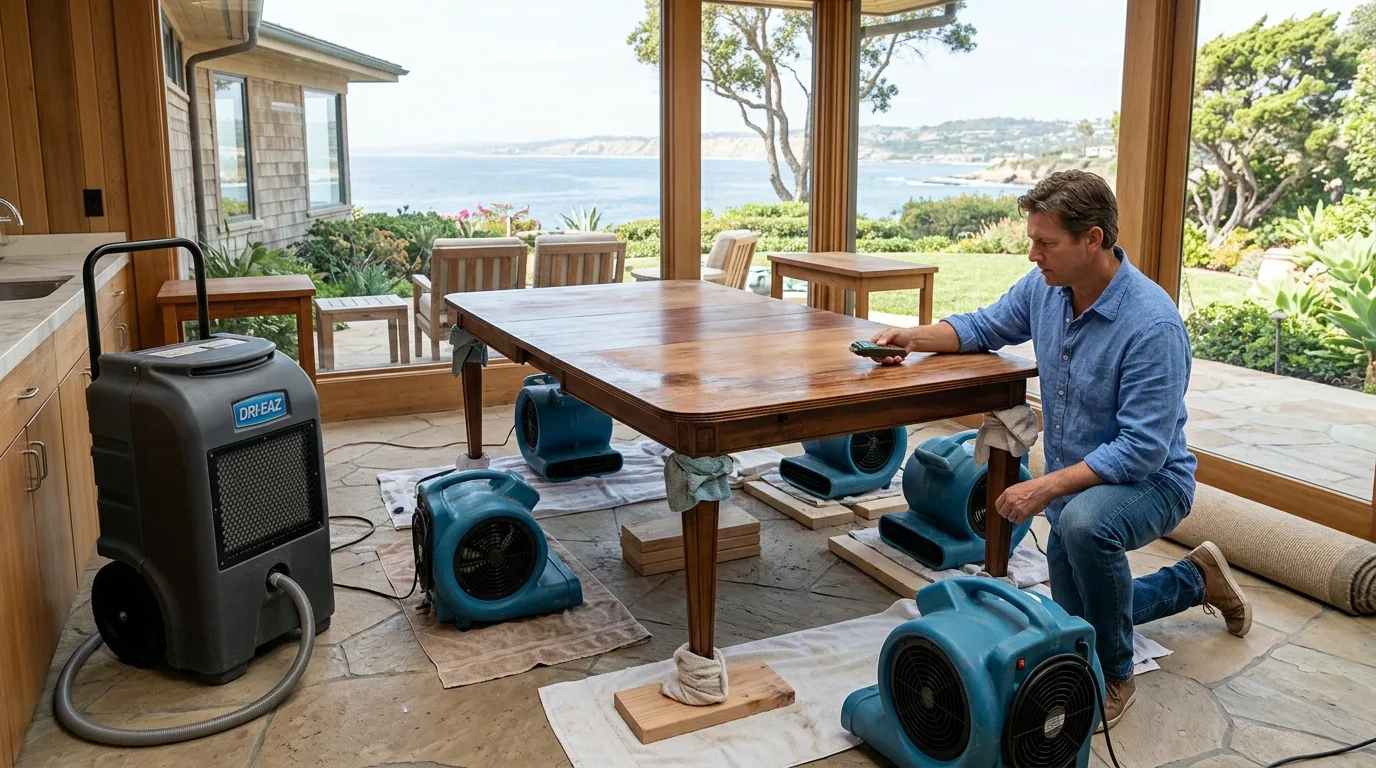
Repair instead of replacement, or how not to fear moisture
Flooding happens suddenly. Water pours onto a desk, a carpet, the upholstery of a sofa. The house turns into a tropical forest: wallpaper bubbles up, humid air fills with odors, the carpet squelches, and fabric blooms with stains. Can you prevent a household flood? No. But you can save the furniture in a flooded home.
For La Jolla homeowners, the risk of water damage often comes from burst pipes, appliance leaks, or even the occasional heavy rain event. Knowing how to act quickly can mean the difference between restoration and replacement.
The first two hours after flooding
When blankets have been dragged to the patio and rugs rolled into bundles, it is time to assess losses. Within those first two hours, time is still very valuable.
Divide your furniture into two categories. The damaged group includes not only items that sat directly in water — humid air alone can ruin things that were seemingly out of harm's way. Evaluate how badly each piece is damaged and compare the cost of the item to the likely cost of repair. Factor in sentimental value as well.
Set the unsalvageable pieces aside and accept the loss. If upholstered furniture stood in water for several hours, mold will develop inside it. Wooden shelves will warp, fasteners will rust, woven elements will soften and fall apart.
Dry everything that can still be repaired. Move furniture to the driest room in the house. If a piece is too heavy to lift, slide wooden or aluminum sheets under the legs so they do not sit on wet carpet. Families drying out flooded homes in nearby Del Mar can follow these steps.
Wooden furniture after water exposure
Wooden furniture — even pieces covered with a vinyl film — survives even serious floods. If water was not pouring onto tables and wardrobes for hours on end, they are not hard to treat.
Clean and thoroughly dry all wooden pieces. Assess the damage: did the film peel off, did a shelf warp, did the legs dry out and crack? A shelf can be straightened, film can be reglued, and leg damage can be concealed.
Cleaning and drying help you gauge whether a piece is truly beyond repair. Fungus and mold form inside damp wood, so the drying process has to be patient and long. If the furniture did not come into direct contact with water, wipe it down with a soft towel, then blot with a dry cloth.
White mold spots can be removed this way: mix equal parts ammonia and water, or rub the wood with mineral spirits. Wipe the surface completely dry right after treatment. If possible, follow up with a furniture-care product containing lanolin.
Things get harder when wooden furniture has stood in water for a long time. But even here, repair is possible: disassemble the piece so individual panels dry faster. Unscrew doors, pull out drawers, carry back panels and shelves outside. Swollen parts can be separated later, once they have dried a bit.
Protect wood from direct sunlight. It is better to move the piece into a room with open windows or onto a shaded patio on an overcast day. Under the sun, damp shelves deform and film dries unevenly. Soaked wood takes weeks to dry — sometimes months.
Why furniture swells from water in the first place
Most kitchen and household furniture is made from laminated particleboard or MDF, both of which contain wood shavings or fibers inside. When water gets in, the material absorbs moisture and expands in volume, causing surface deformation and edge delamination.
The most vulnerable spots are joints, edges, and fastener holes — water penetrates the core of the board through these openings fastest. Repeated moisture exposure at one spot leads to noticeable swelling over a matter of months.
The problem is especially common near sinks, dishwashers, kettles, and coffee makers, where there is constant steam, splashing, and elevated temperature. In La Jolla's coastal environment, ambient humidity can compound the issue. Salt air reaches homes in nearby Pacific Beach just the same.
Which materials are most vulnerable
Laminated particleboard (LDSB) is the most prone to damage, since it is made from ordinary wood shavings. It almost always deforms when water gets in.
MDF holds up better, especially moisture-resistant grades, but it too will deform under prolonged contact with water.
Solid wood can warp, but it can usually be dried and sanded back into shape.
The most resilient materials — plastic, engineered stone, and compact laminate — barely react to water at all.
What to do immediately after water hits the furniture
You need to act as fast as possible to minimize swelling:
- Wipe up water with a dry cloth.
- Open cabinet doors and drawers for ventilation.
- Dry the surface with a hair dryer or a small fan heater.
- If possible, peel off the edge banding to let moisture escape.
- Leave the furniture open to air-dry for several days.
Do not close wet furniture — in an enclosed space the material dries more slowly and swelling gets worse.
How to restore a swollen countertop or shelf
With minor swelling, restoration is often possible. Remove the edge banding, dry the piece thoroughly, and carefully level the surface. In many cases the board returns close to its original shape after drying.
If some unevenness remains, sand the area smooth, level it, and install new edge tape or a decorative trim strip.
For serious damage, pressing or clamping can sometimes force the board back into shape, though this method does not always work.
Repairing laminated edges
If swelling exceeds about two millimeters, make a lengthwise cut and fill it with a mixture of fine sawdust and wood glue. Clamp the piece between flat boards to compress it back to its original thickness. After the filler dries, smooth the edge and apply new edge banding.
A simpler cosmetic fix is to cover the damaged edge with a plastic corner trim. Measure and cut the trim to length, apply adhesive (liquid nails work well), press it onto the swollen edge, and clamp or weigh it down for twenty-four hours until the glue sets.
How to restore cabinet doors and facades
MDF facades can often be saved. Remove the film, dry the panel, level the surface, and then repaint or re-wrap with new film. After repair the door can look nearly new.
Laminated particleboard facades are harder to fix because the material tolerates moisture so poorly. When damage is severe, it is usually cheaper and faster to replace the panel entirely rather than try to restore it.
Sometimes drying under weight helps — place the warped door flat and set a heavy load on top for several days. This works best with mild deformations.
How to protect furniture from water damage going forward
Protecting joints and edges should be the top priority. Always seal countertop seams with silicone, and pay special attention to the area around the sink.
Wipe up water from countertops immediately and never leave wet rags sitting on the surface. Persistent moisture in one spot almost guarantees problems.
Choose quality materials from reputable manufacturers. Damage and nicks in the protective coating should be repaired right away — every exposed edge or chip is an entry point for water. Treat cut lines and drill holes with silicone sealant during installation.
For La Jolla kitchens and bathrooms, placing coasters under potted plants, using drip trays, and keeping an eye on plumbing connections goes a long way toward preventing the kind of slow leak that ruins cabinetry from the inside out.
When furniture can no longer be saved
With heavy swelling the material becomes soft and crumbly, fasteners lose their grip, and the surface starts to flake. This typically happens after a major flood or a serious long-term leak.
Prolonged contact with water causes the board to lose structural strength. In such cases, replacing the damaged components is the most practical solution. When you do replace parts, seal every joint with silicone to prevent future problems.
If the furniture stood in water for many hours, mold has likely begun growing inside. Even if the surface dries out, the interior may already be compromised. At that point, the wisest move is to bring in a water damage restoration specialist who can assess whether the piece — and the surrounding structure — can be safely dried and salvaged.
Furniture that sat in water often means the floors and walls around it got wet too, and drying both is part of water damage restoration in La Jolla; elsewhere in the city the same work is listed under water damage restoration in San Diego. A La Jolla-only resource is also online at waterdamagerepairlajolla.com.