

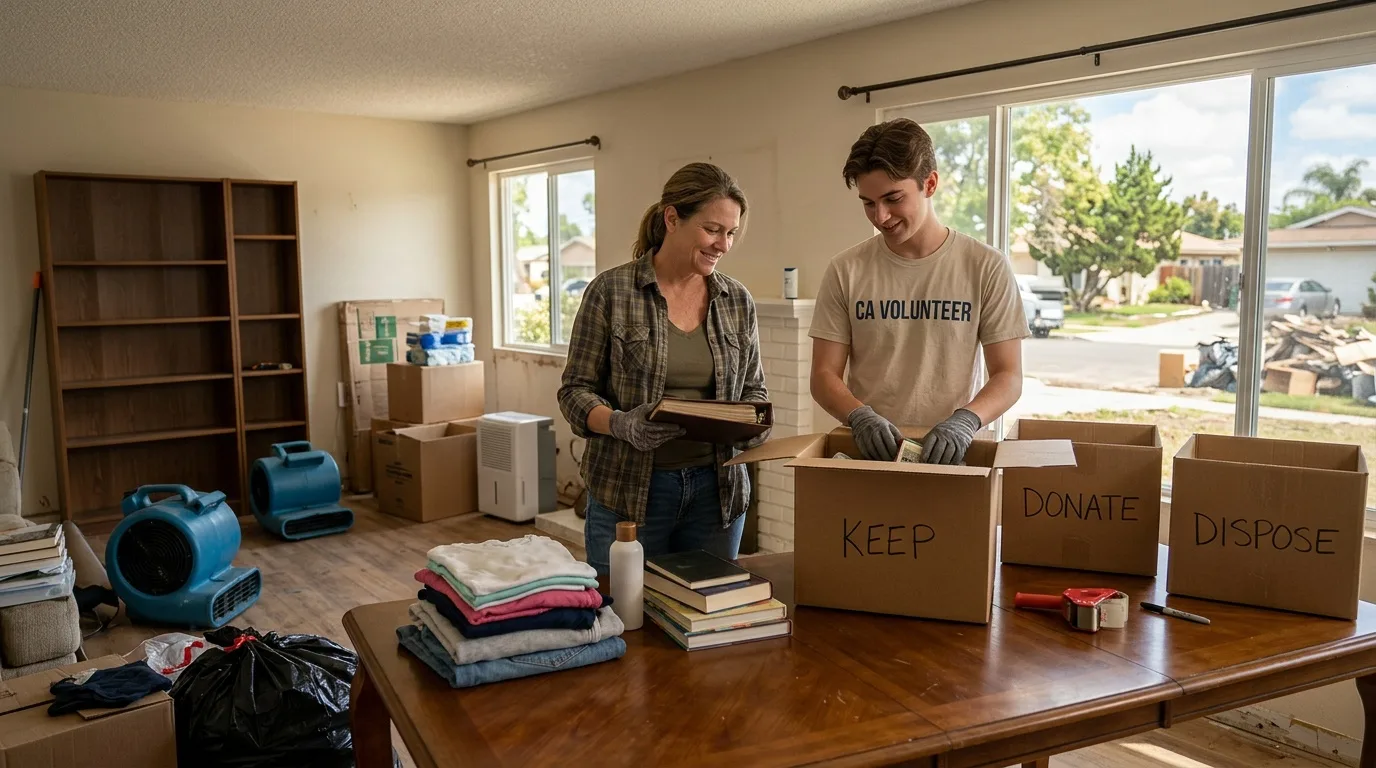
Why sorting through belongings is a separate stage
After a fire or flood in an El Cajon home, the initial emergency cleanup is only the beginning. Once the firefighters or water extraction crew has left and the immediate danger is past, homeowners face a different kind of work: going through everything that remains and deciding what can be saved, what needs professional restoration, and what has to go.
This sorting phase is often harder than the cleanup itself. The urge to get everything back to normal as quickly as possible is understandable, but rushing through it leads to mistakes — keeping items that will keep releasing smoke odor for months, or throwing out things that could have been restored with proper treatment.
Safety before you start
Before touching anything in a fire- or flood-damaged home, you need personal protection. Soot particles are fine enough to penetrate deep into the lungs, and floodwater residue can carry bacteria and chemical contaminants. A respirator rated N95 or higher, heavy rubber or nitrile gloves, safety goggles, and old clothes you can dispose of afterward — these are not optional.
The area where you work should be well ventilated. Open windows in several rooms if the layout allows it, and create a directed airflow rather than just cracking one window open. Ventilation helps reduce the concentration of heavy, contaminated air, but it does not replace actual cleaning.
The basic sequence
The most practical approach is to work in stages rather than trying to solve everything at once. Here is a working order that El Cajon restoration professionals typically follow:
- Assess whether the structure is safe to enter
- Open the space up for air circulation
- Remove debris and obviously destroyed items
- Sort remaining belongings into categories: restorable, needs professional help, and disposal
- Remove soot or water residue from surfaces
- Dry the space thoroughly if water damage was involved
- Treat zones where odor or moisture lingers longest
Skipping steps — especially trying to do cosmetic repairs before removing all contaminated materials — is the most common reason the smell comes back weeks later.
What usually cannot be saved
Certain categories of items should be discarded without hesitation. Food products, whether sealed or not, must go if there is any chance they were exposed to heat, smoke, or floodwater. The same applies to medicines, cosmetics, and children's items like pacifiers, bottles, and soft toys — porous materials absorb toxins that cannot be fully removed.
Charred or partially burned materials — insulation, drywall, carpet padding — are not salvageable. If fabric is scorched even slightly, the item should be discarded. Laminate and linoleum flooring that sat in standing water will warp and grow mold underneath; these need to be pulled up down to the subfloor.
Furniture made from particleboard (MDF, chipboard) rarely survives significant water exposure. The material swells, delaminates, and loses structural integrity. Unlike solid wood, it cannot be dried and restored — once the internal layers separate, the piece is done.
What can often be restored
Textiles and clothing
Clothing, curtains, bedding, and rugs that were not directly burned or submerged for extended periods can often be saved through professional dry cleaning. The key is to act fast. Items should be taken outside to air out as soon as possible — several days in a ventilated spot, away from direct sunlight to prevent color fading.
Before sending anything to a cleaner, brush off loose soot with a soft-bristled brush or vacuum with a brush attachment. Do this outdoors. Sort items by fabric type and color: cottons and linens separately from synthetics, whites from darks, delicates on their own. Heavily soiled items may need a soak in water with baking soda or vinegar before a full wash cycle.
Silk and wool require gentler treatment — cold water, pH-neutral or wool-specific detergent, no wringing. Leather goods should be vacuumed gently, then treated with a leather conditioner and allowed to dry naturally. If the smoke smell persists after two rounds of washing, professional ozone treatment may be the next step.
Solid wood furniture
Wooden furniture reacts to water and moisture differently depending on whether it is sealed with lacquer, wax, or left unfinished. If solid wood pieces ended up in water, the critical thing is to begin drying immediately. Open cabinet doors and drawers, set up fans and dehumidifiers, and let air circulate through the piece.
The bad news for those hoping to take their time: if wooden items sat in water for an extended period, restoring them becomes extremely difficult. The wood warps, joints loosen, and internal surfaces can start developing mold. But if you catch it early — within the first day or two — most solid wood can be saved. After drying, sand down any rough spots and treat with an antiseptic solution.
Upholstered furniture
Sofas, armchairs, and mattresses present a harder problem. Moisture collects inside the padding and is slow to leave. The main danger is mold and mildew developing deep in the cushions where you cannot see it. If the upholstery is fabric, it will need professional deep cleaning. Leather upholstery fares better but still requires conditioning to prevent cracking as it dries.
Sometimes it is simpler and cheaper to part with a water-damaged sofa than to live with the lingering smell of dampness for months afterward. This is an honest calculation each homeowner has to make for themselves.
Electronics
Household electronics — computers, televisions, appliances — should not be plugged in or turned on until a qualified technician has inspected them. Water and electricity are not friends, and attempting to power up a device that has internal moisture can cause a short circuit and destroy it permanently.
For computers, try to remove the hard drive and transfer data to another machine before anything else. Professional electronics restorers have better chances of salvaging the rest of the device by properly cleaning soot and residue from circuit boards. Doing it yourself often makes things worse.
The items people forget about
After a fire, smoke residue does not stop at the obvious places. It gets into the inside surfaces of cabinets, into ventilation ducts, into the gaps between baseboard and wall, into stacks of paper and books, and into stored clothing that seemed safely closed away in a wardrobe.
The materials that hold smoke odor the longest are textiles, upholstered furniture, carpeting, paper documents and packaging, wooden surfaces, porous wall finishes, and any area with residual moisture. Regular airing helps for a few hours, but if these materials remain in the home untreated, the smell returns.
Documents and photographs deserve special mention. Paper absorbs both water and smoke readily. If important papers got wet, separate the pages carefully, lay them flat on absorbent material, and let them dry away from direct heat. For irreplaceable photos and documents, professional document restoration services exist — and the sooner you bring them in, the better the outcome.
Documenting everything for insurance
Before you throw anything out, photograph it. Every damaged item should be recorded — ideally with photos showing the extent of damage from multiple angles, plus a written list describing what the item is, its approximate age and original value.
In El Cajon, as elsewhere in California, homeowners dealing with fire or flood damage will need this documentation when filing insurance claims. Keep all receipts related to the cleanup — dumpster rental, cleaning supplies, professional services. Damaged items should stay in place until your insurance adjuster has had a chance to inspect them, unless they pose a health or safety risk.
Do not sign off on a disposal until you have records. Double-bag items destined for the trash and label the bags as fire- or water-damaged. Your municipality may have specific rules about how disaster debris is handled — check with El Cajon's waste management services before putting anything at the curb.
Common mistakes during the decluttering phase
After a disaster, people understandably want to return home to its normal state as fast as possible. But this is exactly the stage where mistakes happen that extend the recovery by weeks or months:
- Starting wet cleaning too early, before dry soot removal — this smears soot into surfaces and makes it harder to remove
- Leaving smoke-saturated items in the home while cleaning other areas — they keep releasing odor back into the space
- Cleaning only the visible dirt and ignoring ventilation, seams, and hidden corners
- Trying to mask the smell with air fresheners or scented products instead of removing the source
- Rushing into cosmetic repairs (painting, new flooring) before the space is fully cleaned and dried
- Discarding everything in a panic, including items that were realistically salvageable with proper treatment
When to bring in professionals
If the fire or flood was significant — affecting more than one room, leaving soot on ceilings and walls, or leaving standing water — self-directed cleanup often turns out to be too shallow. This is especially true in homes with a lot of furniture, textiles, and stored belongings, which is common in El Cajon's family neighborhoods. The same applies to family homes in nearby La Mesa.
Professional pack-out and contents restoration services can remove your belongings to a climate-controlled facility, clean and deodorize each item individually, and return them once your home is ready. This approach protects items from further damage during the construction phase of restoration and gives specialists the conditions they need to work effectively.
The decision whether to restore or replace a given item is not always obvious. A restoration company can assess each piece and give you an honest estimate of whether the cost of professional cleaning makes sense compared to replacement value. For sentimental items — family photos, heirlooms, handmade things — the math is different, and restoration is almost always worth attempting.
After the sorting is done
Once the decluttering and sorting phase is complete, you should have a clear picture: items being professionally restored, items you are keeping and have cleaned yourself, and items that have been documented and disposed of. The home itself should be free of damaged materials and ready for whatever repairs or reconstruction come next. Santee homes hit by fire or flood go through the same sorting stage.
This is also a reasonable moment to rethink storage. Keep important documents in a fireproof container. Store irreplaceable photographs digitally as well as physically. Make an inventory of valuable possessions — with photos and estimated values — and keep a copy outside the home. None of this prevents a disaster, but it makes the recovery afterward considerably less painful.
If sorting what a fire or flood left behind is too much, our crew can pack out the salvageable items, clean them and hold them until your El Cajon home is ready, and the same help reaches homes around Lakeside. El Cajon readers can also turn to waterdamagerepairelcajon.com.