

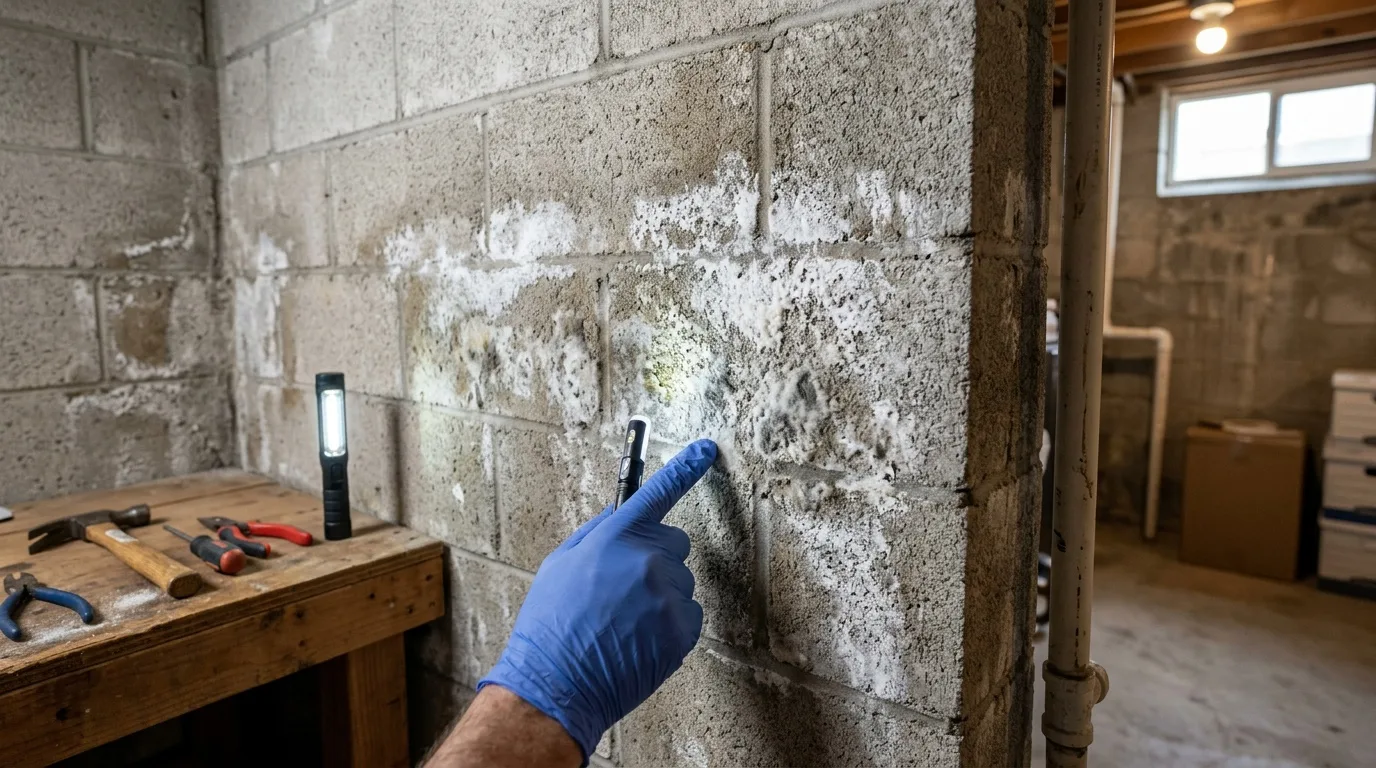
White patches on basement walls are a common sight in Escondido homes, especially after the rainy season or during periods of high groundwater. Many homeowners confuse these deposits with mold and try to fight the problem with antifungal treatments. But the white substance is not always mold — it can also be efflorescence, a fundamentally different phenomenon that requires a completely different approach.
What Is Efflorescence and How Does It Appear?
Efflorescence looks like mold at first glance, but only at first glance. On closer inspection you will notice the mineral nature of the deposits by the following signs:
- The coating is usually white or dirty-white with a fairly hard structure.
- The spots are raised, textured, and tend to grow larger and flake off.
- They often resemble dry flakes and consist of solid particles — crystals.
To complete the investigation and make sure it is not mold, put on a glove and rub a few flakes between your fingers — they crumble easily into powder and dissolve well in water. Owners of homes in nearby San Marcos can run the same flake test.
These patches have a mineral origin, not a fungal one. They appear because mineral salts are added to construction materials — sand, cement, plaster mixes — during manufacturing. Their elevated concentration is what later becomes the main cause of efflorescence.
The primary reason efflorescence shows up in basements is the influence of moisture carrying dissolved minerals. In a basement this is mostly groundwater, which, no matter how carefully the walls were waterproofed, still penetrates and saturates the concrete. The problem gets worse in fall and spring when groundwater levels rise. Salts remain on the surface after moisture evaporates, forming a white coating. Beyond the minerals from groundwater, concrete itself contains insoluble salts that migrate to the surface as water evaporates.
What Is White Mold?
White mold is a fungus that in its early stages looks like a faint whitish film, similar to cobweb or fuzz. Over time it can grow denser, turn grayish, or even black. Unlike salt or efflorescence, mold is alive: it grows, reproduces, and releases spores into the air.
Two types of growth appear on concrete surfaces:
- White coating — sometimes the result of concrete reacting with water, where minerals settle on the surface (efflorescence) and have a fibrous structure.
- Colored mold (brown, green, black) — organic microorganisms that resemble moss; spores travel easily through the air.
Concrete is a porous material, and moisture penetrates through its voids. Mold develops when three factors converge: high humidity, organic residue, and elevated temperature.
How to Tell Efflorescence from Mold
Here are straightforward indicators:
- Touch: Salt is dry and crystalline — you can wipe it off with a finger and it will not come back. Mold is soft, sometimes slightly damp, and if you simply wipe it away it quickly reappears in the same spots.
- Smell: Mold almost always gives off a musty, "damp" odor. Salt has no smell.
- Reaction to water: Efflorescence dissolves in water; mold does not.
- Where it appears: Efflorescence only forms on stone, brick, or concrete surfaces. Mold can grow on virtually anything — wood, fabric, paper, soil in a flower pot, food.
Is White Mold Dangerous?
Yes. Although white mold looks less threatening than black mold, it can trigger allergies, eye and skin irritation, coughing, nasal congestion, and headaches. Children, elderly people, asthmatics, and anyone with a weakened immune system are particularly sensitive to it.
Any mold in a living space is considered potentially harmful because it releases allergens and other substances that can affect health. Mold also threatens structural integrity — it weakens concrete, creates structural damage, and can eventually make a building unsafe.
Are Efflorescence Deposits Harmful?
Efflorescence at first glance seems like nothing more than an aesthetic nuisance. But over time it can lead to deterioration of the concrete surface. More importantly, it signals the same underlying conditions — elevated humidity, poor ventilation, water intrusion — that also create a favorable environment for actual mold growth. The "salt deposits" on your walls are, in effect, an early warning that the basement microclimate needs attention.
Common Mistakes When Removing Deposits
Homeowners often make things worse by choosing the wrong method:
- Scraping mechanically with a blade — damages the surface without addressing the cause.
- Washing with high-pressure water — increases moisture inside the wall, which can draw even more salts to the surface or feed mold growth.
- Painting over without antiseptic treatment — the fungus continues to spread under the paint.
- Using vinegar on concrete — it can corrode sealant and the concrete itself.
- Applying antifungal agents to efflorescence — mineral salts have nothing in common with household fungus, and the methods of dealing with them are completely different.
How to Remove Efflorescence
Start by eliminating the root causes — ensure dryness, adequate air circulation, and a stable temperature in the basement. The same root-cause approach guides mold remediation in Rancho Bernardo as well.
For the deposits themselves, plain warm water and a stiff-bristle brush often work. Salt crystals dissolve readily, so you do not necessarily need cleaning chemicals. Scrub from the edges of the spot toward its center. Keep in mind that overly aggressive scrubbing can remove the crystals but also damage the wall finish.
If the salt content in the building materials was high, stains will keep reappearing after regular washing. In that case, treat the cleaned surface with a specialized water-repellent sealer (hydrophobic impregnation). This treatment nearly eliminates the material's ability to draw water through capillary action and, therefore, to bring salts to the surface.
How to Remove Mold from Concrete Walls
The correct sequence of steps:
- Preparation — dry the area thoroughly (a construction heat gun or dehumidifier works), clean off dirt, but do not touch the mold itself yet.
- Remove belongings from the room or isolate them with plastic sheeting.
- Treatment — apply a chlorine-based bleach solution with a brush or roller, let it soak in, then rinse under pressure with clean water.
- Sealing — once the concrete is completely dry, apply an acrylic sealant rated for exterior use to close the pores.
On smooth, non-porous surfaces like tile, glass, or metal, household antiseptics, hydrogen peroxide, or baking soda may suffice. On porous materials — wood, plaster, drywall, fabric — mold often penetrates deep inside, and full replacement of the material may be necessary.
Preventing Both Problems
Whether you are dealing with efflorescence or mold, the prevention steps overlap:
- Fix any sources of moisture: leaks, condensation, poor drainage around the foundation.
- Ensure proper ventilation in the basement — stagnant air accelerates both salt migration and mold colonization.
- Maintain a consistent temperature; wide temperature swings encourage condensation on cold walls.
- After cleaning, apply a hydrophobic coating to concrete and masonry surfaces to limit capillary water movement.
If white deposits keep returning despite your efforts, the underlying moisture problem has not been resolved. In Escondido's climate — warm, dry summers followed by occasional heavy winter rains — basements can experience sharp swings in soil moisture. A persistent efflorescence or mold problem usually points to inadequate exterior waterproofing or drainage that needs professional evaluation.
White deposits that keep coming back mean water is still getting through the walls — a job for mold remediation in Escondido, with mold remediation in Ramona covering homes to the east. Escondido also has its own local site with their mold remediation service.