

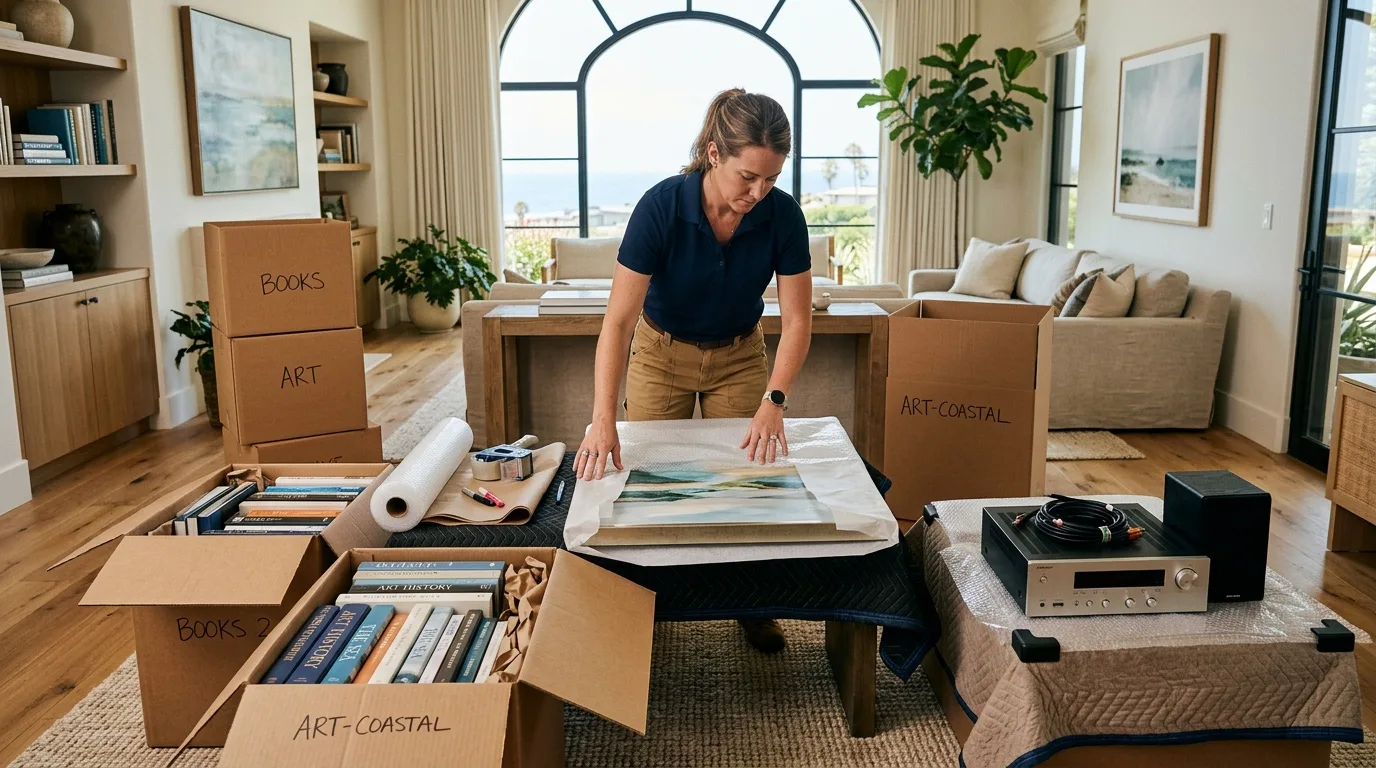
Books deserve a careful move too
Despite the rise of tablets and e-readers, physical books remain an important part of many Del Mar households. Reading is still a favorite pastime, and over the years a family can accumulate a library of impressive size. What do you do with all that weight when it is time to relocate? The question is perfectly practical: printed volumes are heavy, fragile in their own way, and surprisingly easy to damage in transit.
Moving a home library takes real preparation. You cannot just toss books into garbage bags and hope for the best. After that kind of transport there is a genuine risk of ruined spines, torn pages, or volumes lost in the chaos. Books are not an everyday necessity, so try to deal with them well ahead of moving day. If you find borrowed copies on your shelves, return them to their owners. If you spot titles nobody reads anymore, donate them — lighten the load. And if any volumes are in rough shape, repair torn covers and loose bindings before packing. It raises the odds they arrive in decent condition.
Sort first, pack second
For convenience, sort your library before you touch a single box:
- Set rare or antique editions aside — they need special handling.
- Group multi-volume sets together so they travel in the same container.
- Sort the remaining books by size.
Once the library is classified this way, it is time to pack the resulting stacks. The preparation takes a fair amount of effort and time, which is one reason many Del Mar homeowners hire professional movers for the job. A crew of experienced workers can handle the whole sequence — sorting, wrapping, loading, and shelving on the other end — quickly and without fuss.
Wrapping and boxing: what works for a library
Printed editions are delicate cargo. Books are afraid of moisture, easy to crumple or stain, and their bindings can crack. Transporting a home library without proper packaging is not advisable. Simply tying stacks with twine is not enough either — in the back of a truck the bundles will rub against other belongings, which often leads to scuffed covers or crumpled pages.
Take the question of packaging seriously. Stock up on the following materials:
- Cardboard boxes (small to medium — books are heavy)
- Twine or cord
- Newspapers
- Bubble wrap and stretch film
- Packing tape
Before you start wrapping, clean every volume — wipe the dust off covers with a dry, soft cloth. Then tie sorted stacks of books with cord, wrap them in plastic film, and place them into boxes. An important rule: do not stand books on edge, because in that position they tend to warp. Fill empty space inside each box with crumpled newspaper or cloth. Do not build oversized stacks — keep the weight manageable so you can carry a box down a flight of stairs without straining. Seal each box with tape and label it "books."
Packing rare or antique editions is a bit different. Wrap each book individually in bubble wrap and place sheets of stiff cardboard between them. In that kind of shell, the literature arrives in perfect shape. The air-filled bubbles resist moisture, cushion vibrations on the road, and maintain a more stable temperature, while the cardboard adds rigidity to the whole package.
Getting the boxes to the truck
You can move books in any vehicle — it depends on the size of the collection. A few boxes fit easily in a car trunk or back seat. But more often, printed matter travels together with the rest of the household in a moving truck. When loading boxes of books into the cargo area, do not stack too many on top of each other — the weight can crush the contents below. For the same reason, never place heavy objects on top of book boxes.
One more thing: try to schedule your move on a dry day. Even well-wrapped books do not benefit from extra moisture. If it is raining, carry the boxes straight from the door into the truck without leaving them on the sidewalk. Moves out of homes in Solana Beach call for the same dry-day timing.
How professionals pack artwork and framed pieces
Paintings and framed prints serve many purposes in a Del Mar home — from wall decoration to genuine works of art. The price range runs from inexpensive reproductions to original pieces by recognized artists. To preserve their condition during a move, these items must be packed correctly.
Artwork is fragile. It can suffer from rain, mechanical impact, and even the wrong humidity level. Air that is too dry may cause a canvas to shrink and crack, while high humidity encourages mold. During transport, when pieces are exposed to changing conditions, this matters more than usual.
Soft packaging materials
- Plastic film — shields against dirt and dust, though it can trap condensation; acceptable for short trips.
- Acid-free tissue paper — a cotton-based specialty paper resistant to temperature swings, ideal for fine art.
- Bubble wrap — excellent shock absorption, but can also create condensation on long hauls.
- Cardboard sheets — useful as a secondary layer, not a primary one.
- Foam corners and inserts — fill voids and soften edges.
Rigid protection
- Wooden or plywood crates — the most reliable option, providing thorough protection.
- Cardboard boxes — practical and easy to handle for standard frames.
- Tubes — lightweight and strong, good for rolled canvases.
Each painting should be wrapped individually. Avoid using regular adhesive tape directly on surfaces — it can leave marks that are difficult to remove.
Key rules for art in transit
If a canvas can be removed from the frame, roll it with the painted side facing out, wrap it in paper, and slide it into a tube. Handle gently. When rolling is not an option, use a fitted crate and always hold the piece by the stretcher bars, not the canvas itself. Protect both the canvas and the frame from dirt and temperature swings.
Transport framed pieces upright, using protective corner guards. Secure them inside the vehicle with straps so nothing shifts during the drive. For valuable or antique art, consider insuring the shipment.
Move artwork in dry weather when possible. In cold months, do not hang paintings on the wall right after delivery — give them time to adjust to indoor temperature. Paint can crack from a sudden change. Framed pieces from homes in nearby La Jolla need the same handling.
Packing electronics and appliances the right way
Packing household electronics is what guarantees your expensive equipment survives the trip. Start preparing a day or two before the movers arrive. The process involves several steps:
- Wipe down every device inside and out after disconnecting it from power.
- Wait until each item is completely dry.
- Carefully remove all detachable parts — trays, shelves, drawers, cables.
- Wrap each removed part in bubble wrap and secure with tape.
- Tape doors and lids shut, pressing them firmly against the body of the appliance.
- Protect corners and edges with strips of corrugated cardboard to absorb impact.
- Wrap the entire body several times in bubble wrap and fix with tape.
- Add an outer layer of cardboard or packing paper.
- Mark "top" and "bottom" on each package with a marker.
Place packed electronics near the front door so the loading crew can reach them easily.
The right materials make the difference
The ideal scenario is transporting devices in their original factory boxes, complete with the shaped foam inserts designed to hold them in place. If you no longer have those boxes, gather these supplies:
- Large sheets of corrugated cardboard
- Wide, heavy-duty packing tape
- Plenty of bubble wrap
- Polypropylene or jute cord
- Stretch film
- Thick packing paper
- A permanent marker
Loading and securing
Most electronics and appliances must travel upright — never on their side. Laying them flat can damage internal circuitry, break mechanical parts, bend door hinges, or cause coolant to leak in refrigerators. When loading into a truck or SUV:
- Lay a blanket or pad on the floor of the cargo area.
- Stand the appliance close to the wall of the vehicle.
- Strap it down with automotive tie-downs or ratchet straps.
- Drive at a moderate speed and choose the smoothest route you can.
After delivery, set each device in its new spot but do not plug it in right away. Let it stand for several hours so internal components settle — especially important for refrigerators, where the coolant needs time to redistribute after being jostled on the road.
A few final notes for Del Mar homeowners
Whether you are moving across town or relocating from another part of San Diego County, the same principles apply. Books go in small, sturdy boxes. Art travels upright, individually wrapped, with rigid protection where the budget allows. Electronics stay vertical, cushioned on every side, and get a rest period before you power them on.
Professional pack-out crews handle these categories daily. They bring the right materials, know the techniques, and can work through a whole household in a fraction of the time it takes to do it yourself. If your collection of books, framed pieces, or high-end electronics is large enough to worry about, hiring specialists is the practical choice.
If your books, art or electronics were caught in a leak rather than a move, see water damage restoration in Del Mar; our crew packs out libraries and art collections for homes in Carmel Valley too. Del Mar readers can also visit waterdamagerepairdelmar.com.