

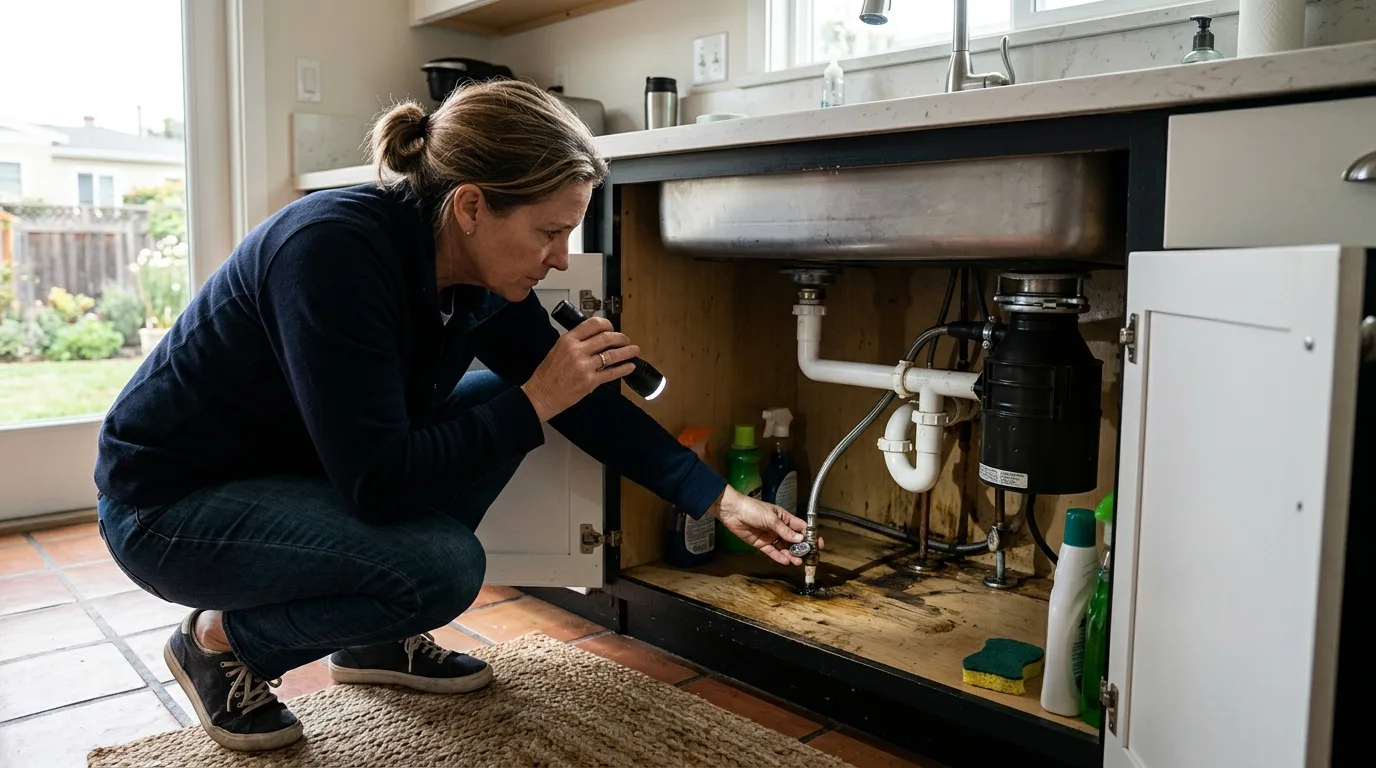
Signals most people overlook
The early stage of water damage is almost invisible. Around the sink area, the edge of the countertop may start peeling — especially if it is made of particleboard or MDF without sealed edges. The trim loses its shape, turns rough, develops tiny blisters. This is evidence that moisture has seeped inside and triggered a deformation process.
Another warning sign is a change in how the room smells. Damp materials, particularly enclosed sections with no airflow, begin to give off a musty odor. If the kitchen regularly carries a damp or faintly sweet-rotten smell, that alone is reason enough to inspect the cabinets and walls for water intrusion.
Stains on walls behind the cabinets and on the ceiling are yet another cause for concern — particularly if a bathroom sits above the kitchen. The stain may be barely noticeable at first, with a blurred outline, but over time it darkens and spreads. A signal like this should not be ignored even if, from the plumbing side, everything in the house appears fine.
How materials change when they stay in contact with moisture
Every material reacts to water in its own way. A laminated countertop starts to swell at the edges, especially at seams. MDF cabinet fronts can warp, causing doors to stop closing flush. Solid wood first swells, but if the contact continues, cracks and delamination follow. Even stone and porcelain tile lose their luster under prolonged moisture exposure, and mold can appear between the tiles on the backsplash.
Cabinet toe-kicks and the rear panels of base cabinets are among the most vulnerable zones. Moisture can pool behind them for weeks. This is especially relevant with built-in appliances — dishwashers, garbage disposals — where water can escape through hoses or gaskets. In most cases, budget-grade cabinetry suffers first, but even sturdier, higher-end kitchens still need regular inspection and upkeep. The same weak spots matter for kitchen leaks in Coronado homes.
Slow leaks often announce themselves through small failures that seem unrelated: the back panel of a pull-out drawer has gone soft, a cabinet leg has started to wobble, a door squeaks even though the hinges are fine. All of these are the result of the structure losing its geometry because of excess moisture.
When you need to act right away
If moisture appears on the floor along the baseboard, it may be a sign of a leak inside the wall or under the sink. Even without a visible puddle, small pockets of water beneath vinyl flooring or tile break down the adhesive layer and warp the subfloor. Another threat is mold growing inside the cabinets. If black specks or a whitish film appear at joints or in corners — especially where you store pots and cleaning supplies — the situation calls for immediate action.
Some homeowners in Point Loma dismiss creaking floors or sagging cabinets as normal wear and tear. But if the changes happen fast, and a kitchen that was installed not long ago starts to shift and settle, the real cause may be deep structural damage to the subfloor from prolonged moisture exposure.
To avoid critical consequences, it is important to check high-risk areas on a regular basis: the zone under the sink, around the dishwasher, behind the backs of base cabinets. Even minor dampness, given enough time, will lead to damage that can no longer be fixed without replacing entire components. Older homes in nearby Ocean Beach deserve the same routine checks.
Why the kitchen sink starts to smell
The main culprit is usually the trap — the curved pipe section under the sink. Before trying to fix anything, it is worth understanding the actual cause. The most common sources of a musty smell under the sink are:
- A clogged trap. It is the first element that catches food scraps, grease, and debris. Over time, a thick layer of decomposing residue builds up inside. The fix: disassemble and clean or replace the trap.
- Infrequent use of the sink. The water seal inside the trap evaporates, and sewer gases rise freely into the room. The water seal is supposed to block gases, insects, and odors.
- Incorrect trap assembly. Even a small mistake during installation can prevent the water seal from forming properly.
- An air lock in the drain stack. This is usually accompanied by slow drainage and a gurgling sound when water goes down.
- Poor sealing between the stack and the corrugated pipe, caused by a diameter mismatch.
- Sagging of the corrugated drain hose — this leads to water pooling in the wrong spot, or to a complete loss of the water seal.
The overflow hole — a source people forget about
The smell can also come from the small opening on the side of the basin. This happens due to:
- Incorrect installation of the overflow tube
- Improper connection to the sink drain
- Stagnant water sitting inside the tube
The fix is straightforward: pour a small amount of chemical drain cleaner directly into the overflow opening and let it sit.
What those sewer gases actually contain
Decomposing matter in the trap releases gases that are not just unpleasant but genuinely harmful. The mixture typically includes methane (60–68 percent), carbon dioxide (30–35 percent), and hydrogen sulfide along with traces of ammonia (up to 2 percent). Hydrogen sulfide is especially dangerous — it is the compound behind the rotten-egg smell. Even at low concentrations, prolonged exposure causes headaches, dizziness, and can affect the nervous and respiratory systems.
How to find the leak yourself
Wipe the trap and all its joints with a dry cloth. Remove any condensation, grime, and water that has already dripped. Then place a basin or a shallow pan under the trap and turn on the faucet — use strong pressure so there is plenty of water moving through. This way, any leak at a fitting or a crack in the body of the trap becomes visible almost immediately.
Beyond the trap, check the supply lines coming to the faucet and the drain tailpiece. In most cases, a kitchen leak originates from one of three places: the drain pipe, the supply hoses, or the trap itself. Cracked bodies, torn corrugated hose, warped gaskets, heavy buildup inside, or a simple installation error — any of these can be the root cause.
Simple ways to clear a mild clog
If the musty smell is coming from organic buildup rather than a structural leak, a few household methods can help before you call a plumber.
Baking soda
Dissolve about five ounces in two cups of boiling water and pour it down the drain. Let it sit for 30 to 40 minutes, then flush with hot water.
Baking soda and vinegar
Pour three to four tablespoons of baking soda into the drain, follow with a cup of heated vinegar. Plug the drain opening, wait 10 to 30 minutes, then rinse with hot water.
Coarse salt
A cup of coarse salt dissolved in about half a gallon of boiling water. Pour it in, leave it for six to eight hours (overnight works well), then flush.
Citric acid
About four tablespoons into the drain, add boiling water, plug the opening for 30 minutes, then rinse.
These methods deal with minor buildup. For serious blockages, a plumber's snake or a commercial drain cleaner may be necessary — just follow the product label and wear gloves.
Preventing the problem from coming back
Point Loma kitchens, like kitchens everywhere, benefit from a few low-effort habits:
- Install a mesh strainer over the drain opening to catch food particles.
- Use a disassemblable trap — it is easier to clean on a regular schedule.
- Scrape plates before washing so less grease and debris enters the drain.
- Once a month, run one of the cleaning methods listed above as maintenance.
- If you plan to leave the house for more than a couple of weeks, pour a thin layer of vegetable oil into the drain to slow evaporation of the water seal.
- Check under the sink every few weeks: look for dampness on the cabinet floor, soft spots on the back panel, and any discoloration around pipe joints.
A musty smell under the kitchen sink is not something to mask with air freshener. It is almost always a symptom — either a slow leak that is quietly destroying the cabinet, or decomposing residue in the drain that is releasing gases you should not be breathing. In both cases, finding the source early and dealing with it saves the cabinet, the subfloor, and a much larger repair bill down the line.
If a slow leak has already softened the cabinet floor or the wall behind it, water damage restoration in Point Loma is the next step. Elsewhere in the city, we handle water damage in San Diego homes as well.