

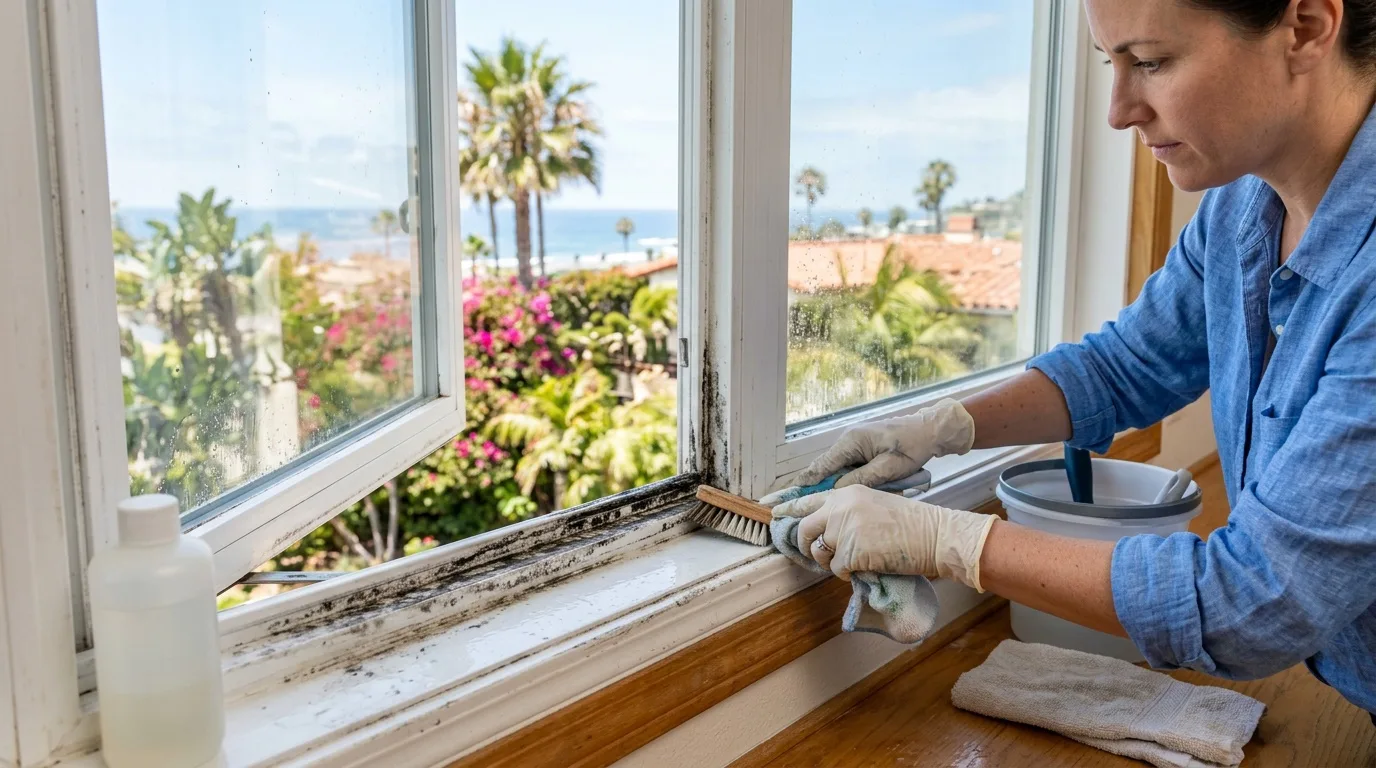
Why Mold Appears on Window Slopes, Seals, and Sills
Due to the high airtightness of modern vinyl windows, mold frequently appears on frames, slopes, and rubber seals. It thrives in greenhouse-like conditions — when elevated humidity and insufficient air exchange combine with a comfortable temperature range. Mold most often settles on window sills, slopes, near the upper corners of the opening, and on the walls surrounding it.
The main reasons behind mold growth on windows come down to several groups.
Installation and Design Errors
Causes linked to the original installation include an improperly sized window, defects and misalignment during mounting, low-quality materials and profiles, accelerated wear of window system components, and an incorrectly chosen sill width or material. Poorly sealed mounting joints let air through and swell from moisture, creating favorable conditions for fungal colonies right inside the wall gap.
Usage Mistakes
One of the leading reasons mold appears on vinyl windows is improper day-to-day use. The most common mistakes are insufficient ventilation (the room should be aired out at least two to three times a day), disrupted temperature conditions, incorrect air-conditioning settings, and a window system that was not matched to the climate. In Del Mar, where coastal humidity is a constant factor, skipping regular ventilation is enough to trigger condensation on glass and frames.
Other Contributing Factors
In a newly built home, walls need three to four months to dry out fully, and during this period the risk of mold is especially high. Climate characteristics of regions with naturally elevated humidity play a role, as do household sources of moisture — cooking, laundry, floor washing, and plant watering. Homes in nearby Solana Beach sit in the same humid coastal band. The location within the building matters too: ground-floor and below-grade units are more vulnerable.
What Makes Window Mold Dangerous
There are more than 200,000 known species of mold fungi in the world. The most hazardous to people is black mold — a multicellular microorganism that releases toxins. Under favorable conditions, colonies expand rapidly and spread to new surfaces, showing up as dark spots.
This is not merely an aesthetic problem. The microorganisms have a genuine negative effect on health and can cause or worsen:
- Respiratory conditions — bronchitis, pneumonia, asthma
- Allergic reactions
- Irritation of the skin and mucous membranes
- Nervous system disorders
- Weakened immune response
- Gastrointestinal issues
- Sleep disturbances and reduced ability to work
Even a small patch of mold can be harmful because it constantly releases toxins into the air. The fungus reproduces most actively at elevated air humidity and temperatures around 59 °F. The situation is especially alarming when mold appears on the slopes of the window opening — near windows there are drafts and air currents that, combined with humidity, lead to condensation. Mold below the sill multiplies faster due to stagnant air and temperature swings caused by the radiator heating one side while cold air enters from outside.
How to Remove Mold from Window Frames and Rubber Seals
If the problem appeared relatively recently, the rubber seals can be treated with fungicidal agents. When the damage is severe, the seals need to be replaced by a specialist. Mold rarely settles directly on the rubber gasket first — more likely, the primary source is somewhere else in the room, and spores migrate to the seal.
Colonies can be destroyed using several types of chemical preparations:
- Fungicides — specialized chemical formulas designed to kill microorganisms. Products with a prolonged action protect surfaces from reinfection for up to five years.
- Chlorinated lime (bleach). Dissolved in water and applied to the affected area, it kills the microorganisms quickly.
- Sodium perchlorate. This solution is applied only to dense, non-porous materials; cellular or porous surfaces break down under its action.
Natural antiseptics also work: tea tree oil or grapefruit seed extract. Dissolve one tablespoon of oil in about seven ounces of clean water and apply to the affected spot. There is no need to rinse it off — the solution continues working as a preventive barrier.
Household remedies that may already be in the kitchen or medicine cabinet — table vinegar, citric acid, copper sulfate, or rubbing alcohol — can be used as well, mainly as diluted solutions. However, hydrogen peroxide, ammonia, vinegar, and baking soda are not very effective on their own and should not be relied on in severe cases.
Removing Mold from Window Slopes
The material covering the slopes heavily determines the right approach. If the slopes are finished with plastic panels, the procedure looks like this:
- Disassemble the slope cladding carefully and remove the panels.
- Clean the surface underneath using mechanical scraping — visible colonies are scraped off with a stiff brush or knife, and all residue is collected and removed.
- Seal any cracks, gaps, and voids thoroughly with silicone sealant or expanding foam. Once cured, trim the excess flush with the surface.
- Apply a fungicidal agent to the entire cleaned area. For small patches, household products work: diluted bleach, vinegar, ammonia, borax, or citric acid. For larger infestations, use specialized fungicides with a prolonged effect — they contain metal ions that provide lasting antifungal and antibacterial protection.
- Allow the surface to dry completely — from two to seven days depending on ambient humidity.
- Reinstall the slope panels. The old finishing materials — plaster, wallpaper — cannot be reused.
If the slopes are lined with drywall (gypsum board), the situation is worse: infected drywall must be fully removed, the wall behind it disinfected comprehensively, and new panels mounted. Vinyl (PVC) panels are preferable here because they resist moisture better and are simpler to treat.
Sometimes a single treatment is not enough, so the fungicide is applied two or three times at intervals of one to two days. All work should be done wearing gloves, a respirator, and eye protection — both the mold itself and the chemicals pose health risks. The same routine applies to window mold in La Jolla homes along the coast.
Dealing with Mounting Seams
Improperly finished mounting seams let air through and absorb moisture. To fix this, inspect the seams around the entire perimeter, scrape away the upper layer of finishing material with a stiff brush, treat the seams with a fungicidal solution, replace the sealant (silicone, acrylic compound, or spray foam), and redo the decorative finish. In severe cases it may be necessary to replace the sill entirely.
Prevention: Keeping Mold from Coming Back
It is far better to prevent mold outbreaks than to fight established colonies afterward. Preventive steps that Del Mar homeowners should pay attention to:
- Regular ventilation. Air rooms out at least two to three times daily. Use the micro-ventilation setting on the window hardware or install a supply-air ventilation valve in the frame.
- Supply ventilation. A trickle vent or micro-gap airing device provides a constant stream of fresh air and keeps humidity down.
- Fix drafts and seal defects. Inspect mounting joints, re-caulk where needed.
- Stable heating. Maintain a consistent indoor temperature; avoid turning the heat off completely overnight.
- Replace window seals on schedule. Rubber gaskets should be replaced every five to seven years even if they look intact.
- Lower humidity. Use desiccant packs (silica gel), a standalone dehumidifier, or the HVAC system's dry mode.
- Manage moisture sources. Run the kitchen exhaust while cooking, vent the bathroom during and after showers, and avoid drying laundry indoors near windows.
- Sill ventilation. If a wide sill blocks the warm air rising from a radiator, install a ventilation grille in the sill above the heat source so warm air can reach the glass.
- Adjust hardware pressure. Tighten the locking mechanisms seasonally — looser in summer, tighter in winter — to control how much air seeps through the seal.
- Periodic wipe-downs. Treat the sill, seals, and frame with a mild antifungal solution once or twice a season as a preventive measure.
If mold is just starting to appear, it is far easier to address at this early stage. The core principle is to eliminate the underlying moisture source rather than simply bleaching the visible stain — otherwise the colonies return within weeks.
Seals that blacken again within weeks usually point to a damp wall behind the frame, the kind of job handled by mold remediation in Del Mar, with mold remediation in Carmel Valley just inland. A dedicated Del Mar site covers the same work from the service side: their mold remediation service.