

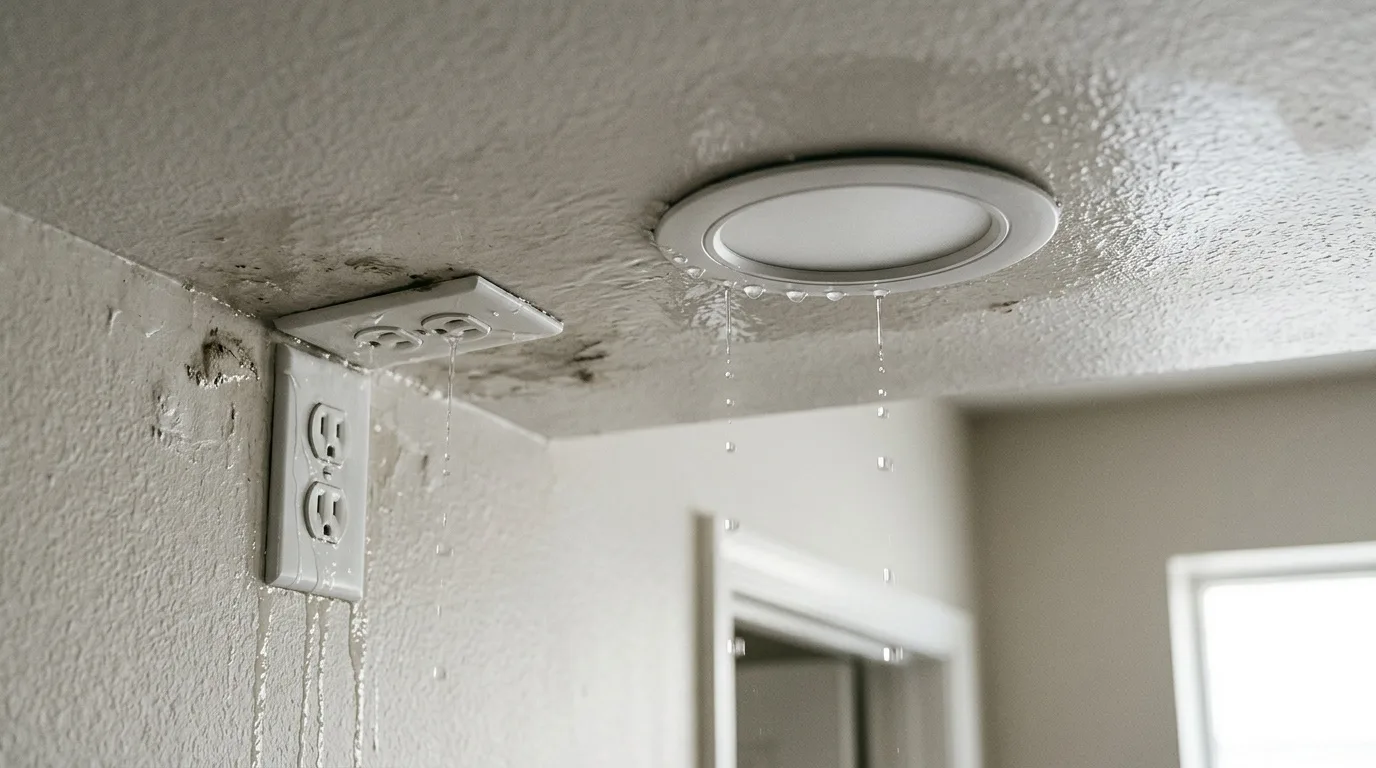
Why water finds the light fixture
A strong leak from pipes, plumbing fixtures or a roof becomes a problem not only for the owners of the home where it starts, but also for the people who live below. Water that gets into a ceiling comes out wherever there is an opening, and the openings in a ceiling are the holes cut for the light fixtures. That is why water leaking from a ceiling light is often the first sign of a leak above, before any stain shows up.
Keep in mind that the leak may not be in the room directly above yours, but off to the side. If the floor between units has cavities, or the floor is slightly out of level, the water will not run straight down but sideways.
With a light leak it is not always clear whether there is water at all. These signs should put you on alert:
- Drops of water appear on the ceiling.
- If the ceiling has many lights, it starts dripping where they are installed.
- You notice streaks or bulges on the ceiling.
The first minutes: power first
Do not touch electrical equipment if it is wet or if you are standing in water. Turn off the electricity only if it is safe to do so.
That is the core of the Ready.gov flood safety guidance from FEMA, and it applies to water in a light fixture as much as to a flooded room.
Switch off the circuit or the main breaker from a dry spot
First, cut power to the room as soon as you see drips, streaks, wallpaper or paint soaking and peeling, or hear hissing or gurgling. This has to be done as fast as possible so that moisture in the wiring does not cause a short circuit.
If you can reach the electrical panel, flip the right breakers with dry hands from a dry spot. If only a little water got to one outlet or light, you do not have to cut power to the whole home; switching off the breaker for that circuit is enough. If you do not know which breaker feeds it, you will have to shut off the whole home at the main breaker. Otherwise there is a risk of a deadly shock. If it is unclear what needs to be done, it is better to call an electrician, and until then do not touch plugged-in appliances or outlets, and certainly do not use appliances or lights.
Cutting the power is recommended even if the water is running far from the wiring. Wet materials conduct well. This way you protect yourself and your family from a shock and prevent a possible short circuit and a wiring fire.
Do not touch the switch or the fixture
Even with the power off, never touch wet devices or wires, and never touch electrical devices and wires with wet hands, because that can also cause a shock.
Water in an electrical outlet
It happens that liquid gets into an outlet or a power strip. The reasons vary, from a flood caused by the neighbors to a spilled cup of tea. Water and electricity are a dangerous combination, so you need to know how to act. With a power strip, do not pull it out of a wet outlet: switch off the breaker first. If water from the outlet has reached the floor, take small children and pets away to keep them safe. Water conducts current very well, and household voltage is enough to cause an electrical injury.
Catch the water
Put out buckets, basins, pots and jars so the drips and streams collect in containers. Watch that they do not overflow.
Move everything you can so water does not pour onto it. Paper gets soaked, electronics fail, wood swells and warps. Cover floors, as well as furniture and large appliances that cannot be moved, with plastic sheeting, for example cut-open trash bags. Wipe up puddles with mops and towels. If the water is on laminate or hardwood, this keeps the boards from soaking up moisture and buckling. It also protects the neighbors below. When a room has to be emptied fast, there is packing out and storing belongings.
Stop the source above
Only after the power is off should you start looking for the source of the leak. Go upstairs and tell the neighbors what happened. If the cause is in their unit, they can stop the leak on their own. It is enough to shut off the water in the unit above.
Condo or apartment: the unit above and the manager
Try to work out where the water is coming from: from the neighbors or from a shared building pipe. Go up a floor, find out whether the residents know about the problem, and try to shut off the water together if that is within your power.
If nobody answers upstairs, call the HOA's management company or the building's emergency line; they can shut off the water to that unit or to the shared line.
Warn the neighbors below about the leak as well. If water keeps coming, over time it will seep through to them. When the home is rented, the landlord also needs to know what is going on.
Take photos and video of everything. Show the whole room where the leak happened as well as the individual wet spots and bulges. Shoot all the damage and soaked items up close.
Brown water in the light fixture
Brown or dirty water can mean the leak is in a drain line rather than a supply line. Drain lines cannot be shut off. In that case you have to go around to the neighbors and ask them to stop using water for a while so the problem does not get worse. The rest stays the same: the circuit stays off, and nobody touches the fixture.
Why an electrician checks fixtures, switches and boxes before power returns
Working with electricity takes special skills, knowledge and experience, so if you are not a professional electrician, you should call a licensed electrician.
A fairly common result of a leak from above is faulty wiring, because in a large leak the electrical wiring is usually what suffers. That is why every checklist puts the same thing first: cut the power to the flooded room as fast as possible. First, this is required for the safety of the people inside. Second, it helps keep the wiring and electrical equipment in normal condition.
Do not use flooded outlets or power strips until an electrician has looked at them. Even if it seems to you that the device has dried enough, or a lot of time has passed since the leak, do not do it, because the water could have caused damage or may still be inside. Only after an electrician has inspected and approved it can you use the outlet again.
Turning the power back on is not recommended until the room has fully dried and the electrician has cleared it. After it has fully dried, a full check of all the wiring is also recommended. But situations differ. The owner may be away during the leak and not get to take the first steps, and then sparking wires, dead light fixtures and outlets can become a source of danger to the people around them.
Can water in a light fixture cause a fire? A short circuit remains a common cause of fires. It happens when wire insulation is damaged or live parts touch. The cause can be worn cable, moisture getting in, mechanical damage or mistakes during installation. Modern breakers can cut power quickly, but only if they are sized correctly and in working order. After a serious leak, the condition of the wiring has to be checked.
Drying the ceiling cavity
Water should be removed even if there is only a little of it. Then the ceiling has to be dried thoroughly. Otherwise mold will appear behind it. Drying a ceiling cavity properly usually takes professional equipment. If spots or a musty smell turn up later, see mold remediation after a water leak.
Ask the electrician when a removed fixture can go back in place and when the light can be used again.
Just dry the room so mold does not appear. If you need professionals for that, keep the receipts. Hold on to the paperwork for the electrician who checked the wiring and for any appliance repairs. Two of our earlier posts go further: checking for hidden moisture after a plumbing failure and repairing water stains on ceilings and walls.
Later warning signs: buzzing, a burning smell, a breaker that trips
Wiring does not need attention every day, so many people only remember it when a breaker trips, it starts to smell of burnt insulation, or an outlet stops working. Yet most serious failures do not happen suddenly. They are preceded by quite noticeable signs. If you ignore them, at worst you may face an expensive repair or even a fire.
Over time, wire insulation ages, loses flexibility and starts to break down. This happens especially fast with constant overheating, high humidity or mechanical damage. Signs of trouble can include:
- a smell of melting plastic;
- sparking at outlets;
- walls heating up near a cable;
- breakers that shut off from time to time.
Many fires start with small things: an old extension cord, a loose outlet or a cheap adapter. Over time the contacts gradually loosen, sparking appears, heating increases. When a powerful appliance is plugged in, the risk goes up considerably.
Most serious electrical problems develop gradually. Sparking outlets, overheating wiring, a smell of burnt insulation or breakers that keep tripping are signals that cannot be ignored. A buzzing switch or fixture after a leak belongs on the same list.
Water from above in Imperial Beach homes
For apartments, the most typical cases are leaks from neighbors, plumbing failures, or condensation in rooms with high humidity. In houses, heavy rain, roof leaks and damaged outdoor wiring are added to that; see roof leaks and ceiling drips during heavy rain. Keep an eye on the roof and the gutters, and after a serious leak have the wiring checked.
Drying after the electrician has cleared the area is described on the pages about water damage restoration in Imperial Beach and water damage restoration across San Diego County. You can also learn about our restoration team.