

When the Smoke Comes From a Fire Miles Away
One morning people in Ramona, Poway and other parts of San Diego County start to notice the smell of something burning, see haze outside the window and find specks of ash on the windowsills. The cause is a wildfire that may be burning many miles away. The wind carries the smoke, and it can take days before it clears. If you smell wildfire smoke in your house, the question is the same for everyone: how to keep it out while the fire is burning, and how to get rid of the smell and the ash afterward.
The San Diego County Air District posts current smoke advisories on the Air District site, and it makes sense to check them before deciding when to open windows.
Keeping Smoke Out of the House During the Fire
The measures are basically the same for everyone: where possible, use air conditioners with an air filtration system and do not open the windows. The rooms can be aired out when the smoke visibly drops: for example, after rain has knocked the soot down and visibility has improved. Then you can air out the house, but do not forget to close the windows again afterward. After that, use fans if there is no air conditioner in the room.
If the house is close to the source of the smoke, in an area where the air becomes opaque, the advice is still the same: shut the windows and doors, wait for the wind to change (or for rain) and for the smoke to drop, and air out the room at that moment.
A house is not airtight. Wildfire smoke getting in the house is normal: dust and combustion products come into the rooms and settle on surfaces. So frequent damp cleaning helps, at least once a day while the smoke lasts. For more on how to prevent smoke from coming into your house when the source is close by, see our article on keeping neighbors' smoke out of your home.
Windows, Recirculation and the Air Conditioner
Can you turn on the air conditioner when there is smoke outside? You can. On one condition: the windows and doors must stay closed. With central air, set the system to recirculate and use the highest-efficiency filter it can take.
A regular household ductless mini-split does not take air for cooling from outside. The indoor unit works in a closed loop — it pulls air from the room, runs it through the heat exchanger and the filter, cools it and returns it to the same room. Outdoor air is not part of this cycle.
Only higher-end equipment with a forced fresh-air intake works differently (on the remote it is labeled fresh air intake). These models have a separate channel in the outdoor unit. While there is smoke, this option should be switched off by hand in the settings, and the system should run on recirculation.
The outdoor unit hangs right in the smoky air, and that is what worries owners most. Smoke does not get into the house through the outdoor unit itself: the refrigerant circuit is fully sealed and closed, it has no physical connection with the room air. The outdoor unit only exchanges heat with the outside air.
But the place where the refrigerant lines pass through the wall is a real weak spot. If that opening was sealed poorly at the time, or the foam has sagged over time, smoke smell and fine particles can, in theory, get in exactly there. This is a question of installation quality. Owners should look at where the lines enter the wall and seal it again if needed.
Running the air conditioner during smoke does not create a danger in itself, because the unit does not add anything from outside to the room. On the contrary, it removes the temptation to open a window when the house is stuffy. A safe setup looks like this:
- A sealed room: closed windows and doors, working seals.
- The fresh-air intake switched off, if the model has one.
- A clean filter, not one clogged with dust.
Do Air Purifiers Help With Wildfire Smoke?
The filter that comes with an air conditioner is a coarse filter, a mesh, sometimes with a layer of activated carbon. Its job is to hold back dust, pet hair, large particles and extend the life of the heat exchanger. PM2.5 and PM10 particles pass freely through the mesh. Smoke, soot and fine dust are not caught by such a filter.
Other solutions work against smoke:
- HEPA filters — they catch particles from 0.3 microns;
- a thick layer of activated carbon — it absorbs odors and gases.
These filters are not put in mini-splits but in household air purifiers, fresh-air ventilation units and heat recovery ventilators. An air conditioner and an air purifier are two different devices with different functions, and confusing them is one of the most common reasons people are disappointed.
A purifier pulls fine suspended particles out of the air, the ones that are combustion products. That is exactly what you see as a bluish haze. Such devices clean air in different ways, with water, with carbon cartridges, there are many types, but the idea is the same — draw air from the room and push clean air back out through filters.
Purifiers need constant care, cartridge replacement. If this is neglected, dust, bacteria and mold will collect inside the unit and can get into the air. In that case the device will do no good.
After the Fire: How to Get Wildfire Smoke Smell Out of the House
Smoke may clear quickly, but the acrid smell of burning is not so easy to get rid of. It soaks into walls, furniture and decor, clothes and other things. Upholstery, bedding, clothes, wallpaper all absorb it. So the sooner you start removing it, the better the chance of saving things and bringing fresh air back into the house.
Airing Out
A cross-draft helps air out the smell of smoke. Once the smoke advisory is lifted and the air outside is clean, open the windows and doors and keep them open longer.
Throw out what is ruined. Things that can be restored, put in a bag and take out to the patio or the yard for a while.
Washing Hard Surfaces
You will have to do a thorough damp cleaning. For this, use warm water with a little mild detergent. Wipe the floor, tables, chairs, cabinets, kitchen utensils and light fixtures with a cloth and this solution.
Fabrics and Clothes
Wash bedding, clothes, towels. Rugs can be sent to a professional rug cleaner. A separate guide covers getting smoke smell out of clothes in more detail.
Home Remedies for the Smell
- Baking soda — put a pinch into several bowls and just set them in the corners of the kitchen; this natural absorbent will soak up the unpleasant smell.
Ozone machines are also used against smoke odor, but they are a separate subject; our article on ventilation, ozone and cleaning advice covers it.
A New Filter
Filters must be cleaned after smoke, even though they do not catch smoke. Fine soot particles and dust still settle on their surface during airing out or when windows are opened by accident, and they also build up on the heat exchanger. A clogged filter worsens air circulation. Then an unpleasant smell appears while the unit is running. Replace the HVAC filter and wash the mesh filters of mini-split units:
- Turn off the air conditioner and switch off its power.
- Carefully open the front panel of the indoor unit and take out the mesh filters.
- Rinse the filters under warm running water, with a mild detergent if needed. Hot water deforms the mesh.
- Soak heavy dirt beforehand.
- Dry naturally in the shade: no direct sun and no hair dryer.
Ash Outdoors and Indoors
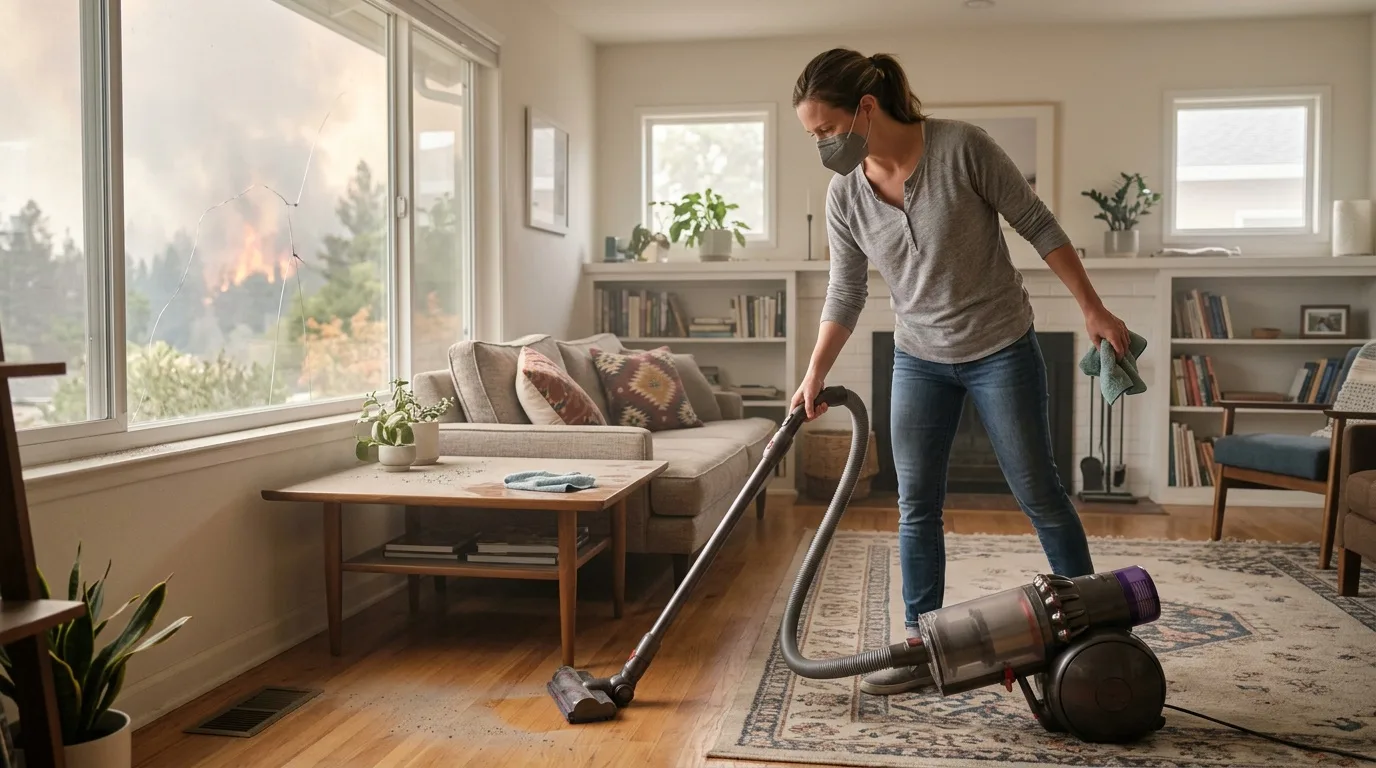
The EPA guidance on protecting yourself from ash is clear. Do not sweep ash dry, and never use a leaf blower. Mist it with as little water as possible, then wet-mop. Use a vacuum with a HEPA filter. Wear a NIOSH N95 or P100 respirator; surgical masks and one-strap masks do not protect.
People with heart or lung disease, older adults and pregnant women should not clean up ash, and children should stay away while it is being cleaned. Ash from burned buildings is more harmful than ash from burned forest.
Why the Smell Comes Back
Washing the filter is basic hygiene, not maintenance. The filter is only the first outer barrier of the system. Inside the unit there are parts you cannot reach without tools: the heat exchanger, the blower wheel, the drain system with its tube. Dust, grease, soot and microorganisms settle there.
A smell of burning after washing the filter can mean soot has settled on the heat exchanger inside the unit. Then you need professional cleaning by an HVAC technician, with the heat exchanger treated with a special product and, if needed, the drain system.
When It Is a Restoration Job
Wildfire smoke damage to a house is not always limited to a smell. If the smell is in the ducts, if ash got inside the house, if there is soot on walls and ceilings, home cleaning is not enough. Then it is a job for fire and smoke damage restoration. Local crews handle fire damage restoration in Ramona and fire damage restoration in Poway. When furniture, clothes and belongings have to be cleaned separately, they can be taken out with contents packout and cleaning services. You can read more about our restoration team on the company page.