

Do home mold test kits work?
A home mold test kit does what the box says: it catches mold spores and lets them grow. The trouble is that this rarely answers the question a homeowner actually has. Spores are part of ordinary indoor and outdoor air. A kit will almost always find some. What it cannot tell you is where the mold is growing, why it is growing there, or whether the amount in your house is a problem.
Public health agencies are fairly direct about this. The California Department of Public Health mold FAQ says it does not recommend store-bought surface or air sampling kits. If you can already see or smell mold, a test adds no useful health information. So before buying a kit, it helps to know what the different kinds actually measure.
What a kit actually shows
Most consumer kits fall into three groups.
Settle plates
This is the petri dish with a layer of growth medium. You open it, leave it in a room for a set time, close it and wait a few days. Whatever spores drift down onto the medium grow into colonies you can see. Some kits offer to send the dish to a lab to name the species.
Swabs and tape lifts
Here you wipe or press a suspicious spot and either culture the sample or mail it in. This can confirm that a stain is mold and not soot or dirt. It says nothing about the wall behind the stain or the room as a whole.
Air cassettes
Some kits come with a cassette that is meant to have air pulled through it by a pump. The cassette goes to a lab for a spore count. This is closer to what a professional uses, but the result depends on where and when the sample was taken, how long the pump ran and whether there is an outdoor sample to compare with. Without that context, a number on a lab sheet is hard to read.
Why a petri dish almost always grows something
Mold spores are everywhere. They come in through open windows and vents, and they are carried in on shoes, clothing, pets and houseplants. Any open dish with growth medium will catch some of them, in a clean house as well as in a damp one. A dish full of colonies does not prove you have a mold problem. A dish with only a few does not prove you don't.
There is also no line to measure against. The EPA guidance on mold sampling notes that no EPA or other federal limits have been set for mold or mold spores. There are also no recommended "unhealthy levels" for spore counts or for particular kinds of mold. So even an accurate count has nothing official to be compared with.
That is the short answer to "are home mold test kits accurate." They can accurately show that spores landed on a plate. That just isn't the useful part.
If you can see mold or smell a musty odor, skip the kit. EPA says that with visible growth, sampling is usually unnecessary. The next step is finding the moisture and cleaning up, not testing.
How to test for mold in a house without a kit
Can I test for mold myself? Yes, in the sense that the most useful checks need no lab at all. Mold needs water. Find the water and you usually find the mold, or the place where it will start.
- Smell. An earthy, damp or rotten smell often shows up before anything is visible. Sometimes it appears only after mold has spread over a large area, for example after a leak that was not dried out in time.
- Look where moisture collects. Bathrooms, kitchens, room corners, the space behind furniture pushed against an outside wall, under baseboards, around poorly sealed windows, and near pipes that drip or sweat.
- Check the finishes. Bubbling paint, loose or wavy wallpaper, swollen baseboards and water stains on the ceiling all point to moisture behind the surface.
- Think about past water. A leak or overflow that was not dried within the first day or two is a common starting point.
- Watch condensation. Everyday activities like showers, cooking and drying laundry add moisture. In rooms with weak ventilation it settles on cool surfaces and stays there.
If you find staining on drywall and are not sure what it is, this guide on telling black wall spots from mold covers the common look-alikes.
When a test actually helps
Testing is not useless. It just answers narrower questions than most kits suggest. It makes sense in a few situations.
You suspect hidden mold
There is a musty smell, or people in the house have ongoing allergy-type symptoms such as a runny nose, sneezing, coughing or itchy eyes, but nothing is visible. Sampling done by an experienced person, together with a moisture search, can help decide whether to open a wall or ceiling. Repeated moisture in one area is often a sign of something bigger, which is covered in this article on mold as a sign of moisture problems.
There is a dispute
A landlord and tenant disagree, or a seller and buyer do. Here documented sampling by a third party carries more weight than a dish from a hardware store.
You want to check that a cleanup worked
EPA notes that surface sampling may be useful to show whether an area has been cleaned or remediated well enough. This is one of the clearest uses for testing.
In all three cases, EPA's advice is that sampling should be done by professionals with specific experience in designing sampling plans and reading the results.
What a good inspector does
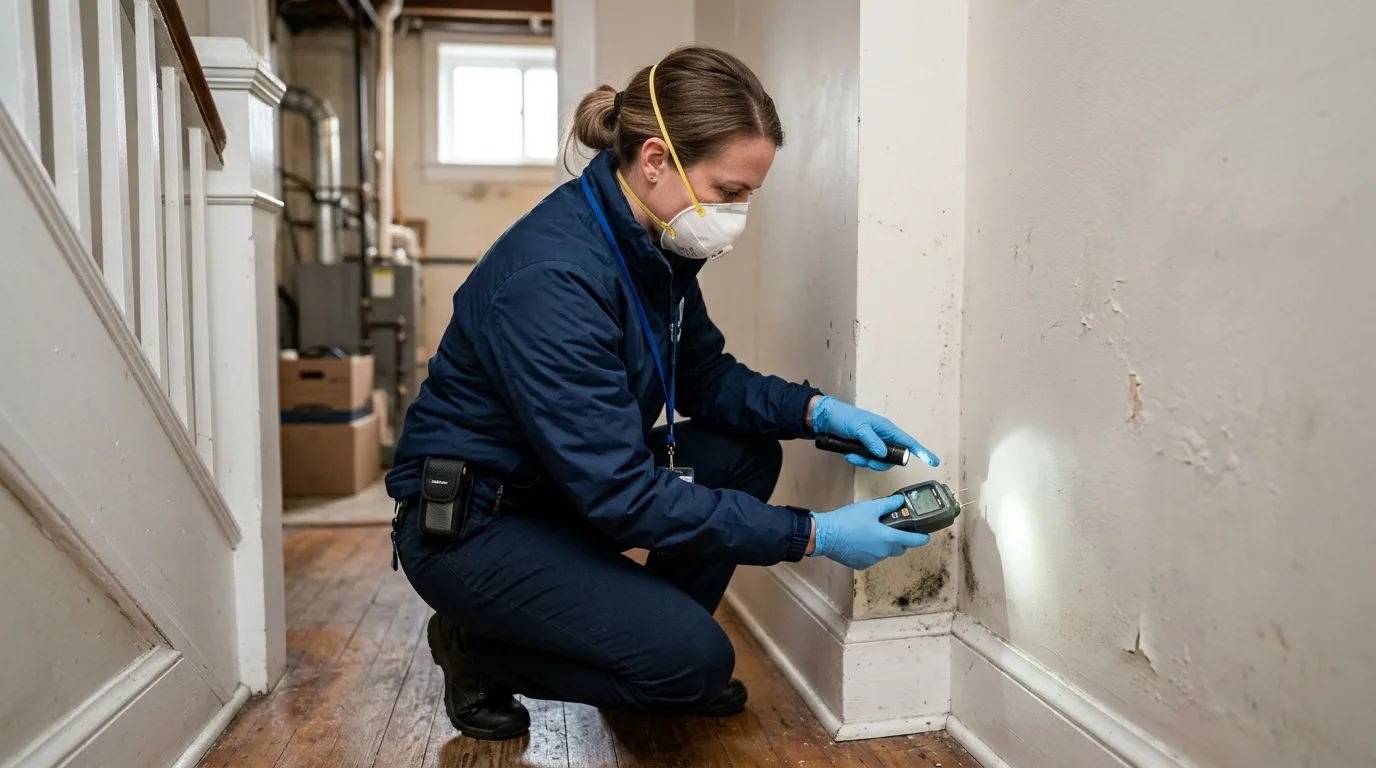
Many experienced investigators rarely test for mold at all. They look for moisture and its source. A visit from a good mold inspection and testing professional tends to look like this:
- A conversation about history: leaks, floods, smells, when symptoms started, which rooms bother people most.
- A visual walk-through, including the attic, crawlspace, under sinks, behind appliances and around windows.
- A moisture meter on walls, floors and trim to find damp materials, compared against readings from dry areas.
- A thermal camera to scan for cool spots. Wet materials lose heat as water evaporates, so they often show up colder than the dry wall next to them. The camera does not see mold. It shows where moisture may be.
- Finding the water: a plumbing leak, a roof or window problem, condensation, or drainage along the foundation.
- Sampling only if it answers a specific question, with the reason explained before it is taken.
How long does mold testing take? The site visit itself is usually a matter of hours, not days, depending on the size of the house. Any lab results come back later. Ask the inspector for a realistic timeline before the visit.
After a burst pipe or supply-line failure, the moisture search matters more than any spore count. This guide to checking hidden moisture after plumbing failures walks through what to look at. If the area is still wet, water damage restoration and drying comes first.
Choosing an inspector in California
According to CDPH, California currently has no state regulations for mold inspectors. Anyone can offer the service. That puts the work of checking on you:
- Ask what tools they bring. A moisture meter should be the minimum.
- Ask how they decide whether to sample and what question the samples will answer.
- Ask whether outdoor comparison samples are part of air sampling.
- Ask for a written report that names the moisture source, not just spore numbers.
- Ask for the findings in writing before agreeing to a large repair, and get a second opinion if something seems off.
If you live in or near Lemon Grove, you can read more about our restoration team and see the services we offer in Lemon Grove. If a moisture source has already been found, the next step is mold remediation for Lemon Grove homes.
Should I test for mold when buying a house?
A general home inspection usually notes visible moisture damage and staining, but it is not a mold investigation. If the inspection report mentions water stains, a musty smell, past leaks, fresh paint over one ceiling patch or a damp crawlspace, a separate moisture-focused inspection is reasonable before closing.
Here, too, the moisture findings matter more than a spore count. A test result from one day says little about what happens in the rainy season or after the next plumbing leak. What helps a buyer most is knowing where water got in, whether the source was fixed, and what it would take to deal with any damaged materials.
Questions about whether homeowners insurance covers mold testing depend on the policy and the cause of the damage. Ask your insurer directly, before any work starts.
The short version
Home mold test kits catch spores, and spores are always there. A kit cannot find the source, cannot compare your result to a legal limit, and does not tell you anything about health risk. If you see or smell mold, move straight to finding the moisture and cleaning it up. Testing has a place in disputes, in hunting for hidden growth and in checking finished work, and it belongs with someone who knows how to read the results. For more on how cleanup works, see our page on professional mold remediation services.