

Why cigarette smoke finds its way into your apartment
Attitudes toward cigarette smoke vary from person to person. Some barely notice it; others react strongly, experiencing headaches or even allergic responses. In Coronado's older apartment buildings, where shared walls and common ventilation shafts are part of everyday life, smoke from a neighbor can become a persistent source of friction—complaints, disputes, and outright conflict.
Tobacco smoke is not simply an unpleasant odor. It is a mixture of resins, nicotine, and microscopic particles that settle on every surface they reach. The smoke is lighter than ambient air and rises, so residents on higher floors tend to receive more of it from neighbors below. It slips through ventilation ducts, gaps around plumbing risers, electrical outlets, door frames, cracks in aging concrete, and open windows. Even a narrow seam between two panels is enough for the smell to travel from one unit to the next. In summer, when windows stay open most of the day, the problem gets worse.
If a neighbor smokes on a balcony, the draft carries the cloud upward and straight into the windows of the unit above. If they smoke inside with a bathroom exhaust fan running, the air pressure differential pushes smoke into the shared ventilation channel—and right out through your own vent grille. Understanding exactly where the smoke enters is the first step toward stopping it.
Ventilation: your first line of defense
Every multi-unit building has a ventilation system. It exists not just to circulate air through living spaces but also as a safety measure. Your vents should be working properly, and checking them two or three times a year—cleaning the grilles, making sure the draft is adequate—is the bare minimum.
Unfortunately, even a well-functioning ventilation setup will not shield you from cigarette smoke on its own. In fact, it can become the very channel that delivers the smell. Most older buildings use a shared duct system rather than individual channels for each apartment. When those ducts accumulate dust and grease over the years, the draft weakens, and smoke from a lower floor drifts into your unit with almost no resistance.
The practical fix is an exhaust fan paired with a backdraft damper. The damper opens when your fan is running and seals shut when the fan is off, so air (and odors) from the shared duct cannot flow backward into your space. This one modification cuts off the most common smoke pathway. Keep in mind, though, that a closed damper will limit natural ventilation, so you will need to compensate—either by running the fan on a timer or by using a supply-air device that pulls fresh air from the exterior wall through its own dedicated opening.
For a standard room of up to about 100 square feet, a fan rated at 150–200 cubic feet per minute is usually enough to clear smoke quickly. If you do run the fan after a neighbor's smoking session, let it work for at least 15–20 minutes to cycle the air fully.
Sealing the front door
If smoke creeps in from the hallway—where neighbors smoke near the stairwell or elevator landing—the entry door is the weak point. Here is what helps:
- Install at least two runs of elastic weatherstripping around the door frame. Two concentric seals block even a faint draft from pulling contaminated hallway air into your home.
- Replace or cover the lock cylinder. An old-style through-lock has a keyhole that acts as a tiny air inlet. A small privacy cover—either a surface-mount plate or an internal flap—closes that gap.
- Seal the door frame itself with expanding foam. Fill every crack between the frame and the wall, then finish with spackle and paint so the repair is invisible. This eliminates the perimeter gap that often goes unnoticed.
These are inexpensive measures, and the difference is immediate. A properly sealed door also reduces noise and drafts, which is a welcome side benefit in Coronado's coastal climate, where wind can push hallway air through even the smallest opening. Apartment blocks in nearby Imperial Beach deal with the same coastal wind.
Sealing the apartment itself
Older buildings—and Coronado has its share of mid-century construction—tend to accumulate structural gaps over time: hairline cracks in slab joints, separating seams between load-bearing panels, and oversized holes around water-supply and drain risers. Each of these is a potential smoke pathway. A targeted sealing effort can close them off:
- In living areas, install baseboard trim with rubber gaskets so the trim sits flush against both the wall and the floor, leaving no air gap at the junction.
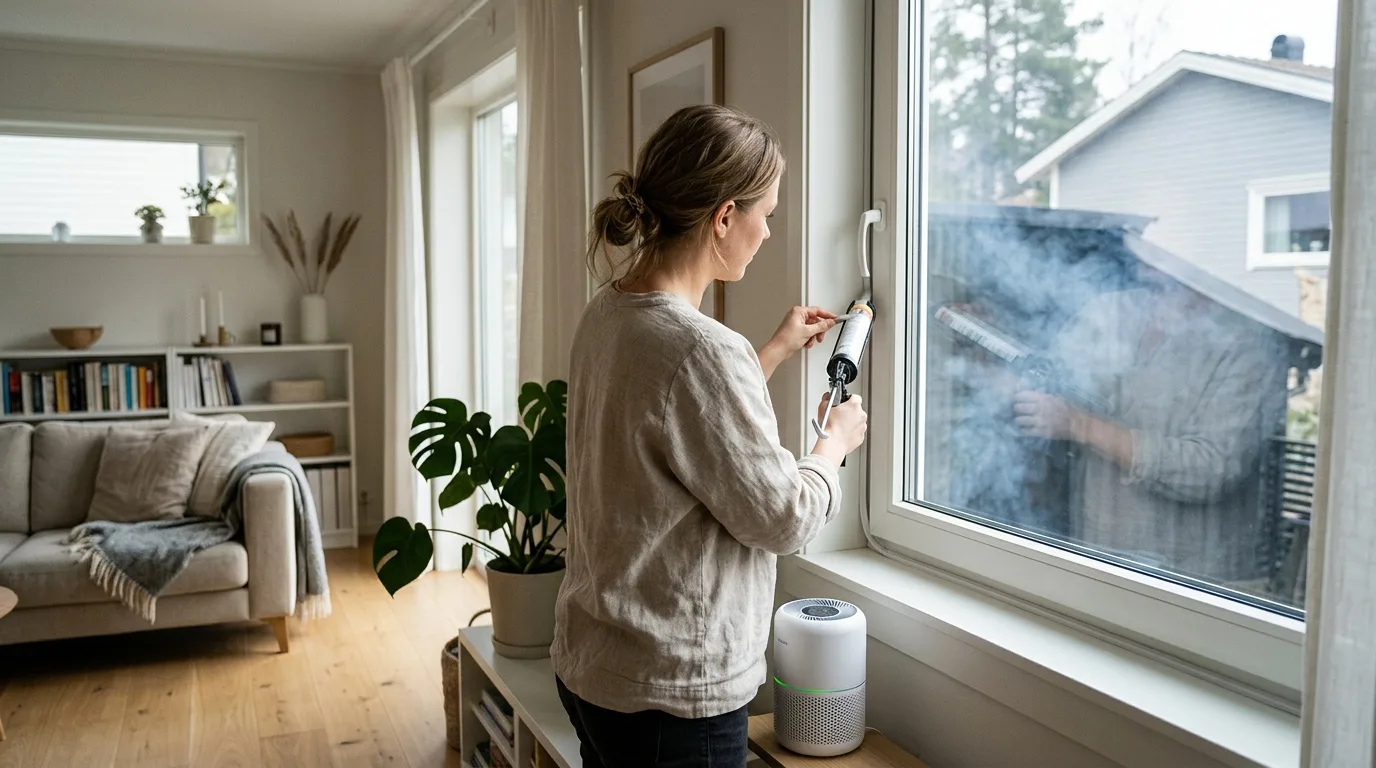
- Fill wall and ceiling seams—especially at panel joints—with expanding foam or flexible caulk. These materials bridge the gap and stay flexible through seasonal temperature shifts.
- Around plumbing and electrical penetrations, pack the voids with fire-rated sealant or foam. Even a half-inch gap around a hot-water pipe is enough for smoke to migrate between units.
- If your apartment has access panels for plumbing cleanouts, seal them with adhesive weatherstrip tape so they do not act as open vents.
The best time to do this work is during a renovation, when walls are exposed and every penetration is visible. But even in a finished apartment, a careful walk-through with a can of foam and a tube of caulk covers most of the trouble spots in a single afternoon. Older homes in Point Loma tend to have the same kinds of gaps.
Getting rid of smoke that has already settled indoors
Sealing and ventilation stop new smoke from arriving. But if the smell has already worked its way into your home—into upholstery, curtains, carpets, and even painted walls—you need to remove what is already there. Tobacco residue is a mix of resins and nicotine particles that cling to fibers and coat hard surfaces. Simple airing will not dislodge them.
Step-by-step deep cleaning
- Open every window and create a cross-draft. Let it run for two to three hours before you start cleaning; you want the loose airborne particles out first.
- Vacuum all carpets, rugs, upholstered furniture, and curtains. Dust traps odor, so removing it is the foundation of everything that follows.
- Wipe down hard surfaces—walls, shelves, doors, window sills—with a vinegar-and-water solution (roughly one part vinegar to two parts water). The acetic acid breaks down nicotine film. The vinegar smell itself fades within an hour.
- Launder all removable textiles: curtain panels, throw-pillow covers, blankets. Adding a few drops of essential oil (lemon or tea tree) to the rinse cycle helps.
- For upholstered pieces that cannot be machine-washed, sprinkle baking soda generously over the fabric, leave it for several hours or overnight, then vacuum it up. Baking soda is a reliable absorbent that neutralizes rather than masks.
Household absorbents and neutralizers
Several common household items work as passive odor absorbers. They will not replace a deep cleaning, but they help maintain freshness between efforts:
- Baking soda — spread a thin layer on carpets, cushions, or mattress surfaces. Leave for several hours, then vacuum. Repeat weekly in a heavily affected room.
- White vinegar — a bowl of undiluted vinegar left on a counter overnight absorbs ambient smoke particles. Wipe surfaces with a diluted solution for direct contact cleaning.
- Activated charcoal — place tablets or granules in small open containers around the room. Charcoal adsorbs smoke particles over two to three days; replace the batch once it stops working.
- Coffee beans — whole roasted beans in small bowls absorb odors and leave behind a mild, pleasant scent. They work best in enclosed spaces like closets or cabinets.
- Essential oils — add about ten drops of citrus or lavender oil to a spray bottle of water and mist the air. Unlike commercial air fresheners, essential oils do not simply overlay the smell with a stronger fragrance; they contain compounds that bind to odor molecules.
When folk remedies are not enough
If the apartment has been exposed to heavy smoke for months or years, household methods may fall short. A portable air purifier with both a HEPA filter and an activated-carbon stage will capture fine particles and gaseous odor compounds simultaneously. An ionizer or ozone generator is a more aggressive option—ozone oxidizes and destroys smoke molecules at the chemical level—but the room must be vacated during treatment and aired out thoroughly afterward. For deeply saturated upholstery and carpets, professional steam cleaning or chemical extraction is the reliable last resort.
Keeping smoke out for good
Once you have sealed, cleaned, and ventilated, a few ongoing habits keep the problem from returning:
- Run your exhaust fan (with the backdraft damper) for 15–20 minutes every time you notice even a faint trace of smoke.
- Wipe walls and hard surfaces with a damp cloth once a week—nicotine film builds up slowly and is easier to remove before it yellows.
- Wash curtains and slipcovers at least once a month if you live next to a regular smoker.
- Keep a few containers of activated charcoal or baking soda in the rooms closest to the smoke source; swap them out every two weeks.
- If you have houseplants, spider plants and bamboo palms are modest but real air scrubbers—they will not solve the problem alone, but they contribute.
Cigarette smoke from a neighbor is one of those problems where a single fix rarely works. The combination of sealing entry points, upgrading ventilation, and regularly cleaning surfaces is what actually keeps the air in your Coronado home clear. None of these steps is expensive on its own, and most can be done in a weekend without hiring anyone.
When neighbor smoke has soaked deep into walls, carpets and upholstery, our crew takes it from there — see smoke and fire restoration in Coronado, or fire damage restoration in San Diego just across the bridge.