

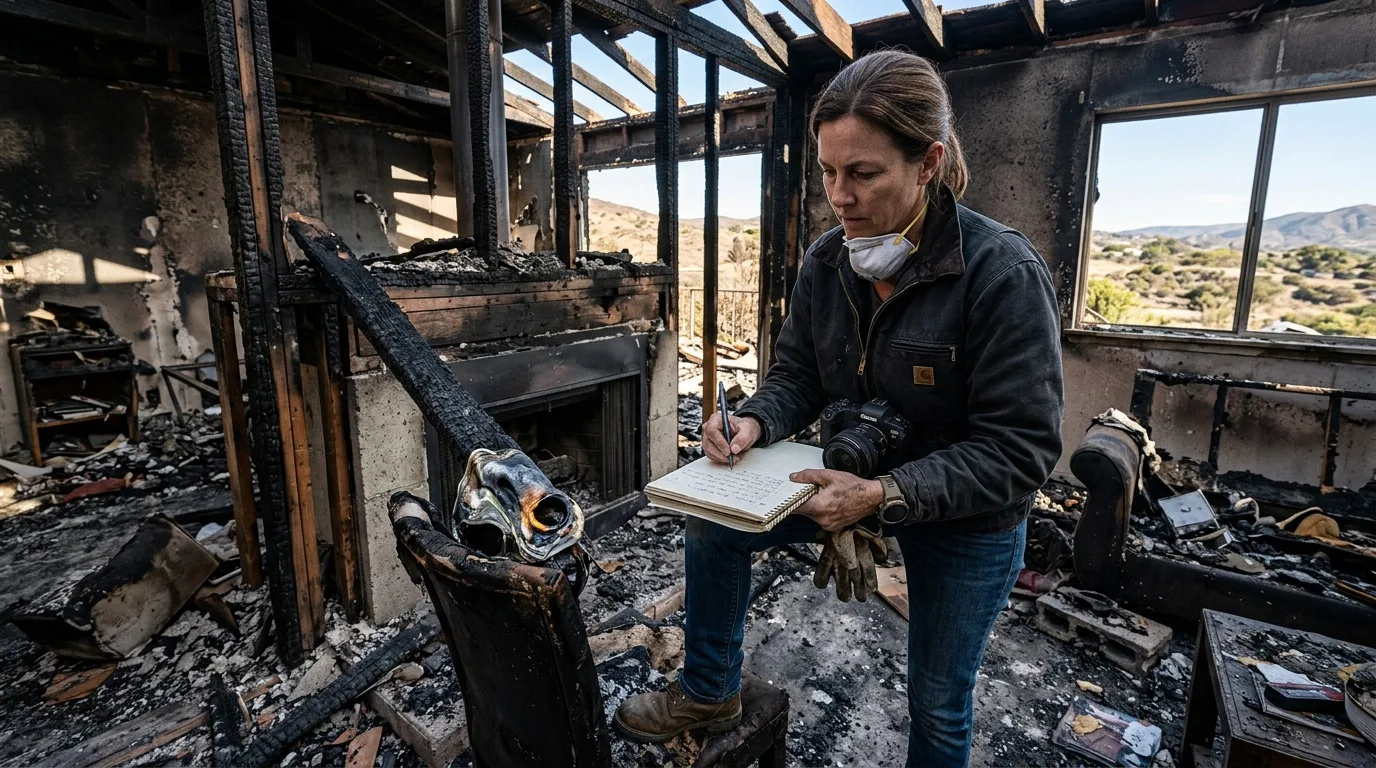
What counts as fire damage — and why it matters for your claim
Fire can destroy a home in obvious ways — charred walls, melted wiring, collapsed roofing. But the full scope of damage usually goes further than the visible burn zone. In many cases insurers distinguish between damage caused directly by fire and damage caused during fire suppression. The difference matters when you file a claim.
Direct fire damage covers everything the flames themselves destroyed or degraded: furniture, appliances, finishes, structural elements. But a separate category exists for losses caused by the firefighting effort — water from hoses saturating floors and drywall, foam residue on electronics, broken windows or doors forced open for access. In San Diego County, where fire departments may respond from multiple stations across the region, the volume of water used can be substantial, especially in older neighborhoods with limited hydrant pressure. We dry out soaked rooms like these during fire damage restoration in El Cajon.
Smoke and soot damage is a third layer. Even rooms untouched by open flame can sustain serious harm from particulate deposits on surfaces, inside HVAC ducts, and throughout soft furnishings. Soot is acidic and continues to corrode metals, discolor paint, and degrade fabrics long after the fire is out. Insurance adjusters look at all three categories — fire, suppression, and smoke — so your documentation should cover each one separately.
Who determines the cause and assigns responsibility
After any significant fire, an investigator — typically from the local fire authority — arrives at the scene. In San Diego County this is usually a fire investigator from the responding department or, for larger incidents, a specialist from the county fire marshal's office. The investigator's job is to fix the time and location of the fire, record the pattern of damage, identify how the fire spread, and establish its probable cause.
The investigator prepares an official fire report. This document records the circumstances, lists preliminary damage estimates, and names the probable origin and cause. If arson is suspected, the case moves to law enforcement. If the fire resulted from an equipment malfunction or electrical fault, the homeowner is generally considered responsible — property owners are expected to maintain the safety of their home's wiring and appliances.
Common causes cited in fire reports include electrical failures, unattended cooking, malfunctioning heating systems, and improperly stored flammable materials. The established cause directly affects your insurance claim: a fire traced to faulty wiring in your own home is handled differently from one that started in a neighboring unit and spread to yours.
Documenting the damage: a step-by-step process
Thorough documentation is the foundation of a successful insurance claim. Without it, even a generous policy can produce a disappointing payout. The process starts the moment it is safe to re-enter the property.
Photograph and video everything
Walk through every affected room and record the damage with both photos and video. Capture wide-angle shots of entire rooms, then close-ups of specific items: scorched cabinetry, water-stained ceilings, soot-covered appliances, warped flooring. Don't limit yourself to the rooms that burned — document smoke damage in adjacent spaces, water pooling in lower floors, and any structural cracks in walls or foundations.
Record the condition of infrastructure: electrical panels, plumbing runs, HVAC equipment, water heaters. These systems are expensive to replace and easy to overlook when the more dramatic damage commands attention. Keep all damaged items in place until the insurance adjuster has had a chance to inspect them.
Compile a written inventory
Create a detailed list of every item that was destroyed, damaged, or contaminated. For each item, note what it was, where it was located, its approximate age, and — if you have the records — what you paid for it. Purchase receipts, credit card statements, and even old photos from social media that happen to show your belongings in the background can serve as supporting evidence.
Organize the inventory room by room. The more specific you are, the harder it becomes for an adjuster to undervalue or skip an item. A line item reading "kitchen appliances" is weaker than separate entries for a refrigerator, dishwasher, microwave, and stand mixer with approximate purchase dates.
Preserve receipts and financial records
Gather every receipt, warranty card, and bank or credit card statement that documents purchases of items now lost or damaged. If original paper receipts burned in the fire, digital copies from email confirmations or retailer accounts still serve as proof. These records help establish the replacement cost or actual cash value of your possessions — the two valuation methods most commonly used in homeowner policies.
Notifying your insurance company
Contact your insurance company as soon as possible after the fire — most policies require written notification within a few days of the incident. In your notification, include your policy number, the address of the property, the date and approximate time of the fire, and a preliminary description of the damage.
Many insurers now accept notification by phone, email, or through a mobile app. Regardless of the method, follow up with a written statement. Keep copies of everything you send. The written record protects you if a dispute arises later about when you reported the loss or what information you provided.
After receiving your notification, the insurer will assign an adjuster to your case. The adjuster visits the property, inspects the damage, reviews your documentation, and prepares an estimate of the loss. Be present during this inspection. Walk the adjuster through every room, point out damage that might not be immediately visible — soot inside cabinets, water behind walls, smoke odor embedded in insulation — and ensure the adjuster's notes match what you've documented independently.
What documents you will need
A complete claim typically requires the following:
- A copy of your homeowner's insurance policy, including the declarations page showing coverage limits and deductibles
- The official fire report from the responding fire department
- Your written notification to the insurance company
- The detailed property inventory with photographs and video
- Receipts, bank statements, or other proof of the value of damaged items
- Estimates from licensed contractors for structural repairs
- Any correspondence with the insurer, including the adjuster's preliminary assessment
If you hired an independent appraiser or public adjuster to prepare your own damage estimate, include that report as well. Having a separate professional evaluation gives you a reference point if you disagree with the insurer's numbers.
Getting a professional damage assessment
The insurance company will send its own adjuster, but you are not required to accept that assessment as final. Independent appraisers — licensed professionals who are not employed by your insurer — can provide a second opinion on the extent and cost of the damage.
A qualified appraiser will measure the area of every damaged room, photograph and describe each deficiency, and compile a written report that includes the estimated cost of repairs and replacement. The report should list the sources the appraiser used for pricing — contractor quotes, material cost databases, labor rate surveys for the San Diego County market.
Make sure the finished report is page-numbered, bound, and signed. This level of formality matters if the claim is later reviewed or challenged. An independent assessment is especially valuable for large losses where the difference between the insurer's estimate and actual repair costs can run into tens of thousands of dollars.
Understanding your policy: deductibles, limits, and exclusions
Before you file, re-read your policy carefully. Three provisions shape how much you will actually receive:
The deductible is the amount you pay out of pocket before the insurer covers anything. If your deductible is $2,500 and the assessed loss is $80,000, the insurer pays $77,500. Some policies have separate, higher deductibles for wildfire-related claims — a detail particularly relevant in San Diego County's fire-prone eastern communities. We handle fire and smoke cleanup in Alpine, one of those eastern towns.
The coverage limit is the maximum amount the policy will pay. If your dwelling coverage limit is $400,000 and the rebuilding cost exceeds that, the excess is your responsibility. Check whether your policy includes an inflation guard or extended replacement cost endorsement, which can increase the payout beyond the stated limit.
Exclusions are situations the policy does not cover. Fires caused intentionally by the policyholder are universally excluded. Some policies also exclude losses from gross negligence or certain types of equipment failure. Read the exclusions section line by line — surprises here are common and costly.
What to do if you disagree with the insurer's valuation
Disputes over payout amounts are not unusual. If you believe the insurer's estimate is too low, you have several options:
- Request a detailed breakdown of the adjuster's calculations. Compare each line item against your own inventory and independent appraisal.
- Submit additional documentation — contractor bids, material quotes, or a second appraisal — that supports a higher figure.
- Invoke the appraisal clause, if your policy includes one. Under this process, each side selects an appraiser, and the two appraisers choose an umpire. Any two of the three can set the final loss amount.
- File a complaint with your state's Department of Insurance if you believe the insurer is acting in bad faith.
Keep all communication in writing. A paper trail of emails, letters, and adjuster reports is your strongest tool if the dispute escalates.
Temporary living expenses
Most homeowner policies include coverage for additional living expenses — the cost of living somewhere else while your home is being repaired or rebuilt. This typically covers hotel stays, apartment rentals, restaurant meals above your normal food budget, and storage fees for salvaged belongings.
Keep every receipt. The insurer will reimburse documented expenses that are reasonable and directly caused by the displacement. In San Diego County, where rental costs run high, this coverage can become a significant part of the overall claim. Check your policy for the time limit and dollar cap on this benefit — some policies cap it at 12 months or a percentage of the dwelling coverage.
Once the adjuster has walked through and the cleanup can begin, our crews take on the soot, smoke and water — see fire damage restoration in Ramona or the full list of cities we cover.
Practical tips for San Diego County homeowners
- Store digital copies of your insurance policy, home inventory, and important receipts in a cloud service. If a fire destroys your paper records, you'll still have access to these documents from any device.
- Update your home inventory annually. New furniture, appliances, and renovations increase the value of your belongings over time. An outdated inventory means an incomplete claim.
- Know your coverage before a fire happens. Review your policy each year at renewal — especially the dwelling limit, personal property limit, and any wildfire-specific provisions.
- After a fire, do not dispose of any damaged items until the adjuster has completed the inspection. Throwing away evidence weakens your claim.
- If the fire was caused by a neighbor's negligence or by a defective product, you may have a separate legal claim against that party in addition to your insurance recovery. The two processes can run in parallel.