

Why Soot and Creosote Deserve Your Attention
Chimney cleaning is part of the responsibilities of every homeowner who has a fireplace, wood stove, or any heating equipment with a flue. An inspection of the entire chimney system should be performed at least once a year. The chimney should be cleaned before the start of the heating season and any time the draft noticeably worsens. You can hire a professional who will evaluate the condition of the system with a trained eye and clean it thoroughly. But removing soot from a chimney is something you can also do yourself.
The main and most troublesome problem for chimneys is creosote. It is a black or brown tar-like substance that can accumulate inside chimneys and flue pipes when wood is burned. Creosote is a byproduct of incomplete combustion: unburned particles combine with gases and settle on the chimney walls. Over time, creosote can harden and become highly flammable.
In addition to fire risk, creosote contains harmful chemicals that can be released into the air if it ignites. This poses a potential health threat to anyone exposed to the fumes. Regular inspections and cleanings are essential to prevent dangerous creosote buildup.
How Soot Forms and Why It Matters
Regardless of whether you heat your home with wood or coal, burning produces soot that settles on the chimney walls and gradually clogs the flue. Soot is one of the byproducts of incomplete fuel combustion in fuel that contains a large amount of carbon. It forms when burning hardwood and softwood, wood briquettes, and coal. Without a sufficient supply of air, the combustion process is disrupted, leading not only to heavy soot deposits but also creating a serious health hazard from increased risk of blockage.
Soot can be a simple mixture of ash and carbon particles. These fine particles indicate that the combustion process is proceeding correctly, and they are fairly easy to remove. Far more dangerous is glassy soot, which takes the form of black, clumped masses. It can quickly clog a chimney, and removing it is significantly harder. The formation of such clumps means the combustion process is disturbed, and the likelihood of soot self-ignition increases.
If the chimney is not cleaned regularly, deposits build up layer by layer, gradually narrowing the flue diameter. The consequences go beyond just poor airflow:
- Reduced draft causes inefficient fuel combustion — the heat output drops and the equipment works noticeably worse.
- A dirty chimney becomes a fire hazard — soot can ignite and lead to serious consequences.
- Smoke that cannot exit properly may enter the living space, bringing an unpleasant smell, soot on household items, and in neglected cases, carbon monoxide poisoning.
What Wood Produces the Most Creosote
Creosote formation is primarily caused by incomplete combustion of wood. Inefficient burning methods — low temperature, restricted airflow — contribute to creosote accumulation.
Softwood species like pine and cedar have higher resin content, which leads to increased creosote formation during burning. Hardwoods such as oak generally produce less creosote due to their lower resin content.
Burning wet firewood leads to excessive creosote accumulation because the high moisture content impedes normal combustion. This increases the fire risk and results in incomplete burning, producing large amounts of smoke and pollutants. Properly seasoned firewood with low moisture content burns more efficiently.
Wood with high resin content — pine, spruce — is particularly prone to heavy creosote buildup. When burned, the resin releases a sticky substance that adheres to chimney walls, forming a thick layer of creosote that represents a serious fire hazard. The recommendation is to choose hardwoods like oak, maple, or cherry, which provide cleaner burning and leave fewer residues. Store firewood in a well-ventilated area and let it dry for at least six to twelve months before use.
When to Clean the Chimney
Ideally, chimney cleaning should be done on a regular schedule. Here in Poway, most homeowners with fireplaces should plan on at least one thorough cleaning per year — typically in the fall before the cooler months, and again in spring after the season ends. Homeowners in nearby Rancho Bernardo can follow the same calendar. There are also some warning signs that signal it is time:
- Smoke color has taken on a dark, unpleasant shade instead of being nearly transparent.
- The flame color has turned aggressively orange instead of a light, steady orange.
- Visual inspection of the pipes shows dark-black and oily deposits on the walls.
Mechanical Cleaning Methods
To clean a chimney yourself, the first thing you need is a proper chimney brush. Before purchasing, pay attention to the cross-section of the flue and match the size and shape of the brush accordingly. A rectangular flue requires a rectangular brush; a round one requires a round brush. The brush material also matters. Wire brushes work well for brick chimneys and flues made of heat-resistant steel. If you have a chimney lined with acid-resistant stainless steel, use a plastic brush — nylon bristle, for instance — so you do not scratch or damage the liner.
Cleaning From the Top
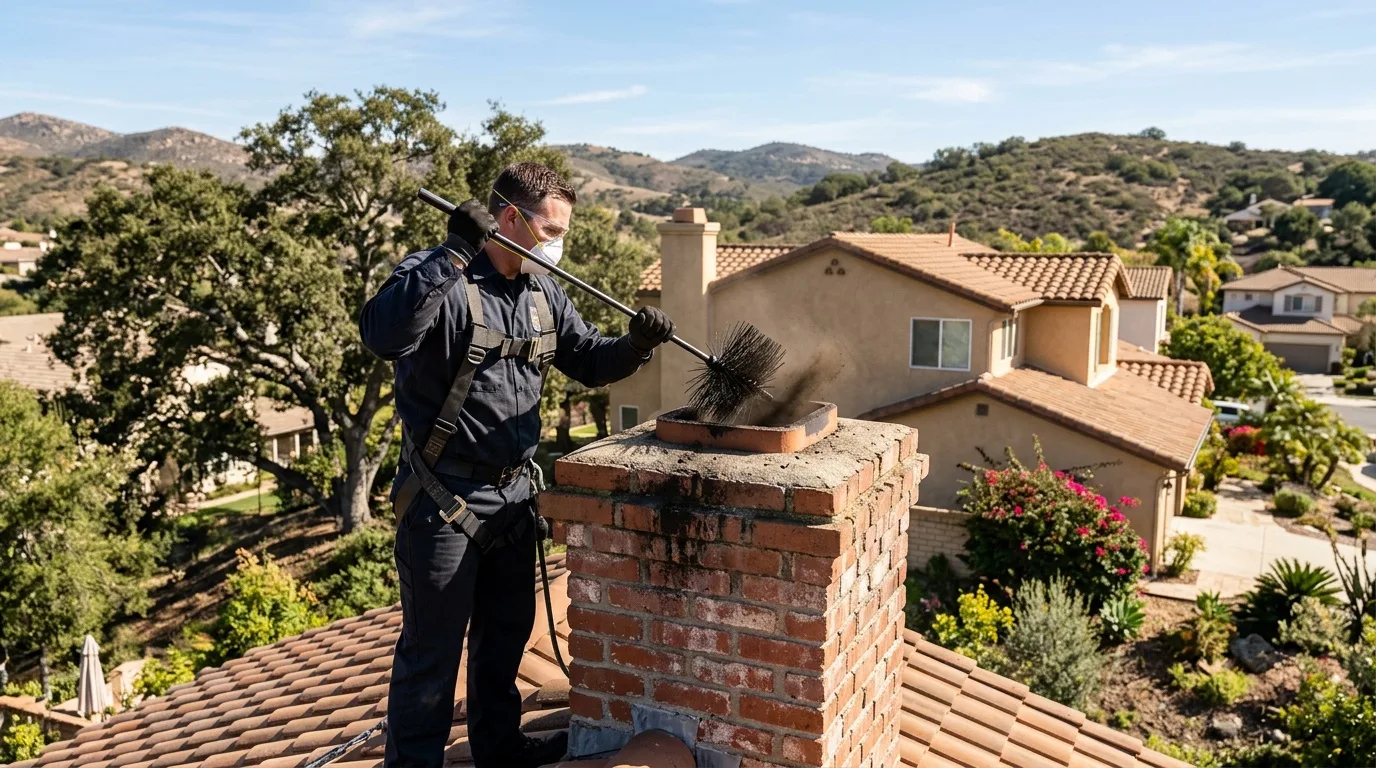
For the full kit you will need several meters of steel cable and a ball — that is, a weight that you attach to the brush. You will also need work clothes, a dust mask, and protective gloves. To clean the chimney, climb onto the roof and lower the brush along with the weight down the flue. Run the brush through the full length of the chimney several times. Then go down to the equipment room, open the previously sealed cleanout at the bottom of the chimney, and scoop out the soot that fell to the base of the pipe.
Cleaning From Below
How do you clean a chimney without going up on the roof? You can use a chimney rod set or a drill-powered cleaning kit. Flexible rods attached to a drill end in a spinning brush that removes even the most stubborn deposits, breaking them apart and literally scraping them off the chimney walls. This method works for removing light to moderate soot and creosote deposits in masonry and ceramic chimneys of any diameter and shape.
For fireplace owners in Poway, cleaning from below is often more practical — the brush is pushed upward through the firebox opening with added extension rods, section by section.
Chemical Cleaning Products
One of the most popular and simplest ways to keep a chimney clean today is using specialized chemical products. You can find chimney-cleaning powders that handle even deposits that have been settling on the walls over years of use. The powder can be used with most fuel types — wood, pellets, briquettes. Simply add the recommended dose to the firebox.
During burning, the active substance in the chemical coats the layer of soot that has settled in the chimney. The alkaline compounds in the powder form a light gray coating of microparticles that settles in the combustion chamber and on heated surfaces. The oxidation process causes the soot to change its structure — it loosens, then separates from the heated surfaces. As a result, the chemical compounds in the soot that cause corrosion and contamination are effectively removed.
An important distinction: powder and brush solve different problems. Chemical products loosen the powdery soot — the loose ash-and-carbon mixture. Glassy creosote, those black fused clumps, they cannot touch. That layer is removed only mechanically, with a brush of the correct cross-section. So the powder works as prevention between cleanings, not as a replacement for them. And separately: burning soot off by deliberately stoking the firebox to extreme temperatures is not recommended — that is exactly how chimney fires start.
Folk Remedies
Given that the dirty-chimney problem is as old as the hearth itself, many methods have been invented over the centuries using materials on hand. Each is effective in its own way but offers no guarantees at every stage of contamination. They are often used before a more thorough cleaning to soften hardened soot layers.
Salt and baking soda. Mix in a one-to-one ratio and pour into the firebox after the second fuel load, when the chimney is warmed. The resulting reaction binds soot, makes it heavier, and helps prevent it from settling on pipe walls.
Potato peels. When burned, potato peels release starch vapors that work against soot and the layer of deposits, softening them enough that pieces break away from the chimney walls on their own. About one to two buckets of peels are needed for noticeable effect.
Aspen and alder logs. These species produce very bright, hot flames when burned and can cause deposits to burn through. For this reason, this method should be used with great caution — in a chimney with thick creosote deposits, it can trigger a chimney fire rather than prevent one.
Folk remedies are preventive in nature and are not very effective on their own. They should not replace mechanical or chemical cleaning.
Reducing Soot and Creosote Formation
A chimney can get clogged for several reasons: combustion temperature is too low, too much solid fuel is loaded at once, the heating appliance is low quality, the fuel is not dry enough, smoldering coals are covered with too much fresh wood, draft is poor, or the equipment is undersized for the home. Identifying and addressing these factors will reduce the amount of soot settling on chimney walls and make removal easier.
Another way to minimize buildup is upgrading the chimney liner. Smooth stainless steel walls make it harder for combustion products to stick. That is why brick or asbestos-cement structures are sometimes fitted with steel inserts or replaced entirely with metal liners.
For Poway homeowners, here is a practical checklist:
- Use only dry, seasoned firewood — let it cure for six to twelve months.
- Avoid burning softwoods like pine when possible; they produce far more resin and soot.
- Never burn trash, painted wood, or plastic in the fireplace.
- Install a chimney cap to keep out rain, debris, and animals.
- Consider using a creosote inhibitor product once a month during the burning season.
- Insulate the chimney pipe where possible — a warm flue reduces moisture condensation inside.
If Soot Ignites in the Chimney
If you suspect a chimney fire — a loud roaring or rumbling sound from the flue, dense smoke, or an unusually hot chimney exterior — act immediately:
- Close the damper to cut off the air supply.
- If water is available, use it only on nearby structures to prevent fire from spreading — do not pour water directly into a hot flue, as thermal shock can crack masonry.
- Stop adding fuel to the fireplace.
- Call the fire department.
Timely chimney cleaning is what prevents this scenario. A well-maintained flue is a safe flue. After a chimney fire, we also handle fire damage cleanup in Ramona.
Sweeping a flue can be a weekend job, but soot and smoke damage after a chimney fire needs a crew — see fire damage restoration in Poway, or homes in nearby Santee just to the south.