

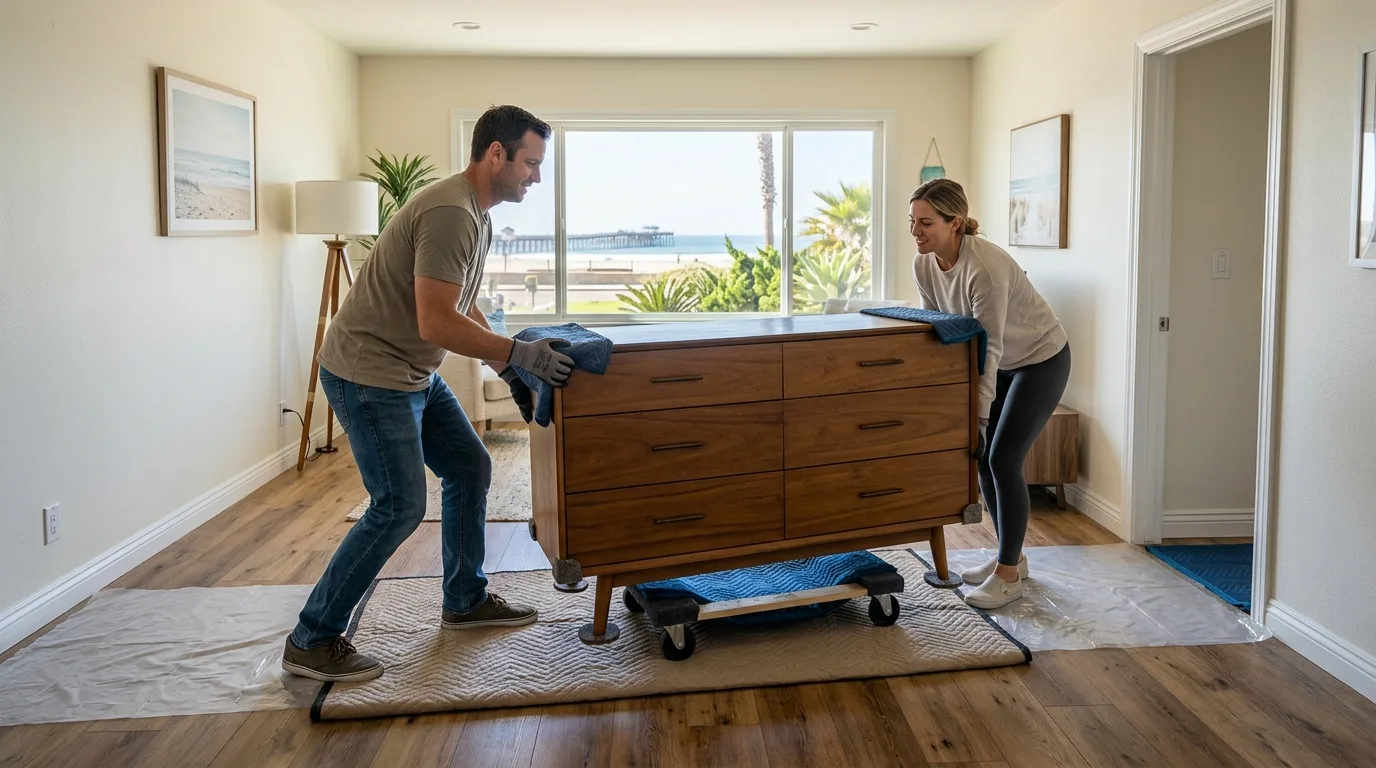
Preparing Furniture Before You Start
Before you begin moving anything, the piece of furniture needs to be fully emptied. Clothes, dishes, books, shelves, drawers and removable doors should all be taken out and set aside separately. This makes the piece lighter and prevents items from shifting around inside during the move. Doors should be secured with painter's tape or soft straps — regular packing tape can leave sticky residue on the finish. If the doors come off their hinges easily, it's better to remove them entirely.
Clear the floor of rugs, toys, cords and anything else along the path. Free up space all the way to the destination spot. Pay special attention to thresholds and changes in floor height — that's exactly where furniture tends to get stuck or start tilting.
Choosing the Right Sliding Pads for Your Floor Type
Furniture pads — sometimes called glides or sliders — are small fittings designed to protect floor surfaces from mechanical damage. They also make it much easier to push heavy pieces around and can help level uneven legs.
Felt and wool pads
These work well on hardwood, laminate and carpeted surfaces. They cushion the pressure from furniture legs and prevent scratching. In Imperial Beach homes with hardwood or engineered wood floors, felt pads are often the safest first choice.
Cork pads
Cork is strong and moisture-resistant, which makes it a good option for heavy stationary furniture. These are typically sold as self-adhesive rounds. They hold up under significant weight but don't slide as easily as other materials.
Plastic and rubber pads
Both offer high durability. Plastic works well on tile — common in many Imperial Beach kitchens and bathrooms. Rubber is better suited for hardwood and laminate, where it grips without scratching.
Teflon (PTFE) pads
These are the slickest option available. If you're doing a full room rearrangement and need to slide heavy furniture across the floor repeatedly, Teflon pads make the job considerably easier. They glide across almost any hard surface.
Quick reference by floor type
- Laminate or hardwood: felt, wool, cork, rubber, or Teflon
- Tile: felt, cork, plastic, or Teflon
- Linoleum or vinyl: felt, rubber, or Teflon
- Carpet: felt, wool, or cork (hard-bottomed sliders work best here)
Methods for Moving Furniture on Carpeted Floors
Carpet creates a lot of friction, especially thick pile carpet. A standard furniture mover — a set with a lever-style jack and four wheeled platforms — handles this well. Look for versions with larger wheels if your carpet has deep pile.
Hard plastic discs placed under each leg also work. These come in various sizes and attach with adhesive, screws or small nails depending on the model.
For lighter pieces — a nightstand, a side table — a basic two-wheeled garden cart can get the job done when moving between rooms.
Aluminum foil, folded into several layers under each leg, provides decent slip on low-pile carpet. It tears under truly heavy loads though, so this trick suits tables and bed frames more than a fully loaded bookcase.
Polyethylene jar lids — the kind used for canning — fit under individual furniture legs and reduce friction noticeably. Similar to foil, these are best for pieces with separate legs rather than a flat base.
Methods for Smooth Hard Floors
On laminate, tile, hardwood or vinyl, the problem is different: friction is lower, but the risk of scratching is higher. Here the goal is controlled sliding without gouging the surface.
A non-slip bath mat flipped upside down (textured side facing the floor) works surprisingly well for small to mid-size pieces. The fabric side cradles the furniture base while the rubberized bottom slides smoothly.
Old jeans make a workable sled for a dresser or nightstand: set the piece on the seat area of the pants and pull by the legs. The denim is tough enough to handle the weight and slides easily on smooth floors.
Thick felt pads under each leg remain the gentlest option for hardwood — a common floor material in Imperial Beach bungalows and older homes near the coast. The same gentle approach suits older homes in nearby Coronado.
Liquid helpers exist too. A thin film of dish soap diluted in water, glycerin, or silicone spray applied to the floor reduces friction dramatically. Test any liquid on an inconspicuous spot first, especially on sealed hardwood, to make sure it doesn't stain or cloud the finish. Clean the residue promptly after moving.
Improvised Tricks That Actually Work
Raw potato rounds. Cut potatoes into slices about 30 to 40 millimeters thick, with a diameter roughly double the furniture leg. Carve a shallow depression in each slice so the leg sits in it without slipping off, skin side down toward the floor. The moisture in the potato creates a thin film that lets the piece glide. This is one of those methods that sounds odd but has been passed around for decades — results vary depending on the weight involved.
Paraffin-coated milk cartons. The inner lining of waxed milk or juice cartons has a slippery paraffin coating. Turn a carton inside out and place it under a leg — the waxy surface slides along most floor types without leaving marks.
Wooden dowels or rolling pins. Three or four round wooden rods placed under the base of a cabinet turn it into a rolling platform. As the piece moves forward, pick up the rod that comes out the back and move it to the front. This is the same principle people have used for thousands of years to move heavy loads — it works as well in an Imperial Beach living room as it did in ancient construction.
Protecting Walls and Doorframes
Floors get the most attention, but walls take hits too — especially in narrow hallways and around door openings. Tape sheets of cardboard to wall corners and doorframes along the route before you start pushing. In a tight corridor, even a careful move can clip a corner and dent drywall or chip paint.
Wrap the corners and any protruding hardware on the furniture itself. Bubble wrap, thick moving blankets, or even folded bath towels secured with painter's tape prevent the piece from gouging walls if it bumps them.
Move slowly and steadily, no jerking or yanking. Don't pull by handles, knobs or the top panel — those aren't built to bear the full weight of the piece. Push from the center of mass with both hands, adjusting direction in small increments rather than wide swings.
Getting Past Thresholds and Transitions
Thresholds between rooms are where most damage happens. Before a threshold, tilt the piece slightly and slide a thin board or strip of plywood under the front legs. Then roll or push the furniture over the raised edge on that smooth surface.
Never force furniture over a threshold with a sudden shove. The impact can crack the frame, break a caster, or pop a door off its hinge. If the height difference is large — say, between a tiled entryway and a raised wooden floor — use a wide ramp secured so it can't slide out from under the load.
After you've placed the furniture in its new spot, remove the sliding pads only after you've confirmed the final position. Then put the shelves and drawers back, reinstall any doors, and check that the piece doesn't wobble. On uneven floors, put firm shims under the low legs — solid plastic or hardwood, not soft cardboard that will compress over time.
When to Call for Help
All of these methods assume you have at least one other person available. A tall, top-heavy wardrobe or a solid wood armoire should never be moved solo — the center of gravity is too high, and a tilt can turn into a fall in a fraction of a second.
Pieces that are bolted to the wall — anti-tip brackets on bookshelves, wall-mounted cabinets — need to have the fasteners removed first. Check for those before you try pulling anything away from the wall.
In Imperial Beach, where many homes have a mix of tile, hardwood and carpet across different rooms, you may need to switch your sliding method at each transition. Plan the full route before you start, and have the right pads, boards and protective material ready at each changeover point. A few minutes of preparation saves hours of floor repair. It works the same way for apartment moves in nearby Chula Vista.
When a leak, a fire or a repair job means the heavy pieces have to leave the house for a while, the contents pack-out service moves, stores and returns them. Our crews do the same work for homes in nearby National City.